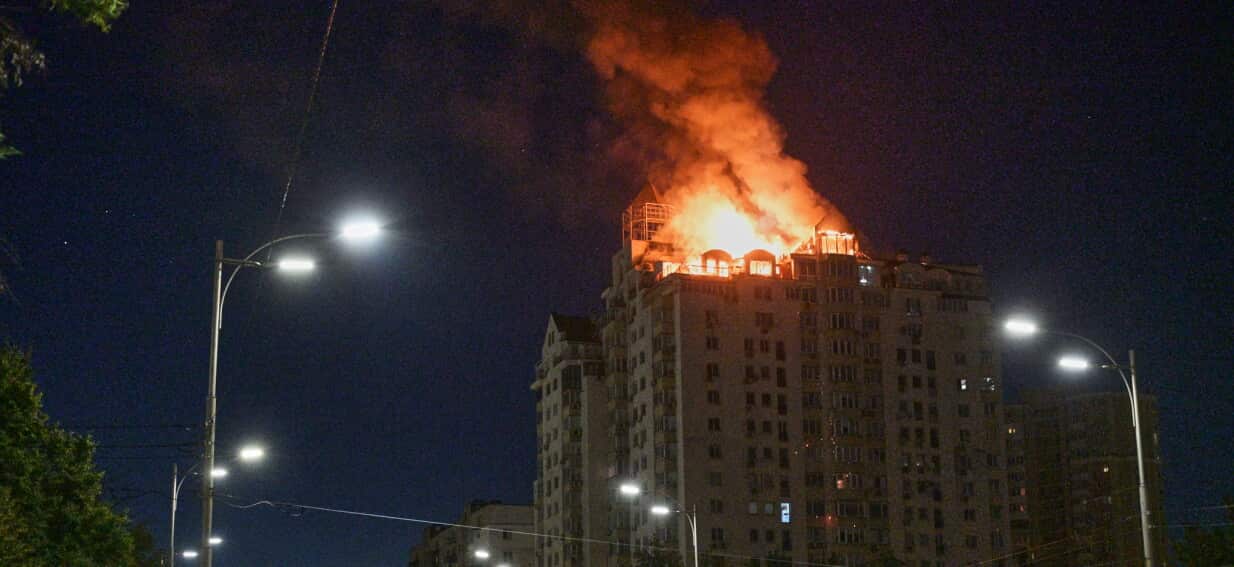
The coffee was still warm when the ceiling gave way.
It is the small, mundane fragments of a morning that haunt you afterward. A porcelain mug decorated with painted daisies. The hum of a refrigerator kicking on. The distinct smell of rain mixing with asphalt outside a window. In Kyiv, these ordinary anchors of daily life do not fade gradually; they are violently erased in milliseconds.
When the sirens began their familiar, guttural wail across the capital, there was no panic. Panic is a luxury for those unaccustomed to terror. Instead, there was only the heavy, collective sigh of a city routine. Parents reached for pre-packed backpacks. Store clerks pulled down metal shutters. People moved toward the relative safety of the metro stations, their footsteps echoing in the concrete tunnels.
Then came the sky.
It arrived not as a singular sound, but as a pressure wave that flattened the air in the lungs before the ears could even register the detonation. Russia’s latest missile barrage was not aimed at some distant, hidden military outpost. It tore directly into the densely packed, beating heart of the city.
At least 18 people woke up that morning, checked their phones, perhaps argued with a loved one or forgot their keys, and never saw the afternoon. Their names are still being spelled out on official ledgers, but their absences are already vast, gaping holes in the lives of those who survived.
The Geography of Fire
To understand the scale of a modern air strike, you have to look past the sterile numbers broadcast on evening news reports. Eighteen dead. Dozens wounded. Buildings damaged. These words are too smooth; they slide off the mind too easily.
The reality is jagged. A missile strike on a metropolitan area is an act of anatomical dismantling.
Consider a typical residential high-rise in Kyiv. It is home to teachers, retired engineers, toddlers, and IT specialists. When a high-explosive warhead impacts such a structure, the physics are merciless. The kinetic energy alone twists structural steel like wet cardboard. The thermal blast incinerates everything within its immediate radius, turning decades of gathered memories—photo albums, children's drawings, favorite armchairs—into fine gray ash.
But the most pervasive weapon is the glass.
Kyiv is a city of windows. Modern office complexes, old Soviet-era apartments, cafes with wide storefronts meant to let in the pale northern sunlight. When the shockwave hits, millions of these windows do not simply break. They atomize. They become a supersonic storm of razor-sharp daggers flying through living rooms and kitchens. A person standing twenty yards away from the actual impact zone can be fatally lacerated by what used to be their kitchen window.
On this particular morning, the emergency crews didn't just fight fires. They waded through drifts of shattered glass that crunched beneath their boots like fresh snow, except it was stained bright red.
The Cost of the Siren
There is a psychological tax that the people of Ukraine pay every single day, one that cannot be measured by economic indicators or territorial maps. It is the erosion of the concept of "inside."
For a human being, home is the ultimate sanctuary. It is the place where you lower your guard, where you sleep, where you are safe. Constant missile strikes destroy that psychological framework entirely. When a missile can punch through nine floors of reinforced concrete while you sleep, the walls of your apartment no longer feel like protection. They feel like a trap.
Imagine the exhausting calculus of a parent in Kyiv right now. Every time the air alert sounds on their smartphone, a clock begins to tick. Do they wake the sleeping children, dress them in the dark, and drag them down five flights of stairs to a cold, damp basement? Or do they gamble? Do they stay in bed, pulling the blankets tighter, praying that the air defense systems intercept the incoming metal before it finds their coordinate?
They must make this decision multiple times a week. Sometimes multiple times a night.
The human nervous system was never designed to sustain this level of cortisol. The trauma is not merely acute, experienced in the terrifying moments of detonation; it is chronic. It is the permanent tightening of the shoulders, the sharp intake of breath every time a truck rumbles too loudly down the street, the inability to look at a clear blue sky without a faint, underlying sense of dread.
The Calculus of Defense
Behind the human tragedy lies a brutal, asymmetric war of mathematics.
Ukraine's air defense teams are among the most experienced in the world, operating a complex, patched-together network of Soviet-era systems and advanced Western interceptors. Every time a radar screen lights up with incoming targets, a frantic, high-stakes game of chess begins.
The attackers use saturation tactics. They launch cheap, slow-moving loitering munitions alongside supersonic cruise missiles and ballistic trajectories. The goal is simple and cruel: overwhelm the defense. Force the defenders to spend their limited, expensive interceptor missiles on decoys so that the lethal payloads can slip through the net.
When an interceptor successfully hits a missile in mid-air, it is a triumph of engineering. A fireball erupts in the sky, and a catastrophe is averted. But even a successful interception has a cost. The debris—tons of burning metal, unexploded fuel, and sharp shrapnel—must go somewhere. It falls from the sky at terminal velocity, raining down on rooftops, parks, and busy intersections. Several of the casualties in this latest strike were not caused by direct hits, but by the falling remnants of a war fought five thousand feet above the pavement.
This is the agonizing paradox of modern urban warfare. Even when you win the tactical battle in the air, the pieces still land on the civilians below.
Beyond the Horizon
The smoke eventually clears from the Kyiv skyline, leaving behind black scars on the concrete and the bitter, unmistakable smell of burnt insulation and brick dust. The sirens eventually fall silent, allowing the normal sounds of the city to creep back in—the sirens of ambulances, the heavy thud of heavy machinery clearing rubble, the quiet weeping of a neighbor.
The world watches these events through a screen, watching the smoke rise in brief video clips between social media updates and commercial breaks. It is easy to compartmentalize the violence, to view it as a recurring plot point in a distant, geopolitical drama that has been running for too long.
But for those standing in the debris, there is no option to change the channel.
A woman stands near the perimeter cordon, her coat covered in a fine layer of white plaster dust. She is not looking at the cameras or the politicians gathering nearby. She is looking at a specific window on the fourth floor of a ruined building, where a blue curtain is flapping idly through the broken frame into the cold afternoon air, waving to an empty room.