The neighborhood smelled like damp pavement and early spring. It was a standard Bronx Tuesday, the kind where the most pressing concern for most residents was finding a parking spot or beating the rush at the corner bodega. On a quiet stretch of Paulding Avenue, the air felt heavy, but not with the threat of violence. It was the heavy stillness of a house holding its breath.
Inside the brick-faced home, something invisible was feeding. Natural gas is a ghost. It doesn't have a scent of its own; utility companies add mercaptan to make it smell like rotten eggs specifically so we can survive our own infrastructure. But sometimes, the ghost moves faster than the warning. It pools in the basements, climbs the floorboards, and waits for a single, microscopic spark to tell it to expand.
When the 49th Precinct officers arrived, they weren't expecting a war zone. They were responding to reports of a gas leak—a routine call that usually ends with a turned valve and a frustrated homeowner.
They never made it to the front door.
The Moment the Air Turned to Iron
Imagine standing on a sidewalk, mid-sentence, and suddenly the world stops being solid.
The explosion didn't just break windows; it erased the concept of a "house" for several seconds. When gas ignites in a confined space, the pressure doesn't just push—it hammers. The force is calculated in pounds per square inch, but to the officers on the scene, it felt like being struck by a freight train made of heat and glass.
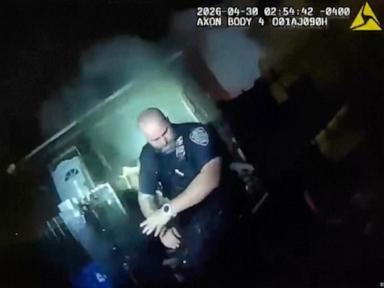
One officer was caught in the direct path of the percussion wave. The physics of it are brutal. The air around him compressed instantly, turning into a wall of solid energy that lifted him off his feet and threw him across the pavement. He didn't fall; he flew. It is a terrifying testament to the power of residential utilities that a man weighing two hundred pounds, decked out in tactical gear and boots, can be tossed like a scrap of paper by the very fuel we use to boil water for tea.
Debris rained down in a rhythmic, terrifying clatter. Wood splinters, bits of insulation that looked like pink cotton candy soaked in dirt, and shards of glass that shimmered in the afternoon sun. The silence that follows a blast like that is the loudest thing in the world. It is the sound of a neighborhood's collective shock.
The Invisible Stakes of the Grid
We live on top of a sleeping giant. Underneath the streets of New York City lies a labyrinth of cast iron, wrought iron, and plastic pipes—thousands of miles of veins carrying the lifeblood of the city's heating and cooking systems. Some of these pipes date back to the Victorian era. They are resilient, yes, but they are also subject to the relentless cycle of freeze and thaw, the vibration of subways, and the simple, crushing weight of time.
When we read a headline about an explosion, we see the fire and the shattered glass. We rarely see the decades of slow corrosion or the tiny fracture in a service line that allowed the ghost to escape. The real danger isn't the gas itself; it's our familiarity with it. We turn a knob, a blue flame appears, and we think we are in control. We forget that we are inviting a volatile element into our living rooms every single day.
Consider the officers who responded to Paulding Avenue. They didn't have the luxury of distance. Their job was to walk toward the smell of rotten eggs while everyone else was running away. That is the unspoken contract of the uniform: to be the barrier between the public and the physics of disaster. On this day, the barrier was breached.
The Human Cost of a Spark
The casualty count often feels like a scorecard in the news cycle. "Five injured, none dead." We breathe a sigh of relief and scroll to the next story. But "non-life-threatening injuries" is a clinical term that hides a spectrum of agony.
It means eardrums ruptured by the sheer volume of the blast. It means shrapnel embedded in muscle. It means the psychological trauma of knowing that the ground beneath you can become an enemy at any second. For the family who lived in that house, it means the total evaporation of their history. Photos, birth certificates, the notched doorframe marking a child’s height—all reduced to ash and splinters because of a faulty connection or a rusted pipe.
The neighbors stood behind yellow tape, their faces illuminated by the flickering lights of the fire trucks. There is a specific look people get when they realize how fragile their own walls are. They weren't just watching a fire; they were recalculating their own safety. They were smelling the air, wondering if that faint scent of sulfur from their own stove was a minor nuisance or a countdown.
The Engineering of Survival
We have built a world of incredible convenience, but that convenience is anchored by high-stakes engineering. To prevent what happened in the Bronx from becoming a daily occurrence, the city relies on a massive, constant effort of monitoring and mitigation.
- Pressure Regulation: Sensors that detect drops in flow which might indicate a breach.
- Ventilation Requirements: Building codes designed to give escaping gas a path of least resistance to the outside air.
- Odorization: The aforementioned chemical additives that act as a biological alarm system.
But even with all the technology in the world, the final line of defense is human intuition. It’s the neighbor who calls 911 because something "doesn't feel right." It’s the officer who reaches for the door handle, knowing the risk, but driven by the need to clear the building.
The tragedy on Paulding Avenue wasn't a failure of courage; it was a reminder of the raw, indifferent power of the energy we harness. Gas doesn't care about heroism. It doesn't care about the history of a home or the career of a policeman. It only cares about expansion.
The fire was eventually brought under control, the smoke cleared, and the investigators moved in with their sniffers and their clipboards. They will find the exact point of failure. They will trace the leak to a specific joint or a specific crack. They will write a report that explains the "how."
But the "why" is simpler and more haunting. We live in a delicate balance with the forces we’ve tamed. Most days, the balance holds. On a random Tuesday in the Bronx, it slipped.
The image that remains isn't the fire. It’s the sight of a single police cap lying on the asphalt, yards away from where its owner was standing, surrounded by the dust of a house that used to be a home. It sits there, a small blue mark against the gray debris, a silent witness to the moment the air turned to iron.