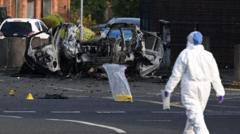
The appearance of a suspect in court following a car bomb attack on a police station marks the beginning of a legal process, but for the community and the force, the trial is a secondary concern. The immediate reality is a shattered sense of security. When a vehicle packed with explosives is detonated at the doorstep of a law enforcement hub, it isn't just an assault on a building. It is a calculated strike against the very concept of civic order. The suspect now faces the weight of the justice system, yet the investigation must look past the individual to the systemic vulnerabilities that allowed a high-yield explosive to reach a high-value target in the first place.
The Mechanics of Modern Domestic Terror
Security cordons failed. That is the blunt reality facing internal affairs and counter-terrorism units today. A car bomb is not a sophisticated weapon in terms of technology, but its psychological payload is immense. It transforms a common object—a sedan or a hatchback—into a massive kinetic threat.
The court proceedings will focus on the "who" and the "when," but the "how" reveals a more troubling narrative about the ease of procurement. We are seeing a shift where improvised explosive devices (IEDs) are no longer the sole domain of foreign battlefields. They are being assembled in suburban garages using commercially available precursors.
The chemistry is basic. The logistics are the difficult part. To move a vehicle laden with several hundred pounds of explosives through monitored streets requires either a failure in intelligence or a level of local anonymity that police are struggling to penetrate. Intelligence agencies often monitor "lone wolf" chatter, but the physical act of "muling" a device to a station requires a specific type of brazenness that suggests a breakdown in traditional deterrents.
The Illusion of Hardened Targets
Police stations were once considered "soft" targets compared to military bases, but the last decade saw a push to harden these sites. We saw the installation of bollards, shatter-resistant glass, and restricted parking zones. Yet, as this latest attack demonstrates, these measures are often reactive. They solve for the last attack, not the next one.
Physical barriers have a ceiling of effectiveness. If a suspect can park within twenty yards of a structural load-bearing wall, the pressure wave from a significant blast will still cause catastrophic internal damage. The court will hear evidence regarding the specific yield of the device, likely measured in TNT equivalence, which will tell us whether this was a crude pipe-bomb-in-a-trunk or a professionally shaped charge designed to bring the ceiling down.
The Recruitment of the Disenchanted
Behind every court appearance is a trail of digital breadcrumbs. Investigators are currently picking through encrypted threads and social media caches to find the radicalization point. It is rarely a straight line. Often, it begins with a grievance—a perceived slight by the legal system, a financial collapse, or an obsession with anti-government rhetoric.
The suspect in the dock is frequently the end of a very long fuse. We must ask if this individual acted in a vacuum or if they were the blunt instrument of a larger, more organized cell. If it is the latter, the court case is merely a distraction from a much larger threat profile still active in the shadows.
The Budget of Blood and Bricks
There is a financial cost to this violence that goes beyond the repair bills. Municipalities are already stretched thin. When a station is taken offline, response times in the surrounding precinct crater. Patrols are diverted to guard remaining infrastructure, leaving neighborhoods exposed.
The "siege mentality" begins to take hold within the rank and file. When officers feel that their home base is no longer a sanctuary, their interactions with the public change. They become more guarded, more suspicious, and more prone to using force. This is the hidden victory of the bomber: the erosion of the relationship between the protector and the protected.
Forensic Accountability
The prosecution will rely heavily on trace evidence. Modern forensics can pull a "chemical fingerprint" from a blast site that identifies the specific batch of fertilizer or fuel used in the mix. They will track the purchase of the vehicle, likely through a series of "straw buyers" or "ghost" listings on digital marketplaces.
But the courtroom is a sterile environment. It does not capture the smell of scorched ozone or the ringing in the ears of the officers who were sitting at their desks when the walls buckled. The defense will likely argue mental instability or coercion, a standard tactic in high-profile domestic terror cases. They will try to paint the suspect as a victim of circumstance or a man pushed to the brink.
The Failure of Predictive Policing
We have spent billions on algorithms designed to "predict" crime. We have cameras on every corner and license plate readers at every intersection. Yet, a car bomb still made it to the front door of a police station. This suggests that our reliance on "big data" has created a blind spot for "low-tech" threats.
A man with a grievance and a trunk full of chemicals doesn't always trigger an algorithm. He doesn't always post his manifesto on a public forum. Sometimes, he just drives.
The trial will likely drag on for months, filled with technical experts and character witnesses. But the real work is happening in the architectural firms and the security consultancies. They are already redesigning the next generation of police stations to be even more insulated, even more removed from the streets they serve.
The Price of Isolation
We are moving toward a future where the police operate out of bunkers. This is a tactical necessity but a social disaster. Every foot of concrete added to a station wall is a foot of distance between the officer and the citizen. The suspect in court may be one man, but the ripple effect of his actions forces an entire society to choose between accessibility and survival.
The evidence presented in the coming weeks will be a catalog of hate and high explosives. It will be a grim reminder that the peace we take for granted is often a fragile agreement that can be shattered by a single ignition switch. If the justice system fails to address the underlying networks that facilitate these acts, then the next car is already being loaded.
The courtroom doors close, the cameras turn away, but the structural cracks in the station house remain as a permanent testament to a threat that isn't going away. Security isn't a destination; it's a constant, exhausting struggle against the inevitable. We fix the walls, we buy the scanners, and we wait for the next person who decides that a bomb is the only way to be heard.
Stop looking at the man in the handcuffs and start looking at the gaps in the perimeter.