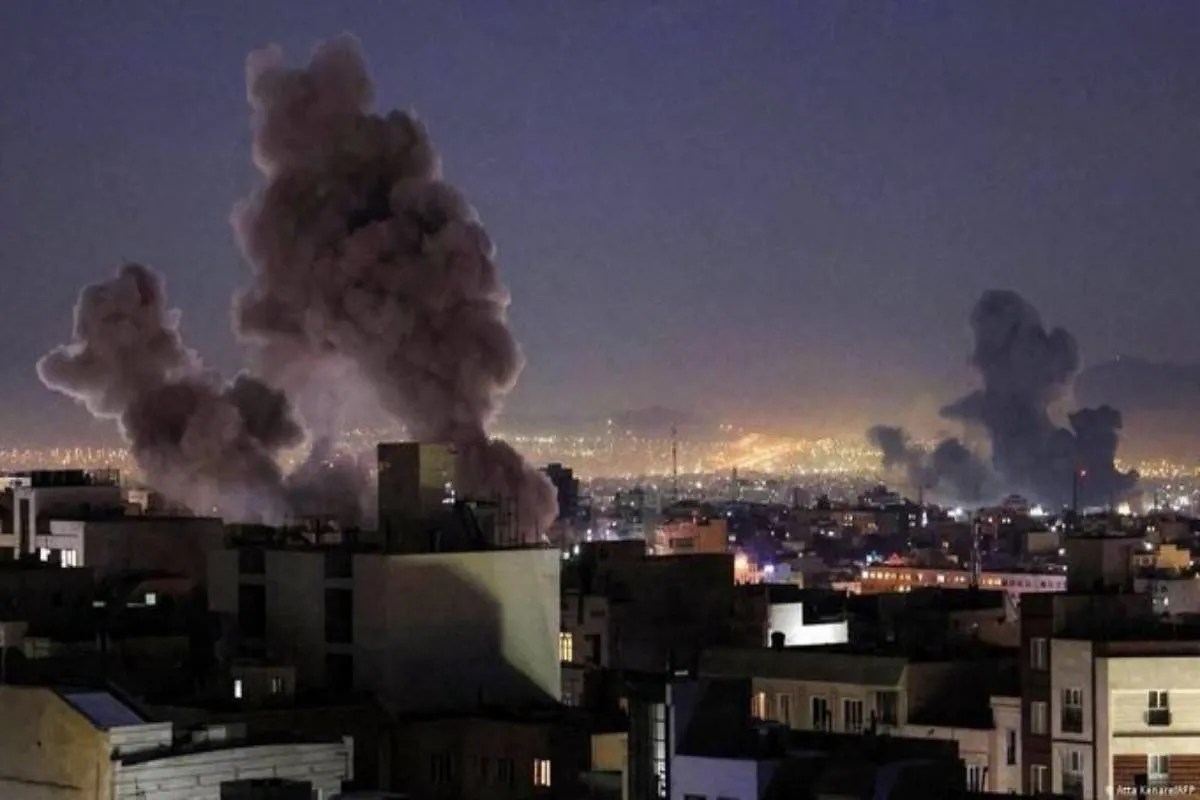
Reports of heavy strikes targeting the Iranian city of Qom represent more than a tactical escalation in the Middle East conflict. They signal a direct assault on the ideological and political heart of the Islamic Republic. While initial accounts focused on the spectacle of six massive explosions, the strategic reality is far more clinical. These strikes target the perceived successor to the Supreme Leadership, Mojtaba Khamenei, and the sophisticated drone production facilities that underpin Iran’s regional power projection. This is not random theater. It is a decapitation strategy meant to cripple Iran’s internal stability and its external military reach simultaneously.
The Strategic Gravity of Qom
Qom is not just another provincial capital. It is the theological nervous system of the Iranian state. When explosions rock this city, the tremors are felt by every cleric in the establishment. Targeting Qom sends a message that no sanctuary remains off-limits, even those once considered untouchable due to their religious significance. Discover more on a related topic: this related article.
The city houses the infrastructure for the IRGC’s most sensitive operations. Beyond the seminaries lie hardened facilities where advanced missile components and unmanned aerial vehicles (UAVs) are assembled. By hitting these sites, intelligence agencies are dismantling the physical tools Iran uses to influence wars in Yemen, Lebanon, and Ukraine. The choice of targets suggests a deep penetration of Iranian security, with precise coordinates that could only come from high-level intelligence or sophisticated signals surveillance.
Mojtaba Khamenei and the Shadow of Succession
The presence of Mojtaba Khamenei in the vicinity during these strikes changes the calculus of the entire operation. Mojtaba, the second son of Supreme Leader Ali Khamenei, has long been groomed in the shadows. He is often viewed as the true bridge between the clerical elite and the IRGC’s military might. Further journalism by Associated Press explores related perspectives on this issue.
His safety is a matter of national survival for the current regime. If the reports are accurate, the strikes indicate that the "Ring of Fire" strategy—where Iran uses proxies to keep its enemies at a distance—has failed. The war has arrived at the front door of the most powerful family in the country. This puts the Iranian leadership in an impossible position. They must either escalate to a level that invites total war or absorb the humiliation of being unable to protect their own inner sanctum.
The Drone Factories of the Holy City
For years, Qom and its surrounding industrial zones have been repurposed into hubs for drone technology. These aren't the hobbyist flyers you see in parks. These are long-range, one-way attack munitions that have redefined modern warfare.
- Production Speed: Facilities in this region have streamlined the transition from design to deployment.
- Component Smuggling: The proximity to major transit routes allows the regime to move sanctioned electronics into assembly lines with minimal oversight.
- Technological Shift: The focus has moved from large, slow drones to "swarming" capabilities that can overwhelm modern air defenses.
Destroying these hubs does more than slow down the IRGC. It creates a vacuum in the supply chain for proxies like Hezbollah. If the source of the technology is under fire, the "resistance axis" loses its most effective asymmetric edge.
The Intelligence Breach
How does an adversary successfully coordinate six major strikes in one of the most heavily guarded cities in the world? This is the question currently haunting the halls of the Evin Prison and the IRGC headquarters. It suggests a total collapse of counter-intelligence.
The coordination required for such an operation implies that the attackers had real-time data on the movement of high-value targets and the operational status of air defense batteries. It is likely that cyber warfare played a silent but lethal role. Before the first kinetic explosion was heard, it is probable that the local radar systems were blinded or fed "ghost" data, a hallmark of the electronic warfare suites utilized by top-tier militaries.
Beyond the Explosions
The psychological impact of these strikes outweighs the physical damage to the buildings. For the Iranian public, the government’s primary promise has always been "security." The state media's attempt to downplay the events often backfires, as social media footage of the plumes of smoke spreads faster than the official narrative can be drafted.
This creates a crisis of confidence. If the state cannot protect Qom—the very symbol of its legitimacy—what can it protect? The hardliners within the regime will likely demand a massive retaliation, possibly targeting Israeli or American assets in the Gulf. However, a massive response risks a full-scale regional war that Iran is currently ill-equipped to win, especially with its economy already in a tailspin and its air force consisting largely of aging Cold War-era jets.
The Role of Precision Munitions
The nature of the "six big blasts" reported by witnesses points to the use of high-yield, precision-guided munitions. These are designed to penetrate reinforced concrete and detonate underground, a necessary feature for targeting the subterranean bunkers common in Iranian military architecture.
- Kinetic Energy Penetrator: Used to reach deep-seated command centers.
- Delayed Fuse Mechanism: Ensures the explosion happens inside the facility rather than on the surface.
- Low Collateral Design: Focused on specific coordinates to minimize the "religious" fallout of hitting civilian seminaries, which would be a propaganda win for the regime.
The technical proficiency shown here is a warning. It demonstrates that the technological gap between Iran and its primary adversaries is not closing; it is widening.
The Geopolitical Fallout
Russia and China are watching these developments with increasing concern. Iran is a critical partner in the burgeoning "anti-Western" bloc. If Iran’s internal security is compromised, it disrupts the flow of energy and the strategic partnership that Russia relies on for its own military needs.
We are seeing a shift in the rules of engagement. The "shadow war" is no longer in the shadows. It is happening in the streets of major cities, in broad daylight, and directed at the very individuals who hold the keys to the future of the Iranian state. The era of deniable sabotage has been replaced by overt, high-intensity strikes.
The Technology of Interception and Failure
The failure of Iran's Russian-made air defense systems, such as the S-300, to prevent these strikes is a massive blow to the prestige of Eastern-bloc military hardware. If these systems are bypassed with ease, it means the entire defensive posture of the Islamic Republic is built on a foundation of sand.
Future conflicts will be defined by this disparity. You can have all the ballistic missiles in the world, but if your command centers are vaporized before you can turn the keys, those missiles are useless. The focus now shifts to whether Iran can develop an indigenous response to stealth technology and electronic jamming, or if they will remain a "blind giant" capable of hitting targets at a distance but unable to see the knife at their own throat.
The Succession Crisis Deepens
The targeting of Mojtaba Khamenei, whether he was physically harmed or just "warned," accelerates the internal power struggle. There are many within the clerical establishment who resent the idea of a "hereditary" transition in a system that ostensibly overthrew a monarchy.
An external strike that highlights Mojtaba's vulnerability may embolden internal rivals. It suggests that being the heir apparent makes you a magnet for high-tech assassination. This could lead to a fracture within the IRGC itself, as different factions debate whether to double down on the current path or seek a de-escalation that preserves their own survival.
Hard Realities of Modern Warfare
Warfare has moved beyond the battlefield and into the infrastructure of the state's mind. By hitting Qom, the attackers have struck at the regime's psyche. They have proven that the most "sacred" and "secure" locations are transparent to modern eyes.
The Iranian leadership now faces a grim reality. Every phone call, every underground meeting, and every movement of a high-ranking official is likely being tracked in high definition. The six explosions in Qom were not just a military operation; they were a demonstration of total transparency in a world where the regime thought it could remain opaque.
Survival for the regime now depends on a radical overhaul of its internal security, but the very technology they need to fix the problem is the same technology being used to dismantle them. They are caught in a loop where every move toward more security only reveals more vulnerabilities to an adversary that is already inside the house. The next phase will not be fought with armies on a border, but with code, signals, and the sudden, terrifying arrival of precision steel through the roof of a "secret" bunker.