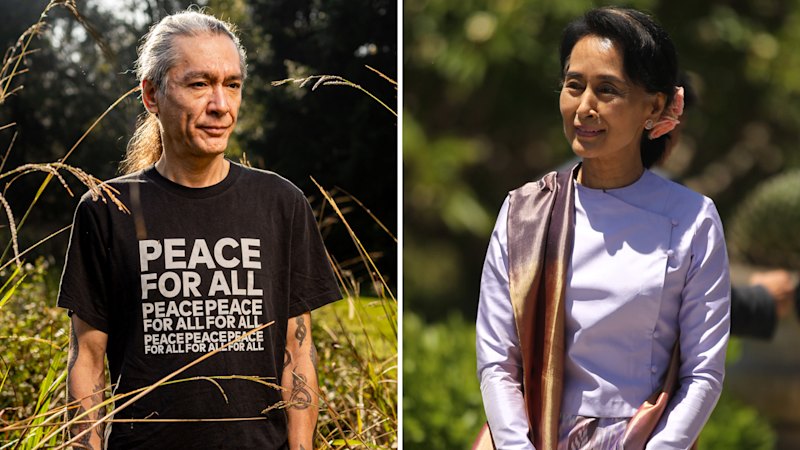
A letter arrived through the official channels of the British Foreign Office. The paper was stiff, a photocopy of a page that had traveled across continents and through the heavy, bureaucratic filters of a military dictatorship. Kim Aris held the copy, looking at the familiar handwriting of his mother, Aung San Suu Kyi. In the text, she mentioned the shifting seasons outside her small world in Naypyidaw—the sharp chill of the winter months, the suffocating weight of the summer heat. She told him her spirit remained strong, and she thanked him for the care package of medicine and food he had managed to send.
That was years ago. It remains the last direct sign of life Kim has received from his mother.
Since that single, heavily monitored communication, an absolute information blackout has descended around the eighty-year-old Nobel laureate. In the spring of 2026, the ruling military junta issued a public announcement claiming she had been moved from a concrete cell to house arrest due to the extreme weather. They released a grainy, undated photograph showing her sitting on a simple wooden bench, facing two police officers. They stated she was in good health.
But a photograph can be captured at any point in time, and a statement costs a regime nothing. To her youngest son, living thousands of miles away in a quiet British suburb, these official declarations mean less than nothing. They are empty words designed to pacify international scrutiny.
The Reality of the Void
When a state decides to erase a person from the public eye, the family is left to navigate a peculiar kind of grief. There is no funeral, no grave, yet there is no presence. Kim Aris finds himself trapped in this liminal space, forced to ask questions that no child should ever have to formulate about a parent.
"For all I know, she could be dead already," he stated during a recent visit to Tokyo, his voice devoid of histrionics, carrying only the flat, heavy weight of exhaustion.
The political reality in Myanmar is complex, but the human reality is brutally simple. A middle-aged man wants to know if his elderly mother is still breathing. He wants to know if her chronic medical conditions—the severe gum disease that prevents her from eating solid foods comfortably, the degenerative neck issues, the heart problems—are being treated, or if she is deteriorating in isolation.
Consider the structure of a modern political detention. It is not merely about physical confinement; it is about the systematic starvation of information. The junta has denied access to her legal team, independent doctors, and international observers like the International Committee of the Red Cross. By cutting off every artery of communication, the regime transforms a human being into a ghost while they are still alive.
A History of Echoes
This is not a new pattern for the family. Decades ago, Kim’s father, the academic Michael Aris, diagnosed with terminal cancer, pleaded with the previous iteration of the military regime for a visa to visit his wife one last time. The request was systematically denied. He died in Oxford in 1999 without ever seeing her again, while she remained confined behind the gates of her family home on University Avenue in Yangon.
Now, the generational loop is closing. Kim faces the same wall of state-sanctioned silence that claimed his father’s final years.
The military government relies on this silence to erode memory. They understand that the world moves quickly; global attention spans are short, fractured by a dozen competing international crises. If they keep a leader hidden long enough, the public consciousness moves on, leaving only the family to scream into the void.
To counter this deliberate forgetting, Kim launched the "81 for 81" campaign, timed to coincide with his mother’s 81st birthday on June 19. It is a grassroots effort, asking ordinary citizens around the world to run, walk, or cycle to draw attention to the total lack of verification surrounding her status. It is less a political movement and more an act of desperation—a son trying to use the collective noise of strangers to force a crack in the regime's wall.
The Limits of Diplomacy
Global politics operates on a currency of statements and expressions of concern. When foreign ministries issue press releases condemning the treatment of political prisoners, it creates the illusion of momentum.
But the reality on the ground remains entirely unchanged by rhetoric. Recently, India’s leadership hosted the Myanmar junta chief, Min Aung Hlaing, rolling out the diplomatic red carpet in New Delhi. For Kim, watching the world's largest democracy warmly receive the man responsible for his mother's disappearance was a profound disappointment. It demonstrated the stark divide between human rights advocacy and the cold, transactional nature of regional geopolitics.
The request being made by the family is fundamentally non-political. They are not asking for a renegotiation of the constitution or an immediate restoration of the ousted government through these specific appeals. They are demanding proof of life.
An independent medical examination or a single unmonitored visit by an international body would settle the question instantly. The fact that the junta refuses to permit such basic access suggests that the grainy photographs and brief press releases are masks hiding a far darker reality.
The waiting does not happen in a vacuum. It happens in the quiet moments of an ordinary day, when the phone doesn't ring, when the mail arrives with no official stamps, and when another month passes without a single shred of verifiable data. A son is left to wonder whether his mother is sitting in a room somewhere, enduring the tropical heat, or whether he is advocating for someone who has already passed into history.
The campaign continues, not because success is guaranteed, but because the alternative is to accept the silence as final. Kim Aris continues to speak to any camera that will turn toward him, driven by a singular, haunting necessity: the simple need to know if his mother is still there.