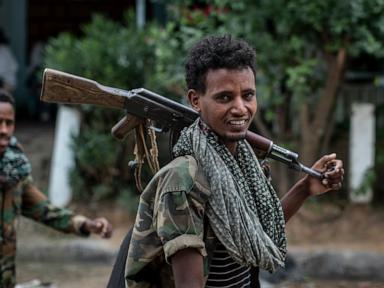
The smoke does not clear all at once. It lingers, thick and gray, clinging to the eucalyptus leaves and the corrugated iron roofs of Mekelle. For months, the sound had been a constant, low-frequency thrum—the distant percussion of artillery, the frantic chatter of small arms, the grinding of armor chewing up red earth. Then came the quiet. Not a peaceful quiet, but the heavy, suspended silence that follows a sudden storm, when the air is still charged and nobody dares to take a deep breath.
History is often written in broad strokes by generals and diplomats who view maps from thousands of miles away, tracing lines of advance and retreat with grease pencils. But history is lived in the dirt. It is lived by a mother dividing a handful of grain among three children while listening for footsteps in the dark. It is lived by a young fighter who traded his schoolbooks for a rifle because he believed, with the fierce certainty of youth, that he was defending the threshold of his home.
To understand why the opposition fighters in northern Ethiopia’s Tigray withdrew from the regional capital, you have to step away from the abstract nomenclature of military strategy and look at the human cost of endurance. You have to look at what happens when a war of attrition reaches the absolute edge of human capacity.
Consider a hypothetical civilian named Dawit, living through the final, desperate weeks before the withdrawal. Dawit is not a combatant. He is a mechanic, or was, before the spare parts ran out and the garage became a shelter for displaced families. In Dawit’s world, the front line was not a conceptual boundary on a CNN graphic; it was the whistling sound overhead that made him push his youngest daughter beneath a heavy oak table. It was the frantic scramble for salt, for cooking oil, for clean water that had not seen a pump in weeks.
By late 2021 and continuing into the shifting phases of the conflict that defined the region's agonizing trajectory, the Tigray People's Liberation Front (TPLF) forces found themselves caught in an existential vise. They had marched south, fueled by momentum and deep-seated grievances, pressing deep into Amhara and Afar regions, threatening the capital of Addis Ababa itself. To the outside observer, it looked like an unstoppable tide.
But logistics are a cruel master.
Think of an army as a runner trying to sprint a marathon without water. The further you stretch your limbs from your heart, the harder it is to pump life into them. Lines of supply snapped. Ammunition dwindled. The federal government, bolstered by new drone technology and a massive mobilization of recruits, braced and pushed back. The push turned into a counter-offensive, and the counter-offensive turned into a slow, grinding squeeze that threatened to encircle the very heartland the Tigrayan forces had set out to protect.
When the leadership announced the decision to withdraw back into Tigray, it was framed in official communiques as a strategic repositioning. In the language of military communiques, withdrawals are tactical maneuvers, adjustments on a chessboard. But on the ground, a withdrawal is an admission of gravity. It is the realization that holding ground outside your home is meaningless if your home itself is bleeding to death from the inside.
The decision was born of necessity, forged in the crucible of isolation. Tigray had been sealed off. Medical supplies had dwindled to near zero. Insulin, vaccines, and basic antibiotics had become more precious than gold. Every shell fired was a shell that could not be replaced. Every life lost was a thread pulled from an already frayed social fabric.
So, the order was given. The columns turned around.
Imagine the psychological weight of that retreat. You spent months fighting your way across unfamiliar terrain, believing that every mile gained was a step toward safety, only to be told that you must pull back, retreat behind your own borders, and brace for the storm that would inevitably follow. The soldiers trudged back through the mountain passes, their boots worn to shreds, carrying their wounded on makeshift stretchers, silence hanging heavy over the ranks. There were no cheers. There was only the dull, rhythmic crunch of gravel beneath tired feet and the oppressive weight of an uncertain tomorrow.
For the people waiting in Mekelle, the return of the fighters was not a triumph; it was a harbinger. It meant the war was not over. It meant the front line had simply contracted, pulling the violence closer, wrapping the regional capital like a tightened tourniquet.
Why does this matter beyond the borders of East Africa? Because the Tigray conflict is a stark reminder of a modern, tragic truth: contemporary civil wars rarely end with a neat signature on a parchment. They end when exhaustion sets in, when the sheer cost of continuation outweighs the possibility of victory, leaving behind a landscape of fractured communities, shattered infrastructure, and generational trauma that no peace treaty can instantly heal.
The withdrawal from the regional capital was a turning point, yes, but it was a turning point marked not by resolution, but by a grim resilience. It signaled that the TPLF forces recognized the futility of an overextended campaign against a vastly superior federal coalition backed by external alliances. It was a tactical acknowledgment that survival required pulling inward, defending the core, and hoping that international pressure, humanitarian corridors, and sheer endurance might eventually crack the siege.
Yet, hope in a war zone is a fragile currency.
When the last of the armed columns crossed back into Tigray and the positions were consolidated, the silence returned to Mekelle. But it was the silence of a holding pattern. Families continued to ration flour. Doctors continued to perform surgeries by the light of mobile phones because the grid had failed. Children played in the rubble of bombed-out factories, their games mimicking the only reality they had ever known.
Wars begin with speeches, manifestos, and the thunder of drums. They are fueled by ideology, historical grievances, and the fierce loyalty of people who believe they have no other choice. But they end in the quiet spaces between heartbeats, in the exhausted sighs of soldiers sitting in the dust, and in the quiet, agonizing wait for a peace that always seems just out of reach.
The dust settles over the northern highlands. The maps are redrawn. The analysts type their reports. But out there, beneath the vast, indifferent African sky, Dawit looks out over a ruined street, waiting for the morning, wondering how much more a human heart can take before it simply stops breaking and learns to live in the ruins.


