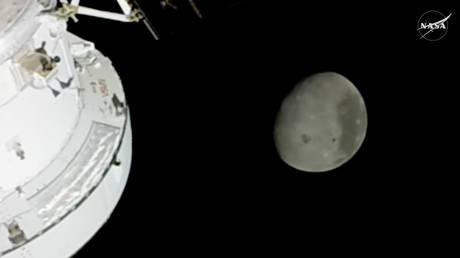
The Artemis II mission just cleared its most dangerous hurdle, skimming the lunar surface in a gravity-assist maneuver that marks the closest a human-rated spacecraft has come to the Moon in over fifty years. But the triumph was shadowed by a calculated, yet nerve-wracking blackout. As the Orion capsule swung behind the lunar far side, cutting off all contact with mission control, the silence served as a stark reminder of the thin margin for error in deep-space navigation. While NASA frames this as a routine orbital mechanic, the reality is that the communication loss exposes the inherent vulnerabilities of a mission reliant on vintage signal architecture and the brutal physics of the lunar shadow.
Orion’s trajectory brought it within approximately 80 miles of the lunar surface. At that distance, the Moon is no longer a distant glowing orb; it is a gargantuan, cratered obstacle that physically blocks the radio waves traveling between the spacecraft and the Deep Space Network (DSN) on Earth. For thirty-four minutes, the four-person crew was entirely alone, operating on pre-programmed sequences with zero room for manual intervention from Houston.
The Physics of the Blackout Zone
Space agencies often downplay the psychological and technical weight of "Loss of Signal" (LOS). They treat it as an administrative line item on a flight plan. However, for those of us who have tracked aerospace development since the Shuttle era, these minutes represent a period of profound risk. If the service module's primary engine had fired incorrectly during the outbound powered flyby, there would have been no way to verify the burn's success—or failure—until the craft emerged from the lunar limb.
The blackout occurs because radio waves travel in straight lines. When Orion passes behind the Moon, the massive bulk of lunar basalt and regolith acts as a lead shield. This isn’t a software glitch. It is a fundamental law of planetary geometry. During this window, the crew is dependent on the onboard flight computers to manage life support, attitude control, and the critical timing of the lunar gravity assist.
Why We Still Don't Have a Lunar Relay
The obvious question remains unanswered in most mainstream coverage. Why, in an era of global satellite constellations, are we still losing contact with our most important astronauts? The answer is a mix of budget prioritization and the slow pace of lunar infrastructure.
- Weight Constraints: Every pound of hardware on Artemis II is dedicated to life support and heat shield integrity. Carrying a dedicated high-bandwidth relay satellite for a single flyby was deemed a luxury.
- The DSN Bottleneck: The Deep Space Network is aging. It is a collection of massive radio dishes in California, Spain, and Australia. These dishes are currently overbooked, juggling data from the James Webb Space Telescope, Mars rovers, and the Voyager probes.
- Latency vs. Coverage: Even with a relay, the speed of light dictates a delay. At the Moon’s distance, you are looking at a roughly 1.3-second lag each way.
The Engineering Strain of the Closest Approach
The flyby wasn't just a sightseeing opportunity. It was a high-stakes slingshot maneuver designed to steal momentum from the Moon’s gravity to propel Orion into a wide, elliptical orbit that will carry it farther from Earth than any human has ever traveled. This "free-return trajectory" is a safety feature. If the engines fail later, the Moon’s gravity has already done the work of aiming the capsule back toward Earth’s atmosphere.
But the proximity of the flyby creates immense thermal and gravitational stress. Orion’s European Service Module (ESM) must endure rapid transitions from the freezing shadow of the Moon to the intense, unfiltered radiation of the sun. The hardware is being pushed to its thermal limits. We saw hints of this during Artemis I—the uncrewed test—where the heat shield charred in ways that weren't entirely predicted by the computer models.
Engineers are currently monitoring the "skip" telemetry. This is the data that tells us how the capsule’s structure reacted to the gravitational gradient. Even a slight deviation in mass distribution or fuel sloshing could theoretically alter the exit velocity. Without real-time communication during the closest approach, NASA is essentially flying blind during the most critical seconds of the orbital insertion.
The Human Element in the Dark
We must consider the crew. Unlike the Apollo missions, where the technology was primitive and expectations of survival were lower, Artemis II carries the weight of a modern, risk-averse political climate. The four astronauts are sitting in a pressurized volume roughly the size of a professional equipment van.
When the signal cuts, the "static" isn't just on the radio; it's in the cabin. They are surrounded by the hum of the CO2 scrubbers and the faint clicking of the thrusters. They are the only humans in the universe who cannot see their home planet. This psychological isolation is a factor that NASA’s flight surgeons study intensely, but no amount of training can simulate the realization that you are on the "dark" side of a celestial body with no link to your species.
The crew’s primary task during the silence is monitoring the Guidance, Navigation, and Control (GNC) systems. They are looking for "state vector" divergences. If the computer thinks they are at point A, but the optical sensors see stars that suggest they are at point B, the crew must be ready to troubleshoot.
The Fragility of the Deep Space Network
The technical backbone of this entire operation is the Deep Space Network. It is a fragile, terrestrial link that is often the single point of failure for mission success. During the Artemis II flyby, the 70-meter antenna at Goldstone, California, was the primary ear for Orion’s re-emergence.
If a solar flare had interfered with Earth’s ionosphere, or if a local power grid failure had hit the DSN site, the "silence" would have extended beyond the predicted 34 minutes. This isn't a hypothetical fear. We have seen DSN scheduling conflicts delay data downlinks for billion-dollar Mars missions. The fact that we are sending humans into this environment without a robust, dedicated lunar satellite constellation is a gamble that speaks to the "minimum viable product" approach of modern government spaceflight.
Breaking the Slingshot
As Orion emerged from the lunar shadow, the first signals to hit the Goldstone dishes were low-gain "heartbeat" pings. These are simple pulses of data that say, "I am alive, and my pressure is nominal." Only after the link is stabilized do the high-definition video feeds and complex telemetry start flowing.
The data gathered during those few minutes of proximity will dictate the rest of the mission. We are looking for:
- Mass Spectrometry: Analyzing the thin lunar exosphere at low altitudes.
- Radiation Mapping: Measuring the "deep" radiation environment near the lunar surface.
- Visual Inspection: High-resolution imagery of potential landing sites for Artemis III, though the speed of the flyby makes this a challenge for traditional optics.
The Artemis II flyby was a success of geometry, but a reminder of our technical limitations. We are still throwing rocks at the moon and hoping the math holds up while we can't see the target.
The mission now moves into the deep-space phase, where the crew will reach an apogee of 400,000 kilometers from Earth. The Moon is behind them, but the challenges of the long-range return are just beginning. The heat shield, which faced unexpected erosion during the first test, remains the final boss of this mission. Every piece of data pulled from the lunar flyby is now being fed into the re-entry simulators. If the gravity assist was too aggressive, or if the exit angle is off by a fraction of a degree, the "skip" re-entry through Earth’s atmosphere could turn from a controlled descent into a ballistic catastrophe.
The silence is over for now, but the data it left behind is being scrubbed for any sign of a flaw that could end the mission before the parachutes ever deploy. Check the telemetry, verify the vectors, and pray the heat shield behaves better than it did last time.