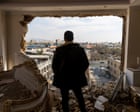
The air in the West Wing smells of scorched coffee and the sharp, metallic tang of ozone from the overworked air filtration systems. It is the fourteenth day. Fourteen days of a conflict that was supposed to be a surgical strike, a swift demonstration of "maximum pressure" that would bend Tehran to its knees before the first Sunday news cycle could even digest the headlines. Instead, the clocks in the Roosevelt Room seem to be ticking backward, dragging the administration into a quagmire that defies every campaign promise of "America First" and "no more endless wars."
Donald Trump is a man who thrives on the roar of a crowd. He feeds on the electric energy of a rally, the call-and-response of a base that mirrors his every grievance. But there are no rallies today. There is only the stifling, claustrophobic quiet of a presidency pinned against the ropes by its own gambit.
Two weeks ago, the decision to escalate felt like a masterstroke of leverage. Today, that leverage has evaporated, replaced by the grim mathematics of regional attrition. The polls, once a source of boastful pride, are hemorrhaging. The middle-of-the-road voters in Pennsylvania and Wisconsin, the ones who bought into the image of the master dealmaker who would keep their sons and daughters off foreign soil, are watching the ticker at the bottom of the screen with a growing sense of betrayal.
The Ghost in the Machine
Consider a hypothetical family in Macomb County, Michigan. Let's call them the Millers. They aren't foreign policy hawks. They don't track the movements of the Islamic Revolutionary Guard Corps on Twitter. But they do track the price of regular unleaded at the Shell station on the corner.
When the conflict began, the price was $3.10. By day four, it hit $4.50. By day ten, as rumors of a closed Strait of Hormuz dominated the evening news, it touched $5.75. For the Millers, the war isn't about geopolitical hegemony or the sanctity of maritime law. It is about the fact that they can no longer afford the commute to work and the grocery bill in the same week.
This is the invisible front line.
The President’s political standing is not being dismantled by a rival candidate’s stump speech. It is being eroded by the quiet, desperate calculations happening at kitchen tables across the Rust Belt. Trump’s brand was built on the idea of the "winner," the man who wins so much we would get tired of winning. But war is rarely a game of clear victories. It is a grinding process of loss. When the "winning" results in a direct hit to the American wallet, the spell begins to break.
The Miscalculation of the Strongman
The administration’s strategy relied on a singular assumption: that the Iranian leadership was a monolith of rational actors who feared economic collapse more than they valued ideological survival. It was a projection of Trump’s own world view. In the world of Manhattan real estate, everyone has a price. You squeeze the partner until they take the deal.
But Tehran isn't a business partner. It is a regime that has spent decades preparing for this exact moment of martyrdom.
Instead of the predicted internal collapse, the first seventy-two hours of kinetic action saw a rallying around the flag in the streets of Iran. The "maximum pressure" campaign didn't fracture the Iranian soul; it cauterized it. Suddenly, the President found himself in a terrifying position for any politician, let alone one seeking re-election: he had started a fight he couldn't finish quickly, and he couldn't leave without looking weak.
Weakness. It is the one word that does not exist in the Trumpian lexicon, yet it is the very thing the current stalemate broadcasts to the world.
The Iranian response has been a masterclass in asymmetrical irritation. They aren't meeting the U.S. Navy in a traditional line of battle. They are using "mosquito" tactics—swarms of fast-attack boats, low-cost drones, and cyber-attacks that blink out power grids in small Midwestern towns for hours at a time. Each incident is too small to justify a full-scale invasion, yet significant enough to keep the American public in a state of constant, low-grade anxiety.
The Fracturing Core
Behind the closed doors of the Oval Office, the bravado is fraying. Sources close to the inner circle describe a President who is increasingly frustrated with his military advisors. He wants "options." He wants "the big solution." But the Pentagon’s options all lead to the same destination: a ground war that would require hundreds of thousands of troops and trillions of dollars.
The very thing he campaigned against.
The political heels are dug in, but the ground beneath them is mud. The GOP, once a disciplined phalanx behind the President, is showing hairline fractures. The isolationist wing, led by the firebrands who promised an end to the "neoconservative" era, is publicly questioning the endgame. Meanwhile, the hawks are demanding more blood, accusing the administration of half-measures that embolden the enemy.
Trump is caught in a pincer movement of his own making.
If he escalates to a full-scale war, he loses the populist base that hates foreign interventions. If he de-escalates and seeks a diplomatic exit, he loses the "strongman" persona that is the bedrock of his appeal. He is searching for a third way, a "Golden Bridge" to retreat across, but the Iranians are smart enough to know that burned bridges are better for their leverage.
The Cost of the Invisible
We often talk about war in terms of "the fallen." We count the bodies. We count the drones lost. We count the missiles fired.
But there is another cost. It’s the cost of the things we don't do because we are staring at a map of the Persian Gulf.
The domestic agenda—the infrastructure bills, the tax tweaks, the border security debates—has been sucked into the black hole of the conflict. The presidency has become a reactive office. The man who once set the national conversation with a single 6:00 AM post is now a passenger to events unfolding in a time zone eight hours ahead of his own.
The psychological toll on the American public cannot be overstated. After two decades of conflict in the Middle East, there is a profound "Middle East fatigue." People are tired of hearing the names of provinces they can’t find on a map. They are tired of the anxiety of the "orange alert" world.
In this environment, the President’s traditional tools of distraction fail. You can't tweet away the reality of a dead sailor coming home to Dover Air Force Base. You can't "nickname" your way out of a global energy crisis. The reality of war is the ultimate "fake news" killer; it is too heavy, too visceral, and too permanent to be spun.
The Empty Stage
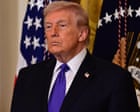
The most striking image of this two-week slide is not a battlefield photo. It is the image of the President standing in the press briefing room, the blue curtain behind him, his shoulders slightly slumped. He is reading from a script prepared by the National Security Council. The ad-libs are gone. The jokes are gone. The biting sarcasm has been replaced by a weary, defensive tone.
He is realizing, perhaps for the first time, that the world does not respond to a brand the way a consumer does. The world is a complex, chaotic system of actors who do not care about your polling numbers or your historical legacy.
The "knocked back" status isn't just about a drop in the polls. It’s about the loss of the most valuable currency in Washington: the aura of inevitability. Two weeks ago, Trump felt like an unstoppable force heading into the next election cycle. Today, he looks like a man trying to hold back a flood with a handheld fan.
As the sun sets over the Potomac, the lights in the Situation Room remain on. The maps are still there. The "options" are still on the table. But the options are all bad. The Master of the Deal is finally across the table from an opponent that isn't interested in his terms, and for the first time in his political life, the silence in the room is louder than the applause.
The ghost of the "endless war" has returned to the White House, and it has no intention of leaving quietly.