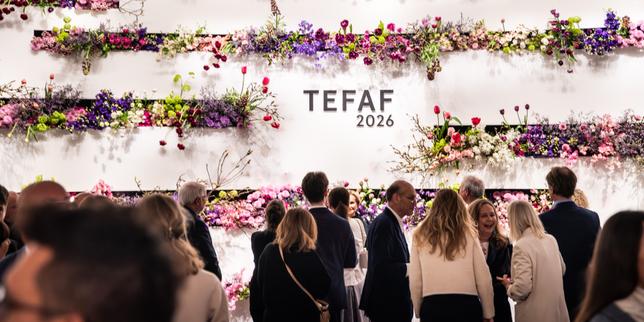
The rain in Maastricht does not fall; it leans. It presses against the medieval stone walls and the glass roof of the MECC exhibition center with a persistence that feels like history trying to get inside. Out on the Meuse river, the water is a flat, industrial gray. But inside the halls of TEFAF, the world is a different color entirely. It is the gold of a 17th-century frame, the deep, bruised blue of a Lapis Lazuli bowl, and the sharp, clinical white of a spotlight hitting a diamond the size of a thumb joint.
TEFAF is not a trade show. It is a sanctuary for the tangible. In an era where wealth is increasingly a flickering number on a screen or a decentralized bit of code, this fair is the ultimate anchor.
People come here to touch the past so they can feel certain about the future.
This year, the atmosphere carries a specific, electric tension. The world outside is fracturing. Conflicts in the Middle East have cast a long, cooling shadow over global markets, and by the old rules of economics, the aisles of Maastricht should be quiet. Logic dictates that when the horizon is on fire, you stop buying Flemish masters and Roman busts.
Logic is wrong.
The halls are humming. And if you watch the way the light catches the silk of a thobe or the tailored sharp edge of a charcoal suit, you realize the players haven’t left the table. They’ve simply changed their bets.
The Geography of a Handshake
Consider a man we will call Omar. He is not a caricature, but a composite of the energy currently shifting the floor of the fair. Omar has flown in from Doha. He is young, educated in London, and carries the weight of a family office that manages more capital than some European nations. For Omar, being in Maastricht while the news cycle at home is dominated by regional instability isn't a contradiction.
It is a strategy.
When your backyard is volatile, you don't look for safety in things that can be deleted. You look for the "Old Masters." You look for things that have already survived three revolutions, two world wars, and the collapse of empires.
"There is a comfort in the provenance," he might say, trailing a finger an inch above a terracotta sculpture. He isn't just buying art. He is buying a hedge against the ephemeral nature of the modern world.
The presence of Gulf buyers at TEFAF this year—collectors from Saudi Arabia, the UAE, and Qatar—is a loud silence. They are not here for the spectacle. They are here because the art market has become a parallel currency. While the headlines focus on the price of Brent Crude or the shipping lanes of the Red Sea, the real movements are happening in the quiet corners of booths where a single "Sold" sticker represents the movement of twenty million dollars.
The Physics of High-Stakes Beauty
Why do they keep coming? Why Maastricht, a quiet Dutch city, instead of the neon-soaked galleries of Dubai or the glass towers of New York?
Because the art world has its own gravity.
To understand TEFAF, you have to understand the Vetting. It is a brutal, beautiful process. Before the doors open, 175 experts from around the globe descend on the fair. They examine every brushstroke with ultraviolet light. They check the chemical composition of the pigment. They verify the wood of the panel. If a single thread of a tapestry is deemed "too new," the piece is removed.
This creates a level of trust that is almost impossible to find in any other asset class. In the stock market, you have transparency reports that can be manipulated. In real estate, you have bubbles that can burst. At TEFAF, you have the physical, undeniable truth of the object.
For a buyer from a region currently navigating the fog of war, that clarity is intoxicating.
Wealth is often a burden of choices. When the world feels like it is spinning too fast, the wealthy don't just want to grow their money; they want to hide it in plain sight. An ancient Egyptian sarcophagus doesn't require a server to exist. It doesn't need a government to give it value. It is valuable because it is rare, it is beautiful, and it is here.
The Invisible Bridge
There is a shift happening in how these collectors interact with the West. It used to be a one-way street: oil money flowing out, European culture flowing in. But look closer at the booths specializing in Islamic art or maps of the Levant.
The Gulf collectors are reclaiming their own history.
They are buying back pieces of their heritage that spent centuries in Parisian salons or English country houses. In doing so, they are building museums in the desert that rival the Louvre and the Met. This isn't just "shopping." This is the construction of a cultural identity that can withstand geopolitical tremors.
Imagine the irony. In a room filled with the spoils of the Dutch Golden Age—a time when the Netherlands was the center of global trade—the new masters of trade are arriving to take the torch. They walk past the Rembrandts not as students, but as peers.
The war in the Middle East is a tragedy of the present. But the fair is a celebration of the "long now." The collectors from the Gulf understand that the headlines of today will eventually be the dusty archives of tomorrow. They are playing a game that spans centuries.
The Sound of a Closing Door
By mid-afternoon, the air in the MECC is thick with the scent of expensive lilies and espresso. The transactions are rarely loud. There are no auctions hammers here, no frantic shouting. There is only the low murmur of negotiation and the scratching of a pen on a heavy cream-colored invoice.
The resilience of the art market in the face of conflict is often criticized as decadence. It is easy to look at a hundred-million-dollar room and see only greed. But that misses the human pulse underneath the commerce.
We are a species that obsesses over what we leave behind.
Whether it is a king in 14th-century France or a sovereign wealth fund manager in 21st-century Riyadh, the impulse is the same. We want to hold onto something that won't rot. We want to possess a piece of the eternal.
As the sun begins to set over Maastricht, casting long, distorted shadows across the cobblestones, the limousines line up. The buyers disappear into the tinted warmth of their cars, headed back to private jets that will take them across borders that are currently contested and fragile.
They leave with more than just crates of canvas and stone. They leave with the quiet satisfaction of having secured a piece of the world that the fire cannot touch.
The rain continues to lean against the glass. The wind howls across the Dutch plains. But inside the crate, wrapped in acid-free paper and nestled in foam, a Greek marble torso remains perfectly still. It has seen the rise and fall of dozens of "unprecedented" crises. It is not worried about the news. It is waiting for the next century to begin.
The deal is done. The money has moved. The history remains.
The lights in the hall dim, one row at a time, until only the most valuable pieces are left in the half-light, glowing like ghosts. Outside, the world is loud, messy, and violent. Inside, for a few million dollars, you can finally buy a moment of silence.
The price of peace has never been higher, and yet, the booths are empty because the walls are already bare.
Everything of value has already found a new home.