The floorboards creaked. Just a faint, familiar groan of aged pine.
To anyone else in the room, the sound meant nothing. But down on the rug, a heavy head lifted instantly. Dark brown eyes locked onto mine. Long before my own mind registered the sudden tightening in my chest—the invisible weight of an unexpected email, the quickening pulse of a bad memory—Barnaby already knew.
He didn't bark. He didn't rush over. He simply shifted his weight, stood up with a slow, deliberate stretch, and crossed the room to press his warm shoulder hard against my knee.
Solid. Anchoring. Unmistakable.
Most of us treat our dogs like furry roommates who happen to sleep on the floor. We feed them, walk them, apologize when we accidentally step on a tail, and laugh when they chase their own paws. We assume they love us because we provide the kibble. We assume their world is simple, smelling mostly of bacon and tennis balls, entirely detached from the heavy emotional machinery that runs human lives.
We are profoundly mistaken.
For decades, behavioral science insisted that dogs were merely reactive creatures. Conditioned machines. Pavlovian learners who associated the sound of a rustling treat bag with joy, and a raised voice with danger. They didn't understand feelings, scientists argued. They merely read the blunt mechanics of our posture.
Then came the brain scans.
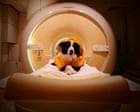
(Note: When neuroscientists place dogs into functional magnetic resonance imaging machines while wide awake, without sedation, they aren't looking for cute television clips. They are mapping the hidden architecture of canine empathy.)
Imagine a quiet laboratory room. A dog lies motionless inside a giant, humming white cylinder, its head resting comfortably in a custom-molded brace. Through specialized headphones, the dog hears a cascade of human sounds. Laughter. Crying. Sighs of relief. Sharp gasps of fear. Screams of anger.
At the same time, liquid crystal displays project different human facial expressions onto a screen. Frowning in sorrow. Baring teeth in rage. Wide-eyed with terror. Neutral. Calm.
What the functional MRI scans reveal is staggering. The caudate nucleus—the region of the brain associated with reward, processing value, and emotional connection—lights up like a switchboard when a dog hears a happy human voice or looks at a gentle face. But more importantly, the temporal cortex, the area dedicated to processing complex visual and auditory stimuli, reacts differently when confronted with distress.
Dogs can distinguish between fearful, angry, and sad human faces. They aren't just guessing. They are processing our emotional states in ways we are only beginning to comprehend.
Consider what happens next in the quiet spaces of our homes.
When you walk through your front door after a grueling day at work, your face might look composed. You might even offer a tight, polite smile to your partner. But your micro-expressions betray you. The subtle narrowing of your eyes, the microscopic tension around your jawline, the specific chemical signature of cortisol leaking into your sweat—all of it forms a complex sensory tapestry that your dog reads effortlessly.
To test this, researchers conducted behavioral trials where dogs were presented with photographs of human faces displaying various emotions, paired with corresponding audio clips. A frightened face was paired with a scream. A sad face with a sob. The dogs didn't just glance and look away. They matched the emotional valence. They lingered longer on images of fear and sadness, their heart rates shifting in tandem with the emotional weight of the stimuli presented on the screen.
They are listening to the music beneath the noise of our lives.
Think about the shelter dogs for a moment. The ones curled tightly in the back corners of cold concrete runs, staring out at the world with cautious, guarded eyes. We often write them off as damaged goods. Unsocialized. Aggressive. Unadoptable.
We forget that every single one of those animals has spent months, or even years, absorbing the ambient panic of overcrowded facilities. They are walking barometers of human neglect and human stress. When a prospective owner walks down the aisle of a shelter, heart pounding with the anxiety of choosing the right animal, the dogs aren't just evaluating the human. They are reading a masterclass in human hesitation.
Fear breeds fear. Sadness draws a quiet, desperate curiosity.
This brings us to a humbling realization about the creatures we invite into our beds and kitchens. They are not living in a simplified emotional black-and-white world. They are swimming in our emotional technicolor, whether we want them to or not.
When you try to hide your depression behind a mask of forced cheerfulness, your dog isn't fooled. When you attempt to swallow your panic before walking into an important meeting, your dog knows long before you reach for your briefcase. They are quiet witnesses to our internal weather patterns.
My grandfather used to say that a good dog owns a piece of your soul you didn't even know was for sale. He wasn't speaking poetically. He was describing an evolutionary partnership forged over tens of thousands of years, wherein wolves that learned to read the subtle flickers of human emotion survived better than those that didn't.
We domesticated them, yes. But in a very real sense, they domesticated our loneliness.
The next time your dog walks over, rests a heavy chin on your bare foot, and lets out a long, shuddering sigh of pure solidarity, do not push them away. Do not assume they just want a piece of whatever is on your plate.
Look down. Meet those dark, ancient eyes.
They already know how heavy the world is today. And somehow, miraculously, they are willing to help you carry it.