The wind in Asmara doesn't just blow. It whispers through the art deco facades of the Cinema Impero, carrying the scent of roasted coffee and the ghosts of a thousand unkept promises. If you sit at a sidewalk café, sipping a macchiato that tastes like 1930s Rome, you might forget that you are in a country often described as a fortress. You might forget that just over the horizon, the earth is beginning to tremble again.
Eritrea is a land of stillness. For decades, it has existed in a state of "no war, no peace," a suspension of time that has molded the souls of its people. But that stillness is fragile. Across the border in Ethiopia, a new hunger is growing—a hunger for the sea. And in the Horn of Africa, hunger usually leads to the sharpening of blades.
Consider a young man named Gebre. He is hypothetical, but his reality is shared by hundreds of thousands. Gebre has spent the last decade in national service. He hasn't seen a paycheck that could buy more than a few sacks of grain. He hasn't seen a world outside his barracks. To Gebre, the "port of Assab" isn't a strategic geopolitical asset or a line item in a maritime treaty. It is the place where his father disappeared during the last border war. It is a memory of salt and blood.
The Geography of Despair
To understand why a new conflict would be a catastrophe, you have to look at the map—not as a general does, but as a mother does. Eritrea sits like a lid on the Ethiopian jar. When the two nations split in 1993, Ethiopia became the most populous landlocked country on Earth. For years, the two neighbors have looked at each other with a mixture of resentment and longing.
Recently, the rhetoric from Addis Ababa has shifted. There are speeches about "natural rights" to the Red Sea. There are whispers that the border, settled by an international commission but never truly embraced, is a historical mistake. When leaders start talking about historical mistakes, the common people start looking for their shovels to dig trenches.
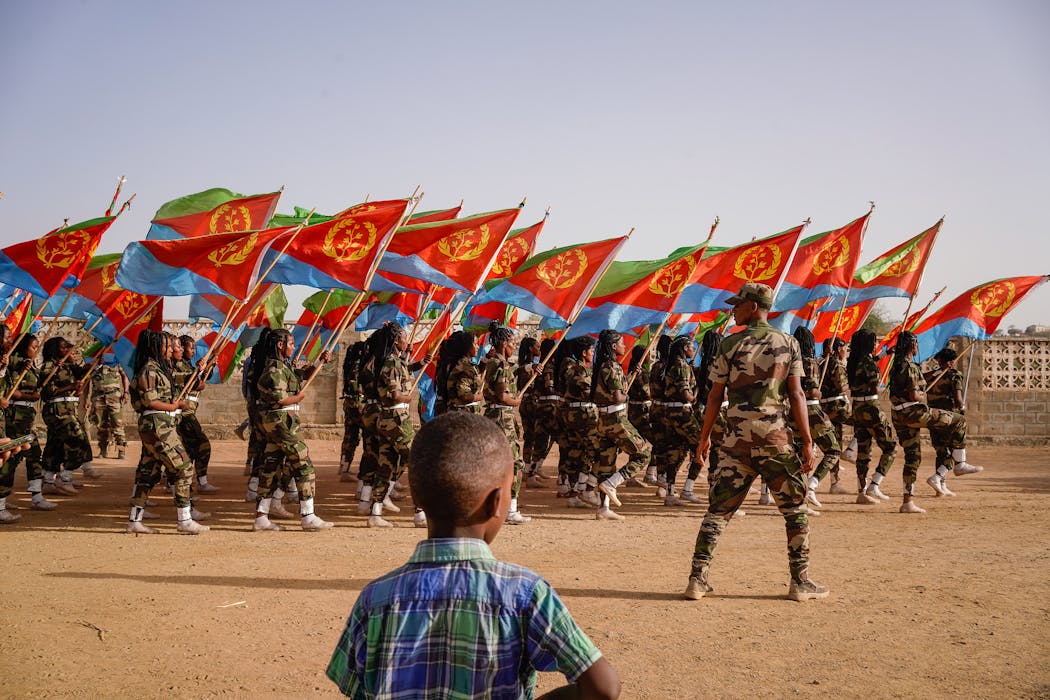
The facts are cold and unyielding. Eritrea is already one of the most repressed nations on the planet. There is no free press. No independent judiciary. No national budget that the public is allowed to see. The "Sawa" military training camp is the rite of passage for every youth, a funnel that leads either to the front lines or to a desperate trek across the Sahara toward the Mediterranean.
War would not just be a setback. It would be an erasure.
The Invisible Stakes
We often talk about war in terms of "theaters" and "objectives." We talk about the Red Sea as a shipping lane, a vital artery for global trade where billions of dollars in cargo pulse through the Bab-el-Mandeb strait. But for the people living on the coast, the Red Sea is a mirror. It reflects their isolation.
If Ethiopia pushes for a port by force, the resulting explosion would not be contained by the desert. The Horn of Africa is a house of cards built on a vibrating table. Sudan is already self-immolating. Somalia is wrestling with the shadows of its past. If Eritrea and Ethiopia collide again, the refugee crisis of the last decade will look like a rehearsal.
Imagine the Mediterranean. Now, imagine it twice as crowded, twice as deadly. That is the invisible stake. It is the human tide that rises whenever the logic of "sovereignty" replaces the logic of "survival."
A Culture Under Glass
There is a specific beauty to Eritrea that makes the threat of war feel like a sacrilege. It is a place where the pace of life has been forced into a slow crawl. In the absence of the internet—which is filtered, slow, and rare—people talk. They walk. They play ancient board games under the shade of acacia trees.
This is not a romanticization of poverty or repression. It is an acknowledgment of what is at risk. War destroys the physical infrastructure of a nation, but it also incinerates its social fabric. Eritrea’s social fabric is already stretched thin by the "long service" that keeps families apart for years. Another conflict would snap the remaining threads.
Metaphorically, Eritrea is a pressure cooker with the valve welded shut. The government uses the threat of "external enemies" to justify the internal tightening of the screws. A real invasion would provide the ultimate excuse for an even deeper darkness.
The Cost of the Corridor
Logistics experts argue that Ethiopia needs the port of Assab to fuel its burgeoning economy. They point to the high costs of using Djibouti’s ports. They talk about "regional integration."
But you cannot integrate regions with tanks.
The economic argument ignores the human tax. Every dollar spent on a long-range missile is a dollar taken from the drought-stricken fields of the highlands. Every hour a soldier spends staring through a telescope at the border is an hour not spent teaching a child to read or building a water system.
When you sit for a coffee ceremony in an Eritrean home, the process is slow. Three rounds: Awel, Kalei, Bereka. The first is strong, the second is smooth, the third is a blessing. It is a ritual of patience. It reminds you that some things cannot be rushed. Peace is one of them.
The current tension is a rejection of that patience. It is an attempt to shortcut history. The tragedy is that the people who will pay for this shortcut are the ones who have already paid the most. They are the grandmothers in the "plastic houses" of the outskirts, the students dreaming of a life beyond the barracks, and the sailors who just want to cast their nets without fear of a naval blockade.
The Red Sea is deep enough to hide many secrets, but it cannot swallow the grief of another generation. If the drums of war continue to beat in the Horn, they will drown out the whispers of the Asmara wind, leaving behind only the silence of the salt flats.
The world looks at the map and sees a strategic gateway. The people of the Horn look at the map and see their children's graves. The tragedy isn't that we don't know how to stop it; it's that we are choosing to watch the fuse burn while we argue about who owns the matches.
The coffee has gone cold. The shadows on the Cinema Impero are lengthening. Somewhere near the border, a young man like Gebre is looking at the stars, wondering if the morning will bring a shift in the wind or the sound of thunder.
Would you like me to analyze the historical treaties that defined the current borders between Ethiopia and Eritrea?