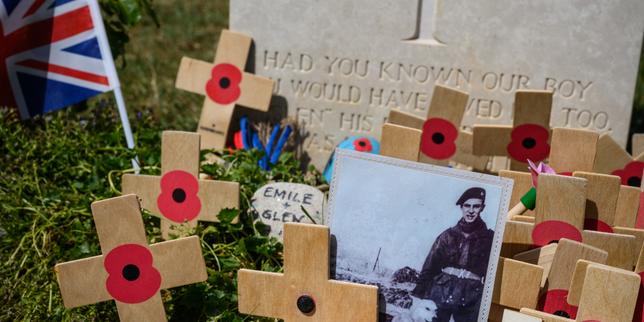
The rain over Normandy did not care about uniforms. It did not care about nations, ideologies, or the frantic ticking of pocket watches in damp trench coats. It fell heavy, smelling of ozone, cordite, and wet wool.
And in the middle of it, a dog breathed.
He was not a hero in the way men write poems about heroes. He had no medals pinned to a chest, no rousing speech to stir his blood before dawn, no ideological hatred for the enemy huddled three fields away. He was a canine paratrooper, wrapped in a special harness, shoved out of the belly of a shaking C-47 into a roaring, black void. His heart hammered against his ribs like a trapped bird.
When he hit the dark French mud, tangled in his shroud lines, he did not run. He waited. Because somewhere out there in the freezing dark, his handler was calling his name in a low, trembling whisper.
We have built our history books out of human words. We carve the names of generals into marble, measure centuries by treaties signed in polished rooms, and count our survival in the body counts of armies. But beneath the thunder of our grand narratives walks another procession. A silent, fur-covered army that never volunteered, never cast a ballot, and never understood why the world kept catching fire.
Consider what happens next: the smoke clears, the treaties are folded, and we look back at the wreckage of our ambitions. We see the tracks of camels in the Egyptian sand, carrying water for an emperor's grand delusion. We see the massive bulk of elephants driven across alpine passes, their breath frosting in the cruel mountain air, carrying armor they could not comprehend. We see pigeons falling out of the grey sky, clutching microfilm tied to their slender legs with red thread, dying in mid-air because a bullet mistook them for a message.
Animals in war are not footnotes. They are the scaffolding upon which human history was built, often at an invisible, devastating cost.
Napoleon knew this better than most. Picture the scorching expanse of the Syrian desert in 1799. The sun is an absolute weight, pressing down on skulls and shifting dunes. Men are hallucinating, their canteens rattling like empty bones against their hips. Dehydration is a slow, methodical executioner.
Enter the dromedary.
To the French soldiers, the camel was initially a beast of mockery, an ungainly creature with an offensive disposition and a breath that smelled of rotting vegetation. Yet, as the desert drained the life from the infantry, the camel became the absolute difference between annihilation and survival. Napoleon formed an entire dromedary corps. These animals could march fifty miles a day without a drop of water, carrying supplies, artillery, and exhausted men who could no longer drag their boots through the sand.
Imagine watching your friend fall behind, swallowed by the heat haze, only to be hauled onto the saddle of a towering, indifferent beast that simply kept walking. The camel did not care about the glory of France. It cared about acacia thorns and surviving the furnace. But without its stubborn, biological resilience, Napoleon's campaign would have evaporated into the desert dust weeks earlier.
The strategy changed as humanity learned to master not just the land, but the very air.
Fast forward to the twentieth century. The industrialization of slaughter required new tools. When technology failed—when radios were jammed, telephone wires were severed by artillery shells, and human runners were cut down in the mud—armies reached back into the oldest partnership on Earth.
They reached for the birds.
Pigeons became the tiny, feathered saviors of the Western Front. We forget how fragile communication really is until it breaks. During the First World War, a homing pigeon named Cher Ami flew twenty-five miles through a storm of shrapnel and machine-gun fire to deliver a message that saved an entire trapped American battalion from being obliterated by friendly artillery. She lost an eye. She lost half a leg. She arrived at the loft bleeding, exhausted, and barely breathing, yet she had crossed the threshold of human error to deliver life.
We marvel at the technology of the telegraph and the radio, but in the crucible of absolute destruction, a bird's homing instinct was the most advanced guidance system on the planet. They did not fly because they were patriotic. They flew because millions of years of evolution wired an unbreakable compass into their skulls, driving them toward home, even when home was a cage surrounded by corpses.
Then came the Second World War, and the theater expanded into the vertical realm.
The night before the Normandy landings, thousands of paratroopers dropped behind enemy lines to disrupt communications and secure bridges. Among them were dogs. Not just any dogs, but specially trained operatives from the British Dickin Medal lineage and American equivalents. These animals were dropped in containers or strapped to the chests of handlers.
Think about the sensory horror of that descent. A dog does not understand airplanes. It does not understand why the floor has vanished, why the wind is screaming at a hundred miles an hour, why the air is thick with the metallic taste of fear. They landed in enemy territory, trained to remain silent, to sniff out hidden mines, to carry medical supplies through gaps in hedges where a man would be instantly cut in half.
During the Battle of Okinawa, dogs served as sentries and scouts in the suffocating humidity of the jungle. They could smell an enemy soldier hiding in a spider hole long before a human patrol stumbled into the crossfire. Many of them died from tropical diseases, shrapnel, and bullets meant for the men holding their leashes.
We owe them a debt that no monument can ever quite balance. Because when we talk about the Greatest Generation, we are talking about a partnership. We are talking about millions of non-human lives swept into the machinery of human conflict, enduring the cold, the hunger, and the terror without ever understanding the grammar of the war they fought.
The next time you walk past a war memorial, look closely at the bronze statues of soldiers standing tall, rifles gripped in hand. Look at the corners of the plinth. Imagine the shadow of a dog crouching in the mud beside them. Imagine the beat of a pigeon's wings against a lead-filled sky. Imagine the heavy, slow blink of a camel standing firm against a sandstorm while empires rise and crumble around its ankles.
They did not write the history books. They simply bled across the pages so we could live to write them.