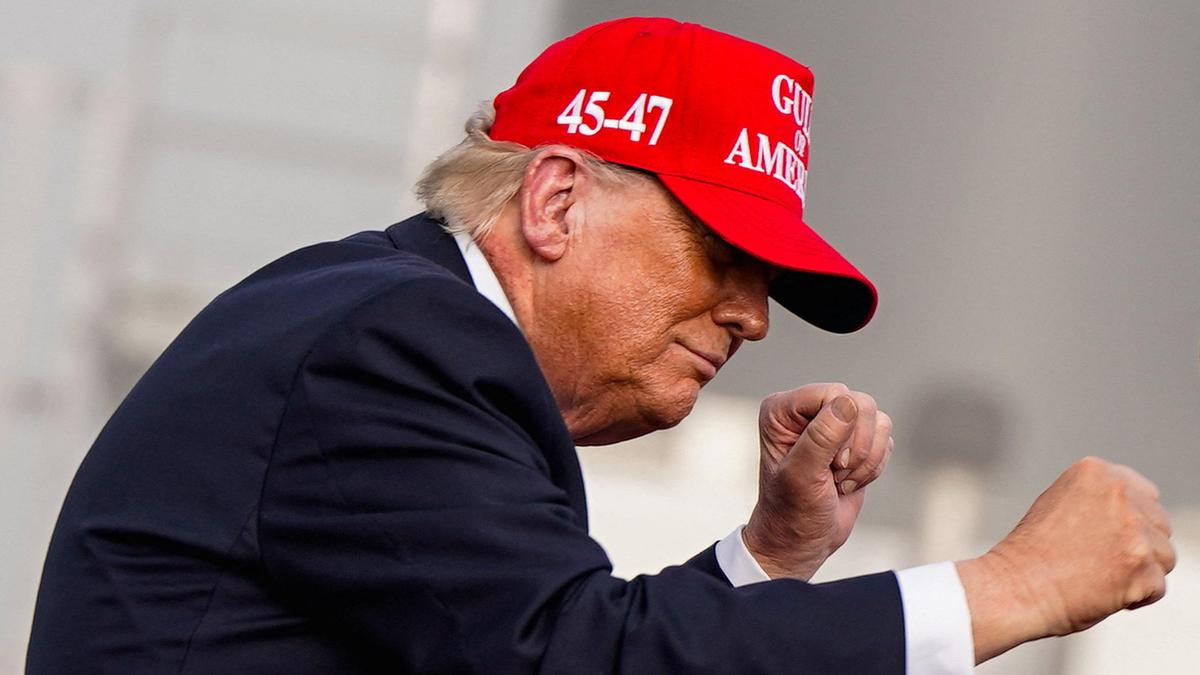
The friction between Donald Trump’s incoming administration and Anthropic is not a simple case of a politician bullying a tech startup. It is the opening salvo in a struggle to redefine what "national interest" means in the age of generative intelligence. While the public focus remains on partisan bias in chatbot responses, the real battleground is the Pentagon’s procurement office. Anthropic, a company founded on the principle of "AI safety" and a cautious approach to deployment, now finds itself caught between its own constitutional AI framework and a Washington mandate to weaponize every available line of code.
The Constitutional Conflict at the Core of Claude
To understand why the Trump circle views Anthropic with such skepticism, you have to look at the architecture of the models themselves. Anthropic uses a method called Constitutional AI. Unlike other models that rely almost exclusively on human feedback to learn right from wrong, Claude is given a written list of principles—a "constitution"—and trained to evaluate its own outputs against those rules.
The problem is that this constitution was drafted by San Francisco engineers, not defense strategists. When a model is programmed to avoid harm or "harmful content" based on a specific set of liberal-democratic ethical guidelines, it becomes difficult to pivot that same model toward military applications. A model that refuses to explain how to disrupt a chemical supply chain because of "safety" is a model that might also refuse to assist a general in planning a kinetic strike against an adversary.
Trump’s advisors see this as a form of baked-in ideological resistance. They argue that "safety" is being used as a shield to prevent American AI from achieving the lethality required to deter China. In their view, if an AI is too polite to fight, it is a strategic liability.
The Military Pivot and the Investor Dilemma
For years, the AI industry maintained a comfortable distance from the Department of Defense. Google’s internal revolt over Project Maven in 2018 set a precedent that many thought would stick. But the arrival of Large Language Models (LLMs) changed the math. The scale of compute required to train models like Claude 3.5 requires billions of dollars—capital that increasingly comes from sources with ties to national security interests or massive sovereign wealth funds.
Anthropic recently began loosening its restrictions on military contracts, a move that signaled a pragmatic shift. However, "support for defense" is a broad term. There is a massive gulf between using an LLM to summarize logistics reports and using it to identify targets in real-time on a battlefield.
The Scale of the Modern Arms Race
- Compute Sovereignty: The Trump administration views the physical chips—the H100s and Blackwell B200s—as national assets. They want to ensure that the companies holding the most "weight" in their models are aligned with a "Maximum Pressure" foreign policy.
- The China Factor: Every delay in deployment caused by an "ethics review" is seen by the current political vanguard as a gift to the Beijing-based developers of models like Qwen or DeepSeek.
- The Loyalty Test: Silicon Valley has long enjoyed a degree of autonomy. The new administration intends to treat AI labs more like Lockheed Martin and less like Instagram.
Why Technical Neutrality is a Myth
Industry analysts often talk about "de-biasing" models as if it were a purely technical cleanup. It isn't. Every decision to suppress a specific type of output is a political act. Anthropic’s leadership, including Dario and Daniela Amodei, have built their brand on being the "adults in the room." They left OpenAI specifically because they felt the race to market was compromising safety.
But in the eyes of the Trump transition team, this "safety" is a synonym for "gatekeeping." They point to instances where Claude might decline to answer questions about certain political figures or historical events in a way they deem "woke." While these examples are often trivial—such as refusing to write a poem about a specific politician—they serve as a proxy for the much larger fear that the AI will "conscientiously object" during a national crisis.
The Infrastructure Trap
Anthropic is heavily dependent on Amazon and Google for the cloud infrastructure necessary to run its models. This creates a secondary pressure point. The government has immense power over these tech giants through antitrust litigation and federal contracts. If the administration decides that Anthropic’s "safety" protocols are hindering the development of a sovereign, aggressive AI capability, they don’t need to sue Anthropic directly. They can simply make life difficult for the hosts.
We are seeing the end of the "neutral platform" era. The next four years will likely see a push for "Patriot AI"—models specifically fine-tuned to prioritize American hegemony over universalist ethical constraints. Anthropic’s challenge is to prove that its safety frameworks can actually make a model more reliable in a high-stakes military context, rather than just more hesitant.
The Engineering Reality of Weaponized AI
Building a "loyalist" AI isn't as simple as flipping a switch. If you strip away the safety guardrails to make a model more aggressive, you risk "jailbreaking" the model’s core logic. A model that is encouraged to be deceptive or lethal in one context may become unpredictable in others.
$$Loss = \sum_{i=1}^{n} (y_i - \hat{y}_i)^2 + \lambda \cdot Safety_Constraint(x)$$
In the simplified logic of model training, the "Safety Constraint" is often seen as a penalty that prevents the model from reaching its "optimal" performance for a specific task. If the government demands the removal of that $\lambda$ penalty to increase "performance," they might end up with a model that is powerful but fundamentally unmanageable.
The tension isn't just about what the AI says; it's about who controls the "Reward Model." Whoever controls the reward model controls the behavior of the intelligence. If the government insists on installing their own reward models, Anthropic ceases to be an independent lab and becomes a federal utility.
The Disconnect Between Ethics and Survival
The Silicon Valley elite often speak in terms of "existential risk" (X-Risk)—the idea that AI might one day wipe out humanity. The Trump administration speaks in terms of "existential competition"—the idea that if we don't build it first, someone else will use it to wipe us out. These two views of risk are fundamentally incompatible. One leads to a policy of "slow down and verify," while the other leads to "accelerate or die."
Anthropic’s Claude is currently considered one of the most sophisticated and "human-aligned" models on the market. But alignment is a relative term. If the goal of the user is to win a trade war or a cyber-conflict, an "aligned" model is one that helps them achieve that goal without hesitation.
The struggle ahead for Anthropic is a test of their foundational myth. Can a company built on the idea of cautious, ethical development survive in an environment that views those very qualities as a form of soft-treason? The pressure to conform will not be subtle. It will come in the form of export licenses, compute subsidies, and the threat of regulatory strangulation.
The move toward an integrated "AI-Military-Industrial Complex" is accelerating. The question is no longer whether AI will be used for power projection, but which specific ethics will be sacrificed to ensure that power is American. Anthropic's "Constitution" is about to meet the reality of realpolitik, and the result will likely be a model that looks very different from the Claude we know today.
Decide now if you want a tool that follows your orders or a tool that follows its own conscience, because the window for having both is closing.