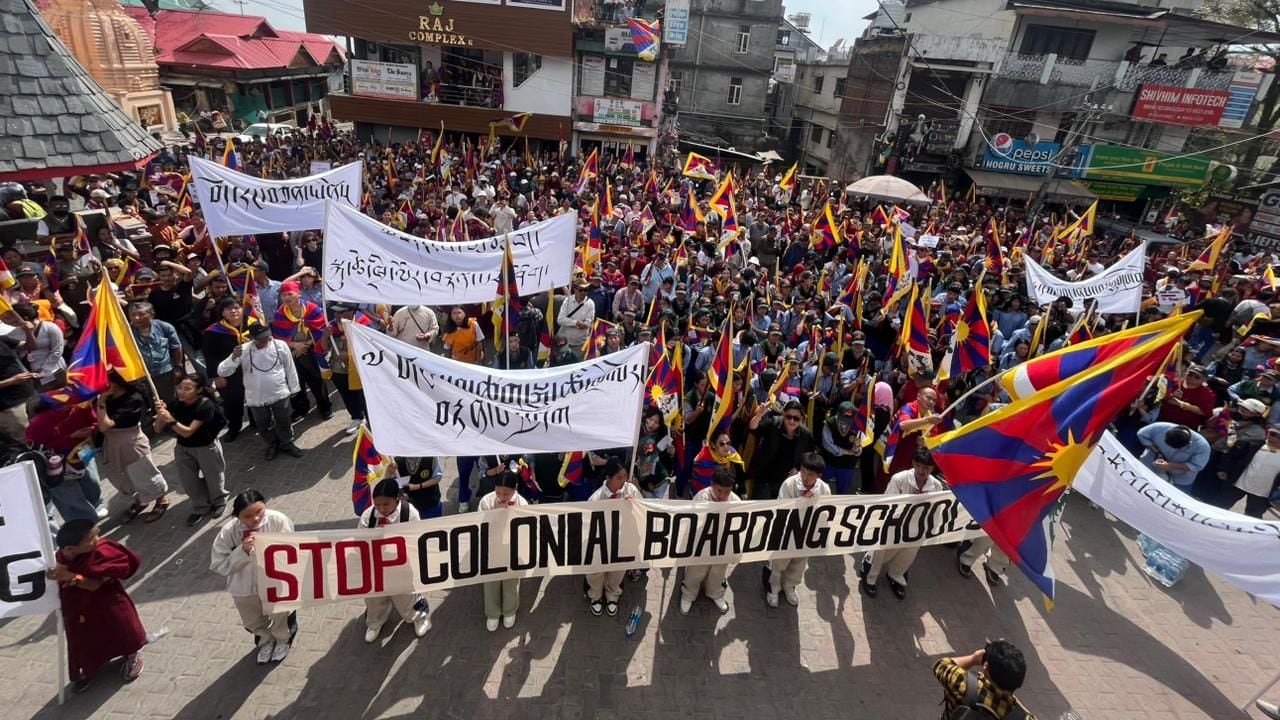
The survival of Tibetan identity is currently being negotiated not through open warfare, but through a systematic application of administrative, digital, and educational engineering. While traditional reporting focuses on the emotional resonance of protests, a structural analysis reveals a coordinated three-pronged strategy designed to achieve "Sinicization"—the forced alignment of Tibetan culture with the political and social norms of the Chinese Communist Party (CCP). This process operates through the homogenization of language, the digital enclosure of the Tibetan plateau, and the reorganization of rural labor.
The Educational Enclosure Logic
The most potent mechanism for long-term cultural shift is the "Boarding School Pipeline." By relocating an estimated one million Tibetan children into centralized residential schools, the state effectively severs the intergenerational transmission of language and religious values.
This is not a byproduct of urbanization but a deliberate design choice. The cost-benefit analysis for the state is clear:
- Linguistic Standardized Efficiency: Replacing Tibetan-medium instruction with Mandarin (Putonghua) creates a workforce that is economically integrated into the national economy while being culturally alienated from its heritage.
- Supervision Density: Centralizing youth in state-controlled environments allows for 24/7 ideological alignment that is impossible in decentralized, family-run rural settings.
- Information Siloing: By controlling the curriculum, the state can rewrite historical narratives, framing the CCP as the sole architect of Tibetan progress while erasing the historical independence or religious governance structures of the past.
The Digital Panopticon and Grid Management
The suppression of dissent within Tibet and the subsequent global protests are linked by a feedback loop of surveillance technology. The "Grid Management" system divides Tibetan neighborhoods into tiny cells, each monitored by "grid members" responsible for reporting "irregular" behavior.
This human intelligence is augmented by a technical stack that includes:
- Biometric Mapping: Comprehensive DNA and iris scanning programs applied under the guise of public health.
- Mobile Intrusiveness: Mandatory installation of surveillance software on smartphones, which flags religious imagery or communication with the Tibetan diaspora.
- Social Credit Integration: Linking political compliance to economic survival. Engaging in "splittist" activities—a term applied broadly to even minor cultural expressions—results in the loss of social benefits, travel permits, and employment opportunities.
This creates a high-friction environment for any form of organized resistance. The risk-to-reward ratio for internal protest has been pushed to an extreme, explaining why the most visible manifestations of Tibetan identity occur outside the borders of the People's Republic of China (PRC).
Economic Coercion and Labor Transfer
The transformation of the Tibetan landscape involves the "Labor Transfer Program," which mirrors strategies used in Xinjiang. By moving nomadic herders and rural farmers into industrial hubs or "socialist villages," the state achieves two objectives simultaneously.
First, it breaks the traditional link between the Tibetan people and their ancestral lands. The nomadic lifestyle is inherently difficult to monitor and control. Settling these populations into fixed housing makes them legible to the state’s administrative and tax systems.
Second, it converts a self-sufficient agrarian population into a dependent urban proletariat. Once removed from their land, Tibetans must rely on state-provided jobs and subsidies, which are contingent on political loyalty. This economic restructuring functions as a leash, ensuring that even if cultural resentment remains, the material capacity for revolt is stripped away.
The Geopolitical Response Gap
Global protests on the anniversary of the 1959 uprising serve as a barometer for international sentiment, but they often fail to disrupt the PRC’s strategic momentum. The reason lies in the "Economic Leverage Asymmetry." Many nations that voice rhetorical support for Tibetan human rights are simultaneously deeply integrated into Chinese supply chains.
The CCP utilizes this dependency to implement "Salami Slicing" tactics in diplomacy:
- Normalization of the Status Quo: By making the occupation of Tibet a decades-long reality, the state bets on international "outrage fatigue."
- Retaliatory Trade Measures: Countries that host the Dalai Lama or officially criticize Tibetan policy face immediate economic blowbacks, such as bans on specific exports or the freezing of diplomatic channels.
- Transnational Repression: The long arm of the state reaches into the diaspora, using family members still in Tibet as collateral to silence activists abroad.
The Succession Crisis as a Strategic Bottleneck
The most significant upcoming variable in the Tibetan conflict is the succession of the 14th Dalai Lama. The CCP has already laid the legal groundwork to claim the authority to recognize the next reincarnation, citing historical precedents from the Qing Dynasty.
This creates a looming "Double Dalai Lama" scenario:
- The State-Appointed Candidate: A figurehead chosen by Beijing to validate CCP policy and provide a veneer of religious legitimacy to the Sinicization project.
- The Diaspora-Recognized Candidate: A figurehead chosen via traditional methods or by the Dalai Lama’s own pre-determined instructions, who will likely remain in exile.
This schism is designed to permanently fracture the Tibetan religious hierarchy. Without a singular, globally recognized spiritual leader, the Tibetan movement risks losing its primary unifying force and its most effective diplomatic asset.
Strategic Recommendation for Global Actors
To move beyond performative protest, international stakeholders must shift toward a "Cost-Imposition Framework." If the PRC perceives the cultural erasure of Tibet as a low-cost operation, the trajectory will not change.
Effective strategy requires:
- Supply Chain Auditing: Identifying and divesting from companies that utilize Tibetan forced labor or provide the surveillance architecture used in the Tibetan Autonomous Region (TAR).
- Reciprocal Diplomacy: Condition diplomatic engagement on access to Tibet for independent observers and journalists, matching the access Chinese state media enjoys in Western nations.
- Multilateral Recognition of Reincarnation: Proactively passing legislation, similar to the U.S. Tibetan Policy and Support Act, which codifies that the selection of Tibetan religious leaders is a purely religious matter, free from state interference.
The goal is not to force an immediate reversal of policy—an unlikely outcome given the CCP’s internal security priorities—but to increase the diplomatic and economic friction of the Sinicization project until it becomes a strategic liability rather than an administrative routine. Success depends on shifting the narrative from a human rights grievance to a fundamental violation of international norms regarding self-determination and cultural sovereignty.
Establish a unified digital repository for Tibetan cultural and linguistic data outside of Chinese jurisdictional control to ensure that even if the physical erosion of Tibetan identity continues within the plateau, the cultural "source code" remains accessible for future generations.