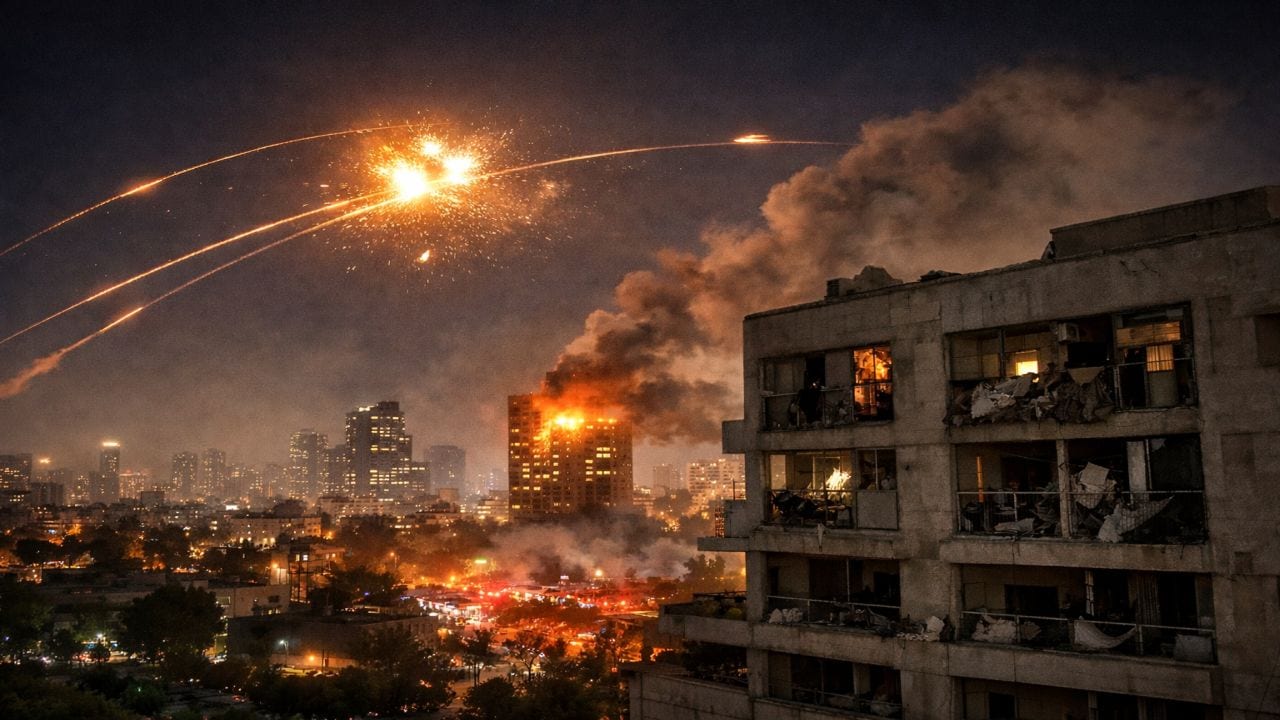
The sirens in Tel Aviv aren’t a signal of impending doom. They are a sound check for the world’s most expensive orchestra.
Every time a red alert blares and the international media rushes to live-stream streaks of light over the Mediterranean, we fall into the same trap. We treat these escalations as traditional kinetic warfare. We measure success in impact craters and body counts. We frame it as a "clash of civilizations" or a "spiral into chaos."
You’re being fed a narrative of fragility. The reality is far more clinical, calculated, and—frankly—industrial. What you saw over Tel Aviv wasn't the brink of World War III; it was a high-stakes stress test of the global defense-industrial complex.
If you’re watching the news to see if the world is ending, you’re looking at the wrong data points.
The Iron Dome is an Economic Weapon, Not Just a Shield
The "lazy consensus" suggests that missile defense is a humanitarian endeavor. It’s not. It’s an attrition calculator.
When Iran launches a swarm of drones or ballistic missiles, they aren't necessarily trying to level a skyscraper. They are trying to bankrupt the interceptor inventory. This is the math the pundits ignore:
- The Cost Asymmetry: An Iranian Shahed-series drone might cost $20,000 to $50,000. A Tamir interceptor fired by the Iron Dome costs roughly $40,000 to $50,000.
- The Escalation Ladder: When the threat moves to medium-range ballistic missiles, the cost jumps. An Arrow-3 interceptor costs roughly $2 million to $3.5 million.
I have sat in rooms with defense analysts who don't look at the radar screens; they look at the burn rate of the national treasury. The "victory" isn't just stopping the missile. The victory is maintaining a 1:1 or better economic ratio. When the sirens sound, the real battle is happening in the supply chains of Raytheon and Rafael Advanced Defense Systems.
The media portrays the sirens as a sign of Israeli vulnerability. In reality, the ability to sound a siren, clear the streets, and engage a multi-layered defense system with a 90% success rate is the ultimate display of sovereign strength. It is a flex of technological superiority that renders the adversary's primary offensive tool—the rocket—largely symbolic.
Stop Asking if the Conflict is Escalating
The most common question on Google and in newsrooms is: "Is the Iran-Israel conflict escalating?"
This is the wrong question. It assumes a linear path toward total war. In the modern era, conflict is a thermostat, not an on-off switch.
Both Tehran and Jerusalem understand the "Redline Equilibrium." Iran needs to project power to satisfy its domestic hardliners and regional proxies. Israel needs to demonstrate that its "Iron Wall" is impenetrable to maintain its status as the region’s untouchable tech-hub.
What we see is a choreographed exchange of kinetic energy.
- Iran sends a "telegraphed" strike—enough volume to look scary on CNN, but slow enough for defense systems to prep.
- Israel intercepts the bulk, showcasing the Arrow and David’s Sling systems.
- The US and regional partners provide intelligence coordination.
- Everyone goes home and claims victory.
The "escalation" is the product. The sirens are the marketing.
The Myth of the "Surgical Strike"
We need to kill the idea that modern warfare in the Middle East is about taking territory. Nobody wants to govern the ruins of their neighbor.
This is about Information Dominance.
The sirens in Tel Aviv serve a psychological purpose for both sides. For Israel, they build social cohesion and justify the massive spend on the defense budget. For Iran, the sound of those sirens is proof of "reach."
But let’s look at the technical reality of these intercepts. When an Arrow-3 hits a target in space, the debris follows a trajectory governed by $r(t) = r_0 + v_0t + \frac{1}{2}at^2$. The "surgical" nature of the defense is a miracle of physics, but the political fallout is messy and unpredictable.
The danger isn't a deliberate start to a Great War. The danger is a "sensor failure" or a "math error." If an interceptor misses and a missile hits a high-occupancy residential tower by accident, the choreography breaks. The "theatrics" of the current conflict rely on 100% technical perfection. That is a terrifyingly thin margin to bet the global economy on.
The Intelligence Failure Narrative is Dead
Every time a missile gets through, or every time a strike catches someone "off guard," the critics scream about intelligence failures.
I’ve seen how these agencies operate. "Failure" is often a choice.
In the world of high-stakes geopolitics, you sometimes allow a move to happen so you can justify a much larger counter-move. It’s the Gambit. If you stop 100% of the threats 100% of the time, your budget gets cut. You need the sirens to remind the populace—and the international donors—why you exist.
The "People Also Ask" section of your brain wants to know: "Is Tel Aviv safe?"
Brutally honest answer: It is the most defended city on the planet, which makes it both a fortress and a giant magnet. You are "safe" until the moment the cost of defending you exceeds the political value of your safety.
Digital Warfare is the Real Front
While you’re staring at the sky watching for the Iron Dome's "star-shells," the real war is happening in the fiber optic cables under the streets.
For every missile launched, there are ten thousand cyberattacks on the electrical grid, the water systems, and the banking sector. The sirens are a distraction. If I wanted to cripple Israel, I wouldn't send a slow-moving drone that a 20-year-old in a bunker can shoot down with a joystick. I’d poison the databases.
The obsession with the kinetic—the "Watch" videos and the siren audio—is a relic of 20th-century thinking. We are addicted to the spectacle of fire. We ignore the silence of the server room.
The Strategy for the New Normal
If you are an investor, a policy-maker, or just a concerned citizen, stop reacting to the sirens.
- Watch the Inventory, Not the Impact: The real indicator of a looming "Total War" is when interceptor production can’t keep up with the launch rate. Until then, it’s just a trade show for defense contractors.
- Ignore the "Brink of War" Headlines: Media outlets thrive on the "Breaking News" dopamine hit. If the headlines aren't talking about the logistics of a ground invasion—tanks, fuel lines, and bread rations—then the missiles are just long-distance signaling.
- Follow the Tech, Not the Rhetoric: The emergence of laser-based defense (like Iron Beam) will change the math entirely. When the cost per intercept drops to $2.00 (the price of the electricity used), the Iranian drone strategy becomes obsolete overnight. That is the shift that matters.
The world isn't falling apart. It’s being re-calibrated.
The sirens in Tel Aviv are the sound of a system working exactly as intended. They are designed to keep the population alert, the enemy cautious, and the cameras rolling.
Stop looking at the explosions. Look at the ledger.
War is no longer about who has the biggest bomb. It’s about who has the most sustainable algorithm.
The next time you hear that rising and falling tone, don’t check the news. Check the stock price of the companies that built the shield. That’s where the truth is hiding.
Buy the shield. Ignore the noise.


