The air in the Andean foothills doesn't just sit; it breathes. It is a heavy, moisture-laden lungful of cedar, wet earth, and the electric hum of a storm that hasn't quite decided to break. For the pilots who navigate the jagged corridor between Colombia and Ecuador, this atmosphere is a physical opponent. It is a wall of gray that hides granite teeth.
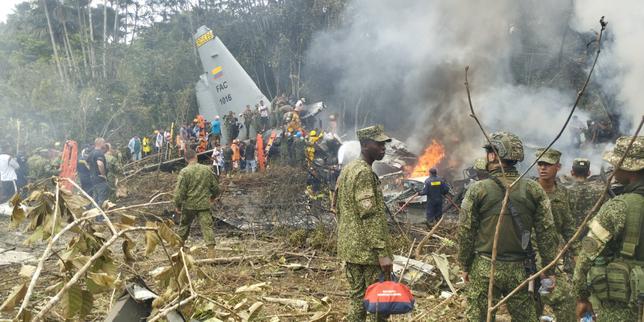
On a Tuesday that began like any other, a military transport plane—an Antonov-32—became part of that landscape. It didn’t just crash. It vanished into the green. Meanwhile, you can explore other stories here: The Calculated Silence Behind the June Strikes on Iran.
When we talk about aviation disasters, we often retreat into the safety of cold arithmetic. We count the seats. We measure the debris field. We cite the tail number. But sixty-six lives are not a statistic. They are sixty-six unfinished conversations, sixty-six empty chairs at dinner tables in Bogotá and Pasto, and sixty-six families who now wake up every morning to a silence that screams.
The Antonov is a workhorse, a rugged Soviet-era beast designed to land on dirt strips and handle the kind of abuse that would make a luxury jet crumble. It is loud. It vibrates in your teeth. On this flight, it carried soldiers, their families, and the mundane cargo of military life. There were men in uniform dreaming of their next leave, and perhaps a child looking out the window at the endless, undulating carpet of the Amazonian canopy. To explore the bigger picture, check out the recent report by BBC News.
Then, the world tilted.
The Anatomy of a Second
Disaster is rarely a single lightning bolt. It is a "Swiss Cheese" model of failure—a series of tiny, infinitesimal lapses that align perfectly to create a hole through which a plane falls. Maybe a sensor flickered. Maybe the wind shear off the Cordillera Central was five knots faster than the airframe could compensate for. Maybe, in that final minute, the pilot realized the fog wasn't a cloud, but a cliffside.
Imagine the cockpit in those final seconds. The smell of hydraulic fluid. The frantic, rhythmic chirping of the terrain avoidance warning—pull up, pull up—a mechanical voice trying to negotiate with gravity. There is a specific kind of terror in knowing the ground is there but being unable to see it. It is the vertigo of the soul.
When the aircraft struck the hillside near the border, the impact wasn't just physical. It sent a shockwave through the social fabric of a region already weary from decades of internal friction. In the borderlands, the military isn't just a force; it’s a lifeline. They carry the mail, the medicine, and the people. When a military plane goes down, the community feels a limb has been severed.
The Weight of the Green
Rescue in the jungle is a cruel paradox. You can be half a mile from a crash site and never see it. The canopy is a ceiling of emerald glass that swallows metal and fire alike. Search teams didn't just walk to the site; they hacked their way through it, fighting a forest that seemed determined to keep what it had taken.
The first responders spoke of a silence that was heavier than the heat. No birds sang near the scorched earth. There was only the hiss of cooling metal and the smell of jet fuel mixing with charred wood.
Why do we care about a crash in a remote corner of the world? Because the border between Colombia and Ecuador is a place where the human spirit is constantly tested by geography. To live there is to be in a permanent state of transit. The people on that flight weren't just passengers; they were the connective tissue of a nation.
Consider the "invisible stakes." This wasn't just a loss of personnel. It was a loss of trust in the very machines meant to protect. Every time an aging transport plane struggles to clear a ridge, every soldier on board eyes the rivets on the wing a little longer. They wonder if the maintenance logs were signed in haste. They wonder if the mountain is hungry today.
The Arithmetic of Grief
We search for someone to blame because the alternative—that the universe is occasionally indifferent to our survival—is too much to bear. We look at the flight data recorders. We analyze the metallurgy of the engines. We point fingers at the defense ministry or the weather patterns.
But for the woman waiting at the airfield in Tulcán, the "why" matters far less than the "where." She doesn't need a report on engine torque. She needs a miracle that isn't coming.
The tragedy of the sixty-six is a reminder that our mastery over the skies is a fragile illusion. We have built pressurized tubes that can traverse continents, yet we remain at the mercy of a sudden downdraft or a patch of ice. We are technical giants with hearts of glass.
The Colombian highlands do not apologize. They simply exist, beautiful and indifferent. The mist eventually returned to cover the scar on the hillside, and the jungle began its slow, relentless process of reclamation. Vines will eventually wind through the fuselage. Moss will soften the jagged edges of the wings.
In the capital, the flags flew at half-mast. Speeches were made. Promises of "never again" were etched into the public record. Yet, somewhere in a hangar, another crew is pre-flighting an old plane. Another group of families is boarding, buckling belts, and looking out the window as the engines cough to life.
They look at the clouds and see a path. The mountain looks at the plane and sees a guest.
The true cost of the crash isn't found in the wreckage or the headlines. It’s found in the way a young sub-lieutenant now grips the armrest during turbulence, his knuckles white, his eyes fixed on the horizon, waiting for the sky to breathe again.
A single boot, polished to a mirror shine, sat atop a pile of twisted aluminum, untouched by the fire. It looked as though someone had simply stepped out of it and walked into the trees.