Kids room organization is a trap. Most parents buy a giant, deep plastic bin, dump every single toy inside it, and call it a day. Then they wonder why their child dumps the entire bin upside down two minutes later just to find one tiny leg of a Lego figure.
It's exhausting. You spend twenty minutes picking up plastic dinos, only to step on a rogue block an hour later.
If your child's bedroom constantly looks like a toy store exploded, you don't need more space. You need a system that respects how children actually play. Most storage solutions are built for adults who like clean lines, not kids who operate on instant visual gratification.
Here's how to fix the mess for good with smart picks that work in the real world.
Why Standard Toy Bins Always Fail
Kids don't organize by logical categories. They don't care about your color-coded folders or labeled drawers. When toys get buried in deep containers, they basically cease to exist. Out of sight really is out of mind for a five-year-old.
When children can't see what they have, they dig. Deep bins force them to excavate, which means every item inside ends up scattered across the rug.
Real organization relies on low-profile, open, and shallow storage. If a kid can't see a toy in two seconds, they'll pull everything else out to find it.
Clear Stackable Bins for Tiny Collections
Small items are the absolute worst offender in any bedroom. Action figures, doll shoes, craft supplies, and racing cars vanish into carpet fibers or pile up in corners.
Ditch the opaque canvas cubes. Switch to clear, stackable plastic bins with drop-front lids or open tops.
What to Look For
Look for low-depth, transparent containers that sit at eye level on low shelving. The key is visibility. When kids can see the exact vehicle or figurine they want, they pull out that single box without disturbing the rest of the room.
- Open Front Access: Lids are a barrier to cleanup. If a child has to open a latch, lift a heavy lid, and place the lid somewhere else, they won't put the toy away. Open fronts eliminate that friction entirely.
- Modular Bases: Get options that lock into each other so a eager toddler can't knock over the entire stack.
Placement matters here. Keep these bins low to the floor. If your child has to stand on tiptoes or pull a heavy tub down from a tall shelf, you're asking for a mess on the carpet.
Rotating Display Bookshelves Instead of Standard Bookcases
Standard bookshelves are terrible for young kids. Books get crammed in spine-out, making it impossible for early readers to figure out what's what. They end up yanking five books off the shelf just to look at the covers.
Forward-facing display shelves—often called Montessori book displays—change how children interact with their room.
When books sit with their covers facing out, kids pick what they want directly. Cleanup becomes a simple matter of sliding the cover back into an open fabric sling or ledge.
If you're tight on floor space, wall-mounted acrylic or wood ledges work wonders. Install three rows starting six inches off the baseboard. It turns storybooks into functional wall art while keeping floor area completely open for play.
Rolling Carts for Craft Supplies and Mobile Play
Fixed storage keeps rooms tidy, but play isn't stationary. Kids move from the bed to the rug to the kitchen table. Heavy stationary boxes mean toys get abandoned wherever play stopped.
A three-tier metal rolling cart is easily one of the most useful pieces of furniture you can buy for a child's space.
You can roll the whole station right next to the activity, then wheel it back into a closet or corner when they're done.
Smart Ways to Layer a Cart
- Top Tier: Daily items like crayons, washable markers, and scrap paper in small open cups.
- Middle Tier: Coloring books, play dough tubs, and simple puzzle sets.
- Bottom Tier: Bulkier items like painting smocks, craft kits, or extra paper rolls.
Because the cart moves with them, the cleanup happens right where the activity ended. No carrying armfuls of pencils across the room.
Low Soft Bins for Plush Animals and Stuffed Toys
Stuffed animals are a unique nightmare. They don't stack. They're bulky. Kids usually have about forty more than they actually play with.
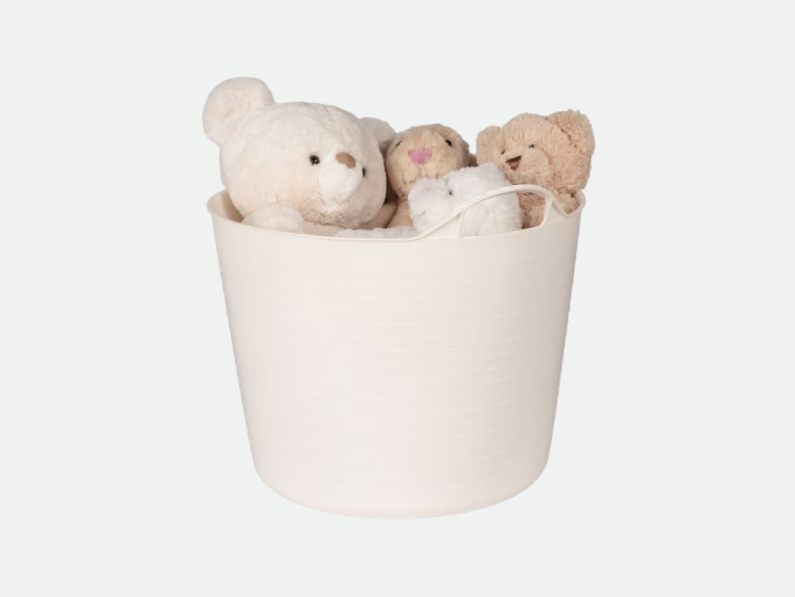
Never put stuffed animals in hard wood boxes or high shelves. Kids throw them, pile them, and dive into them. Soft, wide canvas hampers or woven cotton rope baskets are the only realistic pick here.
Choose a basket that is wide rather than deep. A wide basket lets kids see their favorite teddy without pulling out twenty other animals.
A great alternative is a storage bean bag chair. These are durable canvas bag covers designed to be stuffed with soft plushies. You slide the stuffed animals inside, zip it up, and suddenly you have a functional reading chair instead of a floor mountain of fluff. It's a double win.
Under-Bed Storage Trays with Wheels
The space under the bed is usually a dead zone full of dust bunnies and lost socks. Utilizing this space effectively reclaims massive amounts of square footage in smaller rooms.
Avoid flimsy fabric under-bed bags that collapse when you try to push them under the frame. They snag on carpet and get ripped apart fast.
Instead, invest in heavy-duty wooden or plastic rolling trays with sturdy casters.
Under-bed rolling trays are perfect for broad, flat play sets:
- Wooden train tracks and train cars
- Large building brick baseplates and sorted pieces
- Board games and flat puzzle boards
- Costumes and dress-up gear
Because these trays slide out smoothly, kids can pull them out, build their play scene directly inside or next to the tray, and slide the entire setup out of sight when finished.
Stopping the Influx Before Storage Overflows
You can buy the best storage items on the market, but if you have too much stuff for the room, no system will save you.
Implement a simple rotation system. Divide toys into three equal groups. Keep one group in the room using your smart storage picks. Box up the other two groups and store them in a closet, attic, or basement.
Every two or three months, swap them out.
Your child gets the excitement of "new" toys without you spending a single dollar, and the total volume of stuff cluttering the bedroom drops by two-thirds instantly.
Start small today. Pick just one trouble area in the room—usually the small action figures or the mountain of books. Swap out the deep tub for shallow, open-front bins or a forward-facing ledge, and watch how quickly cleanup stops being a daily battle.