The air changes first.
It does not arrive with a siren or an official text alert. It arrives as a shift in the temperature against the back of your neck, a sudden heaviness that tastes faintly of burned wire and dry pine. If you have spent enough summers near the ancient gravel tracks and dense heather expanses of southern England, you know that smell instantly. It is the smell of a slow-burning fuse.
Outside Brockenhurst, the afternoon sky wears a bruising, coppery hue. The sun is no longer a bright disc; it is a dull, bleeding coin hanging behind a thickening gray curtain.
For Arthur, who has worked the same local grazing lands for forty years, the heat is the enemy. It is not just the numbers climbing on the weather station dials, pushing toward the high twenties and thirties. It is what those numbers are doing to the ground beneath his boots. The topsoil is cracking. The gorse bushes, usually resilient and waxy, have turned into tinderboxes.
"You can hear it before you see it," Arthur often says, leaning against the weathered wooden gate of his paddock, watching the distant plumes climb above the tree line. "The dry brush just snaps under its own weight. All it takes is one spark from a discarded glass bottle, one hot exhaust pipe parked over a patch of dead grass, and the whole place goes up like paper."
The New Forest is deceptive. Tourists come for the wild ponies, the cathedral-like beech avenues, and the deep, silent pools. They see a postcard of timeless English serenity. They do not see a powder keg.
When a wildfire takes hold in conditions like these, standard firefighting logic is turned on its head. The wind shifts unpredictably across the open heaths, jumping firebreaks as if they were nothing more than chalk lines on a pavement. Ground crews from Hampshire and Isle of Wight Fire and Rescue Service face a relentless adversary. They are not just fighting flames; they are fighting physics. Every degree rise in temperature strips the remaining moisture from the vegetation, accelerating the rate of spread exponentially.
Consider what happens next: the smoke begins to settle in the valleys.
In the nearby village, shopkeepers pull their awnings down against the drifting ash. Windows are slammed shut. Parents pull children indoors not just because of the fire itself, but because the particulate-laden air turns every breath into a rasping chore.
Local authorities issue urgent warnings. Stay away. Do not fly drones. Do not light barbecues. Yet, every dry summer yields the same stubborn friction between public recreation and ecological survival.
The forest is old. It has survived monarchs, wars, and centuries of changing climate. But the speed of modern thermal extremes is different. It tests the limits of local emergency response. Water tankers have to be shuttled in from miles away, navigating narrow country lanes choked with rubbernecking traffic. Helicopters beat the smoky air overhead, dropping heavy water payloads onto invisible flare-ups hidden deep within dense pine plantations.
As the sun dips toward the horizon, the fire does not sleep. Instead, it glows.
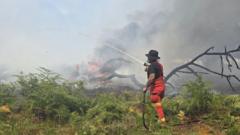
The ridge lines light up in jagged chains of orange and red. Silhouette figures of firefighters—exhausted, soot-streaked, moving with mechanical precision—stand against the blaze, beating back the advance with damp flappers and controlled counter-burns.
Tomorrow, the temperature will rise again. The newspapers will run columns of statistics: hectares burned, deployment numbers, wind speeds. But the real measure of the crisis is written in the silence of the woods, where the ancient moss is gone, and the air still holds the ghost of a warning.


