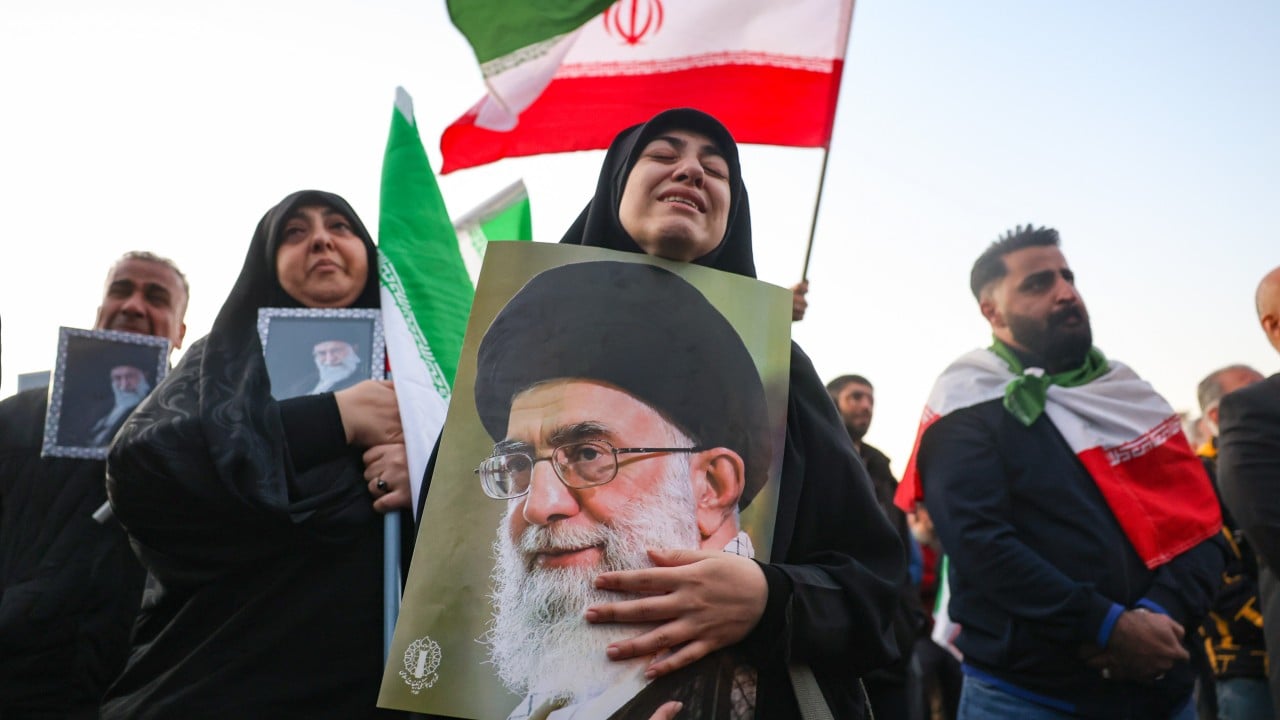
When the news of Ali Khamenei’s death finally broke, the world expected a script. We expected the state-mandated mourning, the grainy footage of weeping crowds in Tehran, and the somber, rehearsed eulogies from regional proxies. What we didn't expect—or perhaps what the regime’s intelligence apparatus failed to suppress—was a woman leaning against a brick wall, exhaling a plume of smoke, and coolly promising to dance on a dictator's grave.
The "Smoking Girl" video did more than go viral. It acted as a digital guillotine. In less than sixty seconds, it dismantled forty years of carefully curated revolutionary piety. This wasn't just a meme or a fleeting moment of internet snark. It was a cold, calculated manifestation of a generational shift that the Islamic Republic can no longer ignore or beat into submission. The woman in the video, whose identity remains shielded by the very digital networks the regime tries to fire-wall, has become the face of an Iran that is no longer afraid to die, because it has already decided the old guard is already dead.
The Anatomy of a Defiant Exhale
To understand why this specific image resonated, you have to look at the mechanics of Iranian repression. For decades, the regime has policed the public body—specifically the female body—as the primary battlefield of its ideology. A headscarf out of place is a political statement. A cigarette in the hand of a woman in public is an act of war against the "morality" codes of the 1979 revolution.
By combining these elements with the announcement of the Supreme Leader’s passing, the "Smoking Girl" stripped the office of its sanctity. She wasn't shouting slogans or waving a flag. She was performing an act of mundane, secular indifference. That indifference is more dangerous to a theocracy than a riot. You can tear-gas a riot; you cannot tear-gas a vibe of total, exhausted contempt.
The Failure of the Martyrdom Narrative
For years, the Iranian state has survived on the oxygen of martyrdom. From the Iran-Iraq War to the "defenders of the shrine" in Syria, the narrative has always been that sacrifice for the Leader is the highest calling. Khamenei’s death was supposed to be the ultimate moment of national grief—a unifying event that would bridge the gap between the disgruntled youth and the hardline establishment.
It failed.
The reaction on the streets of Tehran and in the diaspora wasn't one of loss, but of liberation. We are seeing the total rejection of the "Father of the Nation" archetype. When the "Smoking Girl" spoke about dancing on his grave, she was articulating a sentiment shared by a demographic that has seen its economy hollowed out by sanctions and mismanagement, its social life stifled by Basij patrols, and its future sold off to maintain a shadow empire in Lebanon and Yemen.
The Digital Underground vs the IRGC
The Islamic Revolutionary Guard Corps (IRGC) has spent billions on cyber-surveillance. They have the ability to throttle the internet, track GPS coordinates, and monitor encrypted messages. Yet, they couldn't stop this video.
This highlights a critical flaw in modern authoritarianism. You can control the hardware, but you cannot control the culture. The "Smoking Girl" used the regime's own infrastructure—the high-speed mobile networks intended for state commerce—to broadcast its obsolescence. The speed at which the video was mirrored across platforms like X, Telegram, and Instagram meant that by the time the censors flagged it, the image was already burned into the collective consciousness.
The Economic Engine of Dissent
While the headlines focus on the "smoking girl" as a symbol of social freedom, the underlying pressure is purely economic. Under Khamenei’s long tenure, the Iranian Rial became one of the least valuable currencies on earth. The "Generation Z" of Iran—the ones filming these defiant clips—have no memory of a stable economy. They have only known inflation, corruption, and the "Aghazadeh" (the children of the elite) flaunting their wealth in North Tehran while the rest of the country queues for eggs.
The girl in the video represents a class of Iranians who have nothing left to lose. When you have no prospect of buying a home, starting a career, or even traveling freely, the threat of a prison sentence loses its teeth. The regime’s primary lever of control—fear of the future—doesn't work when the future has already been stolen.
A Post-Khamenei Identity Crisis
The death of the Supreme Leader creates a vacuum that no amount of propaganda can fill. The Assembly of Experts can choose a successor, but they cannot choose a leader who commands genuine respect. Khamenei was the last link to the 1979 revolution. His successor will be seen as a mere administrator of a failing corporation.
The "Smoking Girl" is the first draft of the new Iranian identity. It is secular, it is unapologetic, and it is deeply cynical of any authority that claims divine mandate. This isn't the "Westernized" Iran of the Shah era, which was its own brand of top-down autocracy. This is a grassroots, bottom-up rejection of the very idea that a state should have a say in the private lives of its citizens.
The Global Ripple Effect
The West often misinterprets these moments. Policy makers in Washington and Brussels see a viral video and assume a revolution is forty-eight hours away. That is a mistake. The Iranian state is a multi-headed hydra with a massive vested interest in its own survival. The IRGC controls nearly 30% of the Iranian economy; they aren't going to walk away because of a TikTok trend.
However, the "Smoking Girl" represents a permanent shift in the cost of governance. To stay in power, the regime will now have to rely entirely on brute force. They have lost the "hearts and minds" battle so completely that they are no longer even trying to win it. They are now an occupying force in their own country.
The Symbolism of the Cigarette
In many Middle Eastern cultures, smoking has traditionally been a masculine preserve, or at least a discreet one for women. By making the cigarette a central prop in her video, the girl flipped the script on traditional gender roles and revolutionary expectations. It was a visual "middle finger" to the morality police who have spent decades arresting women for far less.
It is a reminder that the most potent symbols are often the simplest. You don't need a manifesto when you have a match and a camera phone. The smoke she blew toward the camera wasn't just tobacco; it was the ashes of the old guard’s credibility.
The Inevitability of the Dance
The promise to "dance on your grave" is a recurring theme in Iranian protest poetry. It’s a visceral, physical rejection of the funereal gloom that the Islamic Republic has imposed on the country for nearly half a century. The regime celebrates death and martyrdom; the "Smoking Girl" and her generation celebrate the end of that cycle.
As the succession battle plays out in the darkened rooms of Qom and Tehran, the real power is shifting to the streets. It is a slow, grinding process, but the momentum is undeniable. The "Smoking Girl" isn't an outlier. She is the baseline.
If the state cannot provide bread, it must provide a reason for the people to believe. When the people stop believing—and start filming their disbelief—the state becomes a ghost. The dancing hasn't started in the streets of Tehran yet, but the music has already begun to play. Keep your eyes on the girls with the cigarettes; they are the ones writing the new constitution in real-time.