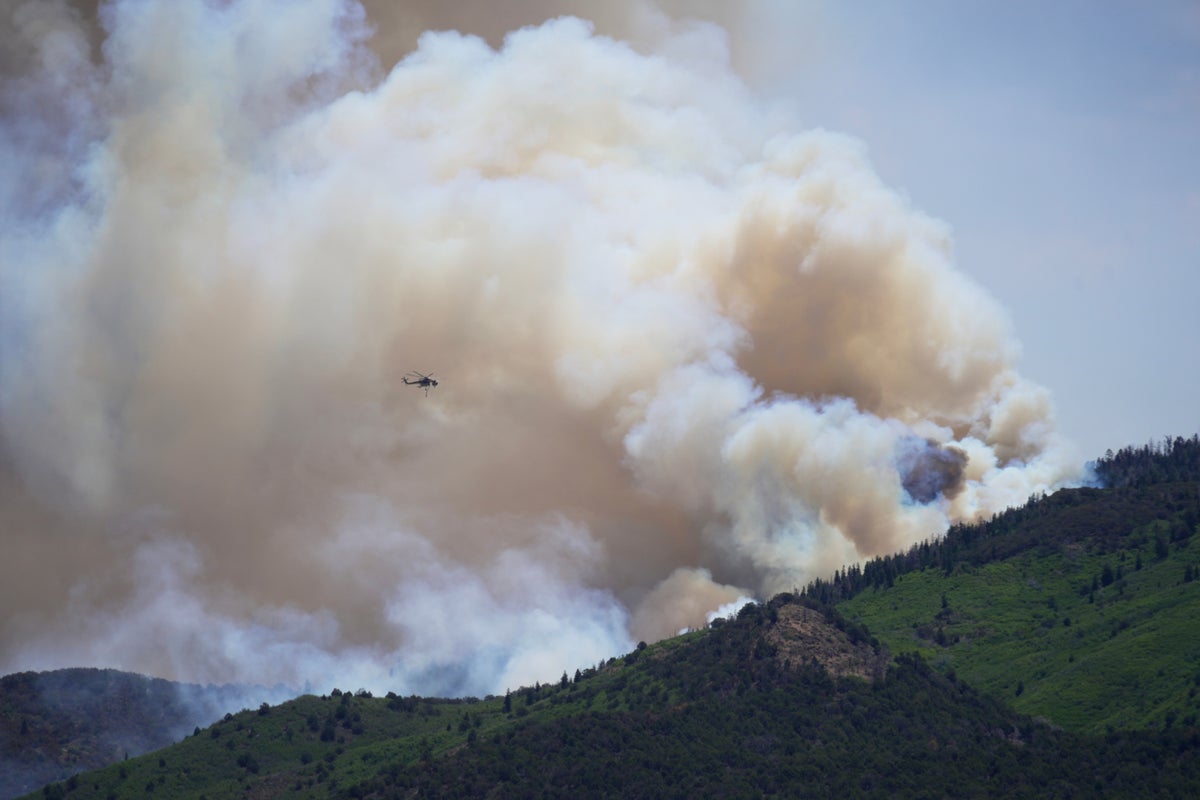
The air in the high country does not smell like pine anymore. It smells like cooked copper and old ash. When the wind shifts from the west, the grit gets behind your teeth, a constant reminder that something miles away is burning down to the bedrock.
Johnathan stood on the ridgeline just outside Glenwood Springs, watching the horizon turn the color of a bruised plum. He was forty-two, though his knees belonged to an older man, worn down by two decades of carrying seventy pounds of gear up slopes that would make a mountain goat think twice. He wasn’t a politician. He didn't read federal budget briefs or policy white papers over breakfast. He read the weather. He read the fuel moisture levels. He read the way the scrub oak curled when the heat index climbed too high.
But policy has a way of finding you, even when you are standing in a ditch with a yellow fire shirt and a pulaski axe.
The debate over how we manage America’s burning forests used to be a technical conversation, isolated to forestry schools and bureaucratic offices in Denver and Washington. Then the policy shifted. The focus turned sharply toward aggressive, immediate suppression, sidelining the slow, expensive work of forest mitigation, controlled burns, and long-term ecosystem management. The logic seemed simple on television: put the fire out, fast, and penalize agencies that didn't comply with aggressive directives.
The reality on the ground was entirely different. By treating every spark as an emergency to be choked out with expensive aerial retardant, the dry forests of Colorado were turned into a giant, unexploded powder keg.
Consider what happens next when a policy designed in an air-conditioned office meets a drought-strangled canyon.
The wind picked up on a Tuesday. It wasn't a historic gale, just a standard summer gust ripping through a draw filled with dead timber—the kind of timber that should have been cleared out five years prior under older, more flexible land-management programs. When the fire caught, it didn't crawl. It raced.
Johnathan’s crew was ordered into a chimney canyon to establish a defensive line. Under older guidelines, supervisors had the discretion to back off, to let a fire burn toward natural barriers if the risk to human life outweighed the value of a few acres of scrub brush. But the directive from the top had changed. Every acre was a battlefield. Retreat was framed as a failure of resolve.
They went in. Two of them never came out.
The loss of life in the high woods is rarely a sudden, cinematic explosion. It is a series of small, quiet failures that pile up until there is no room left to move. It is a chainsaw that stalls because the air is starved of oxygen. It is a radio crackle that gets cut off by a canyon wall. It is the realization that the escape route you were promised on paper is actually a sheer cliff of loose shale.
When federal policy dictates an uncompromising stance on wildfire management, it ignores the basic laws of thermodynamics. Forests need to burn. They have burned for millennia. When we prevent small, low-intensity blazes from clearing out the underbrush, we do not stop fires; we merely delay them, compounding the interest on an ecological debt that must eventually be paid in full.
The public sees the tankers dropping red slurry from the clouds. They see the dramatic press conferences. What they do not see are the seasonal workers making barely above minimum wage, sleeping in tents on baseball fields, breathing in particulate matter that will shorten their lives by a decade, all to defend a line on a map that shouldn't have been drawn in the first place.
But the real problem lies elsewhere, rooted in the way funding is tethered to political optics.
Suppression is dramatic. It looks good on the evening news. A fleet of planes dropping fire retardant looks like a government taking decisive action. On the other hand, spending three years thinning out dead wood and conducting smoky, unpopular prescribed burns looks like a nuisance. It clogs up traffic. It brings complaints about air quality from nearby resort towns. So the money follows the drama. Mitigation budgets are cannibalized to pay for the skyrocketing costs of emergency response, creating a vicious cycle where the danger grows exponentially every single season.
The numbers bear this out with terrifying clarity. Over the last decade, the window for safe firefighting has shrunk. The fire season in the American West is no longer a season at all; it is a permanent condition. Yet, the strategic approach from the federal level treated the crisis as a series of isolated, unexpected disasters rather than a systemic failure of land management. When policy focus shifted toward blaming local state officials and threatening to withhold federal disaster funds unless forests were "cleaned," it showed a fundamental misunderstanding of western geography. You cannot rake a million acres of wilderness.
The friction between local expertise and federal mandates creates a dangerous fog of war. Local fire chiefs, men and women who know every gulch and creek bed in their county, find themselves overruled by regional coordinators pushing a standardized, aggressive agenda. The trust that once held these operations together begins to fray.
Imagine standing in a briefing circle at 05:00. The grass is wet with dew, but the air is already warm. The incident commander is reading from a directive that feels entirely disconnected from the smoke rising just over the ridge. You know the terrain is a trap. Your gut tells you to pull back to the highway and set up a burnout operation there. But the mandate is to hold the ridge at all costs. You look at the younger kids on your crew—twenty-year-olds from out of state who are just trying to save enough money for college tuition—and you have to decide which law you are going to break: the federal directive or the unwritten code of survival.
Johnathan chose survival that day. He pulled his people back. His crew lived, but his career within the federal firefighting apparatus was effectively over. He was labeled as uncooperative, a man who lacked the aggressive spirit demanded by the new paradigm of forest defense.
The two men who died in the neighboring district three weeks later did not have the luxury of choice. They followed the plan. They stayed in the zone because the policy dictated that the fire had to be stopped before it crossed an arbitrary bureaucratic boundary line.
The true cost of these political decisions isn't measured in the millions of dollars spent on aircraft fuel or the value of the timber destroyed. It is measured in the quiet of a living room in a small Colorado mountain town, where a boots-and-uniform funeral service leaves a family wondering why their father died defending a patch of dirt that everyone knew was going to burn anyway.
The smoke eventually clears, leaving behind a gray, sterile landscape where nothing grows for years. The soil becomes hydrophobic, baked so hard by the extreme heat that it can no longer absorb water. When the autumn rains finally come, they bring mudslides that tear down the hillsides, choking the rivers and destroying the water supplies of the cities below. The disaster doesn't end when the red trucks drive away. It ripples outward for generations.
We are left with a system that treats the symptoms while actively worsening the disease. Until the policy shifts away from the theater of total suppression and toward the quiet, difficult work of restoration and respect for local conditions, the ridges of Colorado will continue to demand a price that no family should have to pay.
The wind is picking up again in the canyon. The sun is a pale, sickly orange disk behind the haze, and on the edge of town, another siren begins to wail.