On a Tuesday afternoon in Washington, a congressional staffer stands outside a coffee shop, staring at his phone with a look of quiet exhaustion. His colleague asks if he is catching the E Street Band at Nationals Park the following night. The staffer sighs, glances around as if checking for wiretaps, and shakes his head. "I can't like him anymore," he says quietly. "He's got TDS."
Just like that, a lifetime of loving Born to Run evaporates. It is not because the music changed. The chords are exactly where they were in 1975. The snare still cracks like a firecracker. But in America, music is no longer just music. It is a loyalty test.
We live in a moment where the cultural landscape has split clean down the middle, transforming the simple act of attending a concert into a political declaration. On one side of the ledger, you have the modern White House, an administration that views entertainment through the lens of Roman spectacle. The South Lawn is currently being retrofitted with a steel cage arena to host an upcoming Ultimate Fighting Championship event. For a milestone celebration like the nation’s upcoming 250th birthday, the official line-up leans heavily on nostalgia acts and legacy performers—artists like Vanilla Ice, Bret Michaels, and Flo Rida.
On the other side, forty thousand people stand in a driving rainstorm at a baseball stadium, watching a seventy-six-year-old man from New Jersey sweat through his shirt.
This is the great unwritten conflict in American culture. It is the clash between two entirely different ideas of what a gathering should be. One is built on compliance, transactional fame, and the muscle of the state. The other is built on a messy, roaring, fifty-year-old conversation between an artist and the public.
And if you want to understand why one event struggles for cultural legitimacy while the other fills stadiums in a downpour, you have to look at what happens when the house lights go down.
The Transaction of the Cage
To understand the current administration's relationship with culture, you have to understand the logic of the arena. When a government drafts the UFC to build a fighting cage on the executive mansion's lawn, or when it fills a birthday lineup with pop stars whose peak chart weeks occurred decades ago, it is operating on a philosophy of pure transaction.
Consider a hypothetical artist—let’s call him a mid-tier country singer trying to maintain a touring schedule. For this artist, an invitation to a state-sponsored event is not about artistic expression. It is a calculated business decision. The stakes are entirely financial and defensive. Saying yes means guaranteed exposure to a massive, fiercely loyal demographic. Saying no means risking a devastating digital boycott.
This is entertainment as a shield. The administration uses the celebrity to signal normalcy and strength. The celebrity uses the administration to secure a market share.
But this transaction leaves a hollow core. It requires the artist to check their perspective at the gate. You do not sing about the erosion of the voting rights act or the shuttered factories of the Rust Belt when you are performing on a stage sponsored by the people who run the government. You sing the hits. You keep it clean. You give the crowd exactly what they already believe.
The problem with transactional entertainment is that it treats the audience as consumers rather than human beings. It assumes that as long as the lights are bright enough and the bass is loud enough, nobody will notice that the songs don't actually hurt anymore.
The Ruckus in the Rain
Now change the scenery.
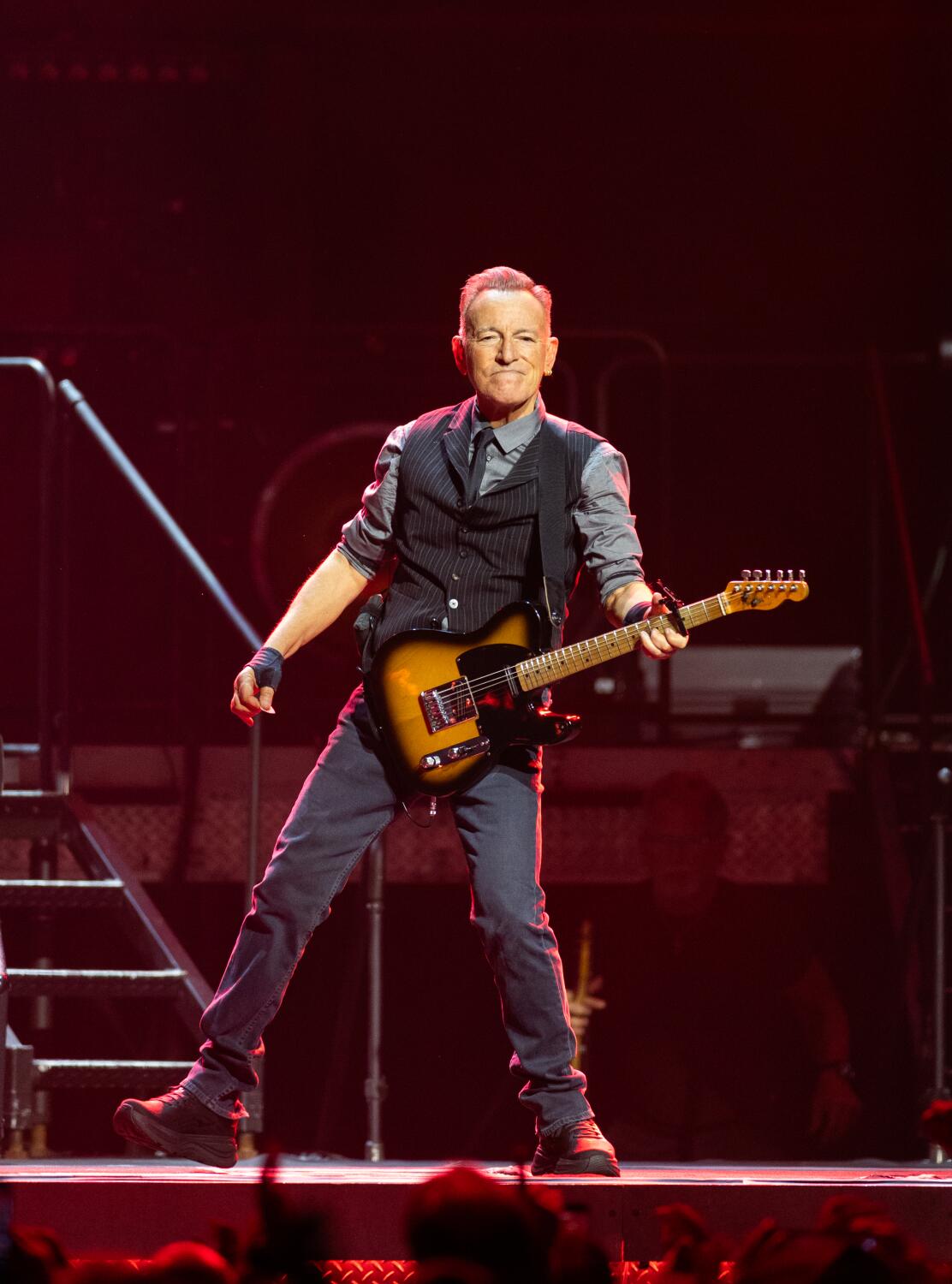
It is Wednesday night. The rain is coming down in sheets, turning the dirt around home plate into slick mud. Bruce Springsteen stands center stage, his voice a gravelly rasp that has survived five decades of road smoke. He is not here to offer an escape. He is here to stage a confrontation.
When Springsteen launches into "House of a Thousand Guitars," he isn't just playing a track from a recent album. He sits cross-legged on the stage, looking out at forty thousand soaked faces, and delivers a four-minute sermon. He talks about a "criminal clown" who has stolen the throne. He talks about the mental toll of being divided from our neighbors. He explicitly calls out the administration’s handling of foreign conflicts and the economic squeeze on working-class families.
The crowd does not walk away. They lean in.
"Say something. Do something. Sing something. Hell, that’s what I do."
— Bruce Springsteen, Backstage at Nationals Park
This is the exact opposite of the South Lawn spectacle. It is a performance that actively courts discomfort. Critics argue that this is nothing more than an aging rock star alienating half his potential audience to satisfy a personal obsession. Pundits on cable news networks frequently point to Springsteen’s high ticket prices, calling his populist rhetoric hypocritical when a seat in the lower bowl costs more than a week's worth of groceries for a working family.
Those criticisms are not entirely wrong. The economics of modern stadium tours are brutal, and the irony of a multimillionaire singing about the plight of the factory worker is an old, valid contradiction.
Yet, the people in the rain do not feel cheated. Why?
Because the relationship between Springsteen and his audience is not a transaction. It is a covenant. A covenant is built on shared history, vulnerability, and the understanding that the artist is allowed to be human, angry, and flawed. When Springsteen sings about a darkening American dream, he is tapping into a tradition that stretches back to Woody Guthrie—whose voice played over the stadium speakers as the wet crowd filed out into the D.C. night.
Why the Stage Wins
This is the hidden mechanics of cultural power. You can buy a lineup of platinum-selling artists. You can build a cage on the lawn of the most famous house in the world. But you cannot buy the collective goosebumps that happen when an arena full of strangers realizes they are all feeling the exact same grief at the exact same time.
Artists do not want to play the state-sponsored stage because art requires independence to survive. The moment a song requires a government stamp of approval, it ceases to be art and becomes a jingle.
The real tragedy of our current divide is not that a congressional staffer feels he has to give up his favorite records to keep his job. The tragedy is that we are forgetting how to listen to things that challenge us. We are trading the wild, unpredictable, sometimes maddening experience of a live human voice for the safe, curated comfort of a political rally disguised as a concert.
But on Wednesday night, as the water dripped off the brims of thousands of baseball caps and the E Street Band struck the final chord of "Land of Hope and Dreams," the stadium felt massive. It felt larger than the current administration. It felt larger than the headlines.
Donald Trump did not create the fractures in American life; he merely capitalized on them. But a stadium in the rain reminds us that those fractures are not the whole story. The music doesn't cure the divide. It doesn't fix the laws or stop the conflicts overseas.
It just proves that for three hours, forty thousand people can stand in the cold, look at the same ugly truths, and refuse to go home.