The dust in a classroom has a specific smell. It is a mixture of shaved graphite, old paper, and the chalky residue of lessons that refused to stick. In the Iranian highlands, where the air is thin and the winters bite with a dry, metallic cold, that smell is a constant. It is the scent of a future being built, one shaky sentence at a time.
On a Tuesday that should have been unremarkable, that scent was replaced by the odor of scorched concrete and something far more acrid.
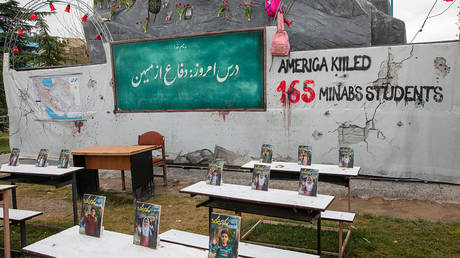
Grainy footage has recently surfaced, a shaky, digital eye peering into the immediate aftermath of a U.S. airstrike on a school in Iran. It isn’t the kind of high-definition cinematic war we are used to seeing in theaters. It is stuttering. Raw. The camera pans across a courtyard where, moments before, children likely played a frantic game of football with a deflated ball. Now, there is only a crater.
The crater is not just a hole in the earth. It is a puncture wound in the local psyche.
The Calculus of Collateral
When we talk about modern warfare, we use words that act as a buffer. We speak of "surgical precision." We discuss "kinetic operations." These are clean words. They suggest a world where a missile can distinguish between a threat and a textbook.
But the footage tells a different story.
Imagine a desk. Not a metaphorical desk, but a wooden one with a notched corner where a bored ten-year-old carved his initials with a smuggled pocketknife. In the video, that desk is splinters. It lies among the ruins of a wall that once held a map of the world.
The military reports will eventually come out. They will cite intelligence reports. They will mention "high-value targets" or "proximity to insurgent assets." They will use a logic that makes sense in a windowless room in Virginia, where the world is a series of thermal signatures and GPS coordinates.
But for the mother standing at the edge of the rubble, the logic is broken. She does not see a strategic necessity. She sees the backpack she saved for three months to buy, poking out from under a slab of grey stone.
The Invisible Stakes
To understand why this footage is vibrating through the international community like a struck tuning fork, you have to look past the fire. You have to look at the precedent.
Every time a school becomes a target, the "rules of engagement" undergo a silent, terrifying shift. If a school can be a target because of who might be standing next to it, then no space is sacred. The invisible stakes are not just the lives lost in that specific strike—though those losses are absolute and irreversible. The stake is the very concept of a "safe zone."
When the safety of a school is compromised, the education of an entire generation halts. Not because the building is gone, but because the trust is gone. Parents in the surrounding villages now have to make a choice that no human should ever face: Do I send my child to learn, or do I keep them home to live?
Knowledge becomes a gamble. Literacy becomes a risk.
The Anatomy of the Strike
The footage captures a specific kind of silence that follows a blast. It is a pressurized quiet, the sound of the air rushing back into a vacuum.
In the video, men move through the smoke with a frantic, aimless energy. They are digging with their bare hands. There is no heavy machinery here, just fingernails against rebar. The U.S. military has maintained that its operations are designed to minimize civilian casualties, employing sophisticated sensors and human-in-the-loop verification.
Yet, the camera does not lie about the geography. The school was not a hidden bunker. It was a known landmark.
Consider the "Targeting Cycle." It is a multi-step process involving identification, validation, and execution. Somewhere in that cycle, a human being looked at a screen, saw the heat signatures of small bodies, and decided the mission outweighed the risk. Or, perhaps more chillingly, the system failed to see them at all.
We are told that technology has made war more "humane." That is a lie we tell ourselves so we can sleep. Technology has only made war more distant. It has allowed the person pulling the trigger to be thousands of miles away from the smell of the graphite and the old paper.
The Weight of the Evidence
Disinformation is the shadow that follows every explosion. In the hours following the strike, various narratives began to compete for dominance. One side claimed the school was being used as a weapons depot. The other claimed it was a deliberate act of terror.
The footage serves as a stubborn anchor in this sea of claims. It doesn't offer a political opinion. It only shows the physical reality: the size of the crater, the type of debris, and the undeniable presence of school supplies.
Ballistics experts who have analyzed the clips suggest the use of a low-collateral-damage munition, intended to focus the blast inward. But "low-collateral" is a relative term. To the person inside the radius, there is no such thing as a "small" explosion.
The strike occurred during a period of heightened tensions, a time when the "fog of war" is at its thickest. In this fog, mistakes aren't just errors; they are tragedies that fuel the next decade of conflict. Every child who watched that school fall is a future adult who will never need to be told who their enemy is. They saw it from their bedroom window.
The Human Cost of Precision
Statistics are a way of hiding the truth in plain sight. We hear "twelve casualties" and our brains process it as a number, a data point to be compared to yesterday's data point.
Let's look at one.
In the footage, there is a man holding a pair of shoes. They are small, blue sneakers. He isn't crying; he is just staring at them. He turns them over in his hands as if he’s looking for a way to fix them. He is caught in the moment where the brain refuses to accept the new reality.
That man is the personification of the "unintended consequence." He is the variable that doesn't fit into the mission brief.
His grief is a political force. It is the fuel for the "hearts and minds" battle that the U.S. military claims it wants to win. But you cannot win a heart when you have broken the ribs that protect it. You cannot convince a population of your moral superiority when your calling card is a hole where their children used to learn.
The Echo in the Halls
The international community will hold meetings. There will be "deep concerns" expressed in polished rooms with mahogany tables. There will be calls for an "independent investigation," which will likely be blocked or delayed until the news cycle has moved on to a celebrity scandal or a fluctuating stock market.
But the echo of that strike will not fade. It will live in the way the local community looks at the sky every time they hear a distant hum. It will live in the empty chairs at dinner tables.
The footage is more than just a record of a military action. It is a mirror. It asks us what we are willing to accept in the name of security. It asks if we believe that some children are more "collateral" than others.
The bell at that school will not ring tomorrow morning. The teacher who spent the night before grading papers will not stand at the chalkboard. The boy who carved his initials into the desk will not finish his thought.
The world moves on, but the crater remains. It stays there as a reminder that in the cold calculus of modern war, the most expensive thing we lose isn't the missile. It’s the graphite, the paper, and the quiet promise of a Tuesday morning.