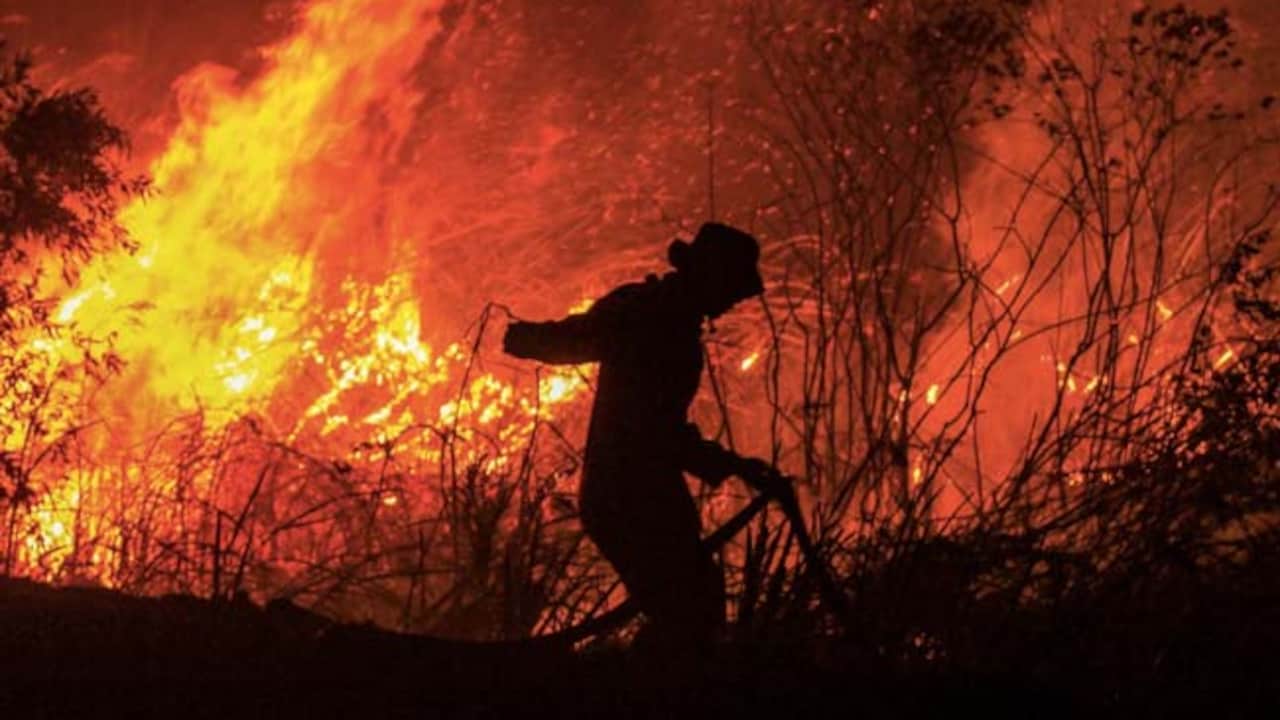
The air does not merely get hot before a megafire. It thickens. It turns into something heavy and metallic that sticks to the back of your throat, tasting faintly of copper and old pennies. For weeks across southern Europe, the thermometer had been stuck above 44 degrees Celsius. The earth was done sweating; the moisture had been baked out of the soil down to the bedrock.
Then came the wind. Meanwhile, you can read related stories here: Stop Fact Checking Political Memes You Are Feeding the Monster.
When the Tramontane blows across the Mediterranean basin during a heatwave, it doesn’t offer relief. It acts like a giant bellows pushed against an open furnace. It takes a single, stray spark—perhaps from a dragging trailer chain on a Greek highway, or a poorly discarded cigarette near a hiking trail in Portugal—and turns it into an apex predator.
Most news reports cover these disasters from thirty thousand feet. They give you the numbers. They tell you that thirty thousand people were evacuated from Rhodes, or that ten thousand hectares burned in the Gironde region of France. But statistics are anesthesia. They numb the mind to the terrifying reality of what it actually means to flee for your life while the horizon turns a bruised, apocalyptic purple. To explore the bigger picture, we recommend the detailed article by The Washington Post.
To understand the true scale of what is happening to the European continent, you have to look smaller. You have to stand on the cracked asphalt of a village square in the Peloponnese and watch an old man refuse to leave his olive grove because those trees were planted by his grandfather, and without them, he has no map of his own life.
The Anatomy of an Evacuation
Consider a hypothetical family, though their situation is mirrored in thousands of real homes from Spain to Croatia right now. Let’s call them the Rossis. They are vacationing in a small, pine-fringed coastal town in Italy. It is 2:00 AM. The power failed three hours ago because the electrical grid buckled under the weight of a million air conditioners running simultaneously across the province.
The first sign of danger is not visual. It is auditory.
A low, guttural roar begins to echo off the surrounding hills. It sounds uncannily like a freight train, but there are no tracks for fifty miles. This is the sound of a crown fire—a blaze that has leaped from the forest floor into the tops of the trees, moving faster than a human can run.
Then comes the smell of resin cooking. Pine trees contain high amounts of terpenes, volatile organic compounds that become explosive when heated to extreme temperatures. Before the flames even touch a tree, the intense heat vaporizes these oils, creating a cloud of flammable gas around the canopy. When the fire front arrives, the entire forest doesn't just burn. It detonates.
The Rossis have five minutes to grab their lives. What do you take when the air is raining gray ash and the sky is bright orange at midnight? You don't grab heirlooms. You grab passports, water bottles, and your children’s hands.
Outside, the panic is quiet. That is the part the television cameras miss. There is very little screaming. Instead, there is the frantic, rhythmic slamming of car doors, the crunch of gravel, and the desperate coughing of people trying to breathe through wet t-shirts tied around their faces. The local police are shouting orders in a language half the tourists don't understand, pointing toward the only road that hasn't yet been swallowed by the smoke.
Why the Old Rules No Longer Apply
For decades, Mediterranean ecosystems developed a symbiotic relationship with fire. Low-intensity blazes cleared out dead underbrush, allowing seeds to germinate and the forest to renew itself. It was a predictable cycle.
But the heatwaves of recent years have shattered that equilibrium. Climate scientists point to a phenomenon known as atmospheric thirst—or Vapor Pressure Deficit. When the air becomes extraordinarily hot and dry, it aggressively pulls moisture out of living vegetation. Plants become living tinder.
The fires we are seeing now are not traditional forest fires. They are pyro-convective storms. They create their own weather systems, generating massive clouds called pyrocumulonimbus. These clouds can produce dry lightning, striking the earth miles ahead of the main fire front and igniting entirely new blazes. They can spit out fire tornadoes that lift burning logs and hurl them across rivers and four-lane highways.
Firefighters trained in the old methods find themselves utterly helpless against these monsters. Water dropped from Canadair planes often evaporates before it even hits the flames, turned to steam by the ambient heat.
This forces a brutal shift in strategy. Emergency services are no longer trying to save the trees. They are barely trying to save the houses. The entire operation shifts to a single, desperate metric: civilian survival.
The Tourist Utopia on Fire
The economic engine of southern Europe is built on the promise of perpetual summer. Millions of travelers travel south every year from the gray, damp climates of northern Europe, seeking the sun-drenched coastlines of Greece, Spain, and Italy.
But the dream is curdling.
Travelers now find themselves trapped in a strange, high-stakes lottery. A holiday booked months in advance is now a gamble against meteorological extremes. The very landscape that draws people—the fragrant pine forests sloping down to turquoise waters—has become a geographic trap. Many of these coastal villages have only one road in and one road out. When that artery is cut off by fire, the sea becomes the only escape route.
During recent evacuations on the island of Rhodes, local fishermen and flotillas of private yachts had to beach themselves on the sand to pull terrified tourists off the shore. People waded through the surf carrying toddlers on their shoulders and luggage over their heads, fleeing a wall of smoke that made the beach look like the edge of the world.
This leaves a devastating economic wake. When the tourists flee, they leave behind local economies that rely on those brief summer months to survive the entire year. Taverna owners, hotel maids, and boat operators watch their livelihoods turn to ash in an afternoon. Even after the smoke clears and the black scars on the hillsides are the only things left, the visitors do not return. The trauma of the escape lingers far longer than the physical cleanup.
What We Lose When the Smoke Clears
When a forest burns at these unprecedented temperatures, the soil itself is sterilized. The intense heat destroys the organic matter and microbes necessary for life to regenerate. The ground becomes hydrophobic—it literally repels water.
When the autumn rains finally arrive on the scorched hillsides, the water cannot penetrate the soil. Instead, it rushes down the barren slopes, carrying millions of tons of topsoil, ash, and debris into the valleys below. The fire disaster of July transforms seamlessly into the mudslide disaster of October.
We are watching the permanent alteration of the European landscape. The iconic stone pines and holm oaks that have defined the Mediterranean basin since the time of the Roman Empire are struggling to return. In their place, invasive, fire-prone scrubland takes over, creating a landscape that is even more vulnerable to the next heatwave.
It is a feedback loop that feels impossible to break.
The silence that follows a megafire is perhaps the heaviest part of the entire experience. There are no birds. No insects. No wind rustling through leaves because there are no leaves left—only charred, skeletal fingers pointing toward a gray sky.
The immediate danger passes. The thousands of people who fled are housed in school gymnasiums and temporary shelters, counting themselves lucky to be alive. But as they sit on cot beds, breathing in the smell of smoke that has settled permanently into their clothes, a quiet realization sets in.
The world they left behind just a few hours ago is gone, and the summers they used to know are never coming back.