The morning air over the East River tasted like burnt coffee and wet asphalt. Down on First Avenue, the sirens didn't stop. They never stopped during Climate Week, but this year the frequency felt different, higher pitched, like an instrument tuned past its breaking point.
Inside a sterile conference room on the forty-second floor of a glass tower, men and women in dark wool suits were politely nodding. Outside, five blocks away, a nineteen-year-old college sophomore named Maya stood on the pavement with a cardboard sign that was already turning soggy from the September mist. She wasn't shouting. She was just watching the reflections of the skyscrapers warp across the hoods of idling town cars.
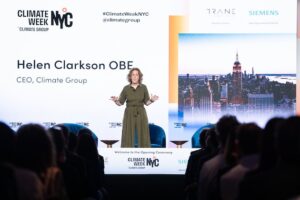
Every autumn, the ritual repeats. The world’s elite descend upon New York City with freshly ironed itineraries, translated briefing packets, and a vocabulary polished until it reflects nothing at all. They gather under the banner of Climate Week NYC to trade pledges, sign memorandums of understanding, and commit to action. The press releases go out in neat bullet points by noon. Millions of dollars mobilized. Gigatons of carbon targeted. Net-zero deadlines pushed thirty years into a comfortable future where none of the people in the room will have to face a microphone to explain why the math failed.
But math has a stubborn way of ignoring press releases.
To understand what happened when the gavel came down on the opening day of commitments, you have to look past the mahogany tables and into the soil. Let's trace a hypothetical hectare of drought-stressed farmland in the Central Valley, or a low-lying neighborhood in Dhaka where the monsoon drains back into the kitchen floors. In those places, world leaders' commitments are not abstract nouns. They are weather. They are survival.
The diplomats spoke of ambition. Maya spoke of water.
Consider the mechanics of a pledge. When a head of state steps up to a mahogany podium and promises a thirty percent reduction in emissions by the end of the decade, the room applauds. The tickers on financial news networks update. The stock prices of green-energy firms twitch upward by a fraction of a point. It feels like victory. It feels like gravity has been momentarily suspended by the sheer force of collective intention.
Yet, behind the polished veneer of diplomatic consensus lies a vast, quiet machinery of inertia. Bureaucracies do not pivot on a speech. They grind. They creak. They resist.
I remember standing in a municipal water office in the American Southwest a few years ago, watching a veteran civil engineer stare at a spreadsheet that predicted reservoir levels for the next ten years. He wasn't crying, and he wasn't angry. He just looked tired. He pointed to a line that crossed a red threshold—the point where the intake pipes would sit dry above the receding water line.
"They can sign all the papers they want in New York," he told me, wiping dust from his glasses with a thumb that had seen too many dry summers. "The pipe doesn't care about a press release. The pipe only cares about what’s coming down the mountain."
What is coming down the mountain right now is less than what we were promised, and more than we are prepared to handle.
The opening day of Climate Week NYC brought a familiar litany of high-level pledges. Nations large and small stepped forward to pledge billions for adaptation funds, accelerated phase-outs of coal, and tighter caps on industrial methane. The announcements were framed as turning points. Every year is a turning point. We have so many turning points now that the globe feels like it's spinning in circles rather than moving forward.
The human cost of this delay is rarely captured in the quarterly reports. It lives in the quiet panic of a homeowner whose insurance policy has just been cancelled because their zip code is suddenly classified as a wildfire vector. It lives in the lungs of a child in an urban heat island who spends August nights gasping through an asthma attack because the concrete refuse of the city radiates heat long after the sun goes down.
When leaders commit to action in conference rooms insulated from the weather, they are negotiating with a ledger that keeps its own balance.
We have built an entire global economy on the assumption that tomorrow will look fundamentally like yesterday, just slightly faster and with better screens. That assumption is dead. The physical systems that regulate our climate have crossed thresholds that human laws cannot negotiate with. You cannot filibuster a glacier. You cannot tax a heatwave into submission.
Yet, within that terrifying realization lies a strange, fierce clarity.
When Maya lowered her sign as the autumn dusk began to turn the Manhattan skyline into a jagged silhouette of charcoal and neon, she wasn't defeated. She was calculating. She knew, with the instinctive certainty of a generation that has grown up reading disaster reports alongside geometry textbooks, that salvation was not going to be delivered via keynote address.
The real work of this century isn't happening in the high-level plenaries where prime ministers shake hands for the cameras. It is happening in the municipal garages where mechanics are retrofitting diesel bus fleets into electric ones on tight city budgets. It is happening in the university labs where chemists are trying to make solar panels out of earth-abundant materials instead of toxic rare earths. It is happening in the courtrooms where children are suing their own governments for stealing their future.
The commitments made this week in New York matter, but only as a baseline. They are the scaffolding, not the cathedral.
As the motorcades rolled uptown and the conference center lights slowly blinked out for the night, the air grew colder. Down on the pavement, the cardboard sign had dried, stiffening into a shape that refused to fold. Maya picked it up, turned her collar against the wind, and started walking toward the subway.
The storm is already here. The only question left is how fast we learn to build in the rain.


