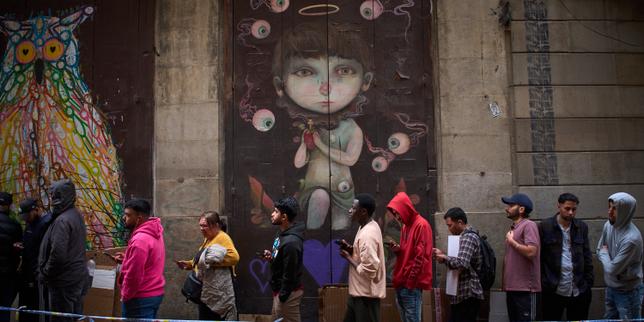
Spain has just upended the European migration debate by moving to grant legal status to roughly 500,000 undocumented residents. This is not a vague proposal or a campaign promise. It is a legislative reality driven by a cross-party alliance that effectively ignores the rising tide of hardline border rhetoric seen in France, Germany, and Italy. While neighboring nations scramble to tighten frontiers and expand deportation centers, Madrid is betting that the path to economic stability lies in bringing the "invisible" workforce into the light of the formal economy.
The mechanism is straightforward yet profound. By lowering the residency threshold and streamlining work permits, the Spanish government aims to absorb a massive population that is already living, working, and consuming within its borders, but doing so in the shadows. This move has sent shockwaves through the French political right, where leaders view the policy as a "pull factor" that will inevitably draw more migrants across the Mediterranean and toward the Pyrenees. However, the Spanish logic is rooted less in idealism and more in the cold mathematics of demographics and social security.
The Economic Engine Behind the Amnesty
Spain is facing a demographic winter. Its birth rate is among the lowest in the world, and its aging population is putting a relentless strain on the pension system. For the Spanish Treasury, 500,000 people working "off the books" represents a massive loss in potential tax revenue and social security contributions. These individuals are already picking fruit in Almeria, cleaning houses in Madrid, and delivering food in Barcelona. They are part of the daily life of the country, yet they contribute nothing to the state's coffers because the law forbids it.
By granting residency, the state transforms an informal laborer into a taxpayer. Internal estimates suggest this move could inject billions of euros into the public purse over the next decade. It is a pragmatic calculation. If you cannot stop people from entering, and you cannot afford to deport them all, the only logical remaining option is to integrate them into the fiscal structure of the nation. This is the "Spanish Model," and it stands in direct opposition to the "Fortress Europe" mentality currently gaining ground in Brussels.
Why the French Right is Alarmed
In Paris, the reaction has been one of predictable fury. For politicians like Bruno Retailleau or Jordan Bardella, Spain’s move is a breach of the collective European security wall. Under the Schengen Agreement, once a person obtains legal residency in Spain, the path to moving elsewhere in the European Union becomes significantly easier. France fears it will become the ultimate destination for those regularized in Spain, further straining its own social services and fueling its already volatile immigration debate.
The criticism centers on the idea of the "call air" effect—the notion that an amnesty acts as a magnet for future migration. The French right argues that Spain is unilateralizing a problem that affects the entire bloc. They see it as a betrayal of the recent EU Migration Pact, which focused on faster asylum processing and more efficient returns. To the critics, Spain is rewarding illegal entry, which they believe will only encourage human trafficking networks to ramp up their operations.
A Breakdown of the Legislative Alliance
What makes this development particularly fascinating is how the law came to be. This wasn't just a pet project of the far-left. The initiative began as a "People’s Legislative Initiative" (ILP), backed by over 700,000 signatures from Spanish citizens. It received support from a broad spectrum of society, including the Catholic Church and several business associations.
- The Church: Argues from a standpoint of human dignity and social cohesion.
- Business Groups: View the regularization as a way to solve chronic labor shortages in agriculture and hospitality.
- Political Centrists: Saw the move as a way to reduce the "black market" economy which undermines fair competition.
Even the conservative People’s Party (PP) initially allowed the bill to proceed in the lower house, though they have since pivoted toward a more critical stance as the European political climate has shifted rightward. This internal Spanish consensus highlights a deep rift between how Spain views its migrant population versus how France or Germany views theirs.
The Reality of the Shadow Economy
To understand why this is happening now, one must look at the sheer scale of the informal sector in Southern Europe. In many Spanish regions, the agricultural industry is entirely dependent on undocumented labor. These workers live in "chabolas"—shantytowns made of plastic and cardboard—hidden just behind the high-tech greenhouses that supply Europe with its winter vegetables.
The current system creates a permanent underclass. Because they lack papers, these workers have no recourse when they are underpaid or forced to work in dangerous conditions. This suppresses wages for everyone and creates a distorted market where "honest" employers who pay social security cannot compete with those who exploit illegal labor. Regularization is, in many ways, an attempt to level the playing field for Spanish businesses.
The Fiscal Math of Social Security
The Spanish pension system requires a certain ratio of active workers to retirees to remain solvent. Currently, that ratio is slipping toward dangerous levels.
- 1960s: Over four workers per retiree.
- Today: Roughly two workers per retiree.
- 2040 Forecast: Approaching a one-to-one ratio in several provinces.
Without a massive influx of young, tax-paying workers, the Spanish state will eventually be forced to either slash pensions or raise taxes to unbearable levels. The 500,000 people being regularized are overwhelmingly young and in their prime working years. They are the demographic "bailout" that the Spanish state desperately needs, regardless of the political optics.
Security Versus Integration
The counter-argument, often voiced by security experts in Northern Europe, is that regularization undermines the rule of law. If the path to legal status is simply staying in a country long enough without getting caught, then the visa system becomes irrelevant. There is a genuine concern that this policy creates a "wait it out" strategy for anyone wishing to enter Europe.
Furthermore, the administrative burden of processing 500,000 applications is immense. Spain’s bureaucracy is already notorious for delays. If the process is botched, it could lead to thousands of people stuck in a legal limbo—neither fully undocumented nor fully legal—which creates its own set of security and social risks. There is also the question of "secondary movements." Will these new residents stay in Spain, or will they head to the higher-wage markets of the north as soon as their papers allow?
The Human Factor and Social Cohesion
Beyond the spreadsheets and the border security reports, there is a fundamental question of what kind of society Spain wants to be. Proponents of the bill argue that having half a million people living in fear of the police is a recipe for social fragmentation. When a significant portion of the population cannot report a crime, visit a doctor without anxiety, or enroll their children in school with confidence, the entire community suffers.
Integration is not just about a work permit; it is about ending the "us versus them" dynamic that populist movements thrive on. By bringing these people into the system, the Spanish government is betting that they will become more invested in the success of the country. It is a high-stakes gamble on the power of inclusion over the power of exclusion.
The Role of Local Municipalities
Local mayors across Spain have been some of the loudest voices calling for this change. Unlike national politicians who debate theory in parliament, mayors have to deal with the practical realities of undocumented residents in their parks, schools, and health clinics. They see the reality of "irregularity" every day. For a local official, a regularized resident is a neighbor who can finally sign a rental contract, open a bank account, and pay local property taxes.
A Divergent Path for the Continent
The Spanish move marks a definitive break from the "Dublin System" mindset that has dominated European migration policy for decades. While the rest of the EU is looking for ways to build walls and offshore asylum processing to countries like Albania or Rwanda, Spain is looking inward at the people already there.
This isn't just about 500,000 people; it’s about the future of the European labor market. If Spain's economy sees a significant boost in the coming years due to this influx of legal labor and tax revenue, other aging nations might be forced to reconsider their own hardline stances. If, however, it leads to a surge in arrivals and social friction, it will provide the ultimate ammunition for those who want to end the dream of an open-border Europe once and for all.
The tension between Madrid and Paris is not just a diplomatic spat. It is a clash of two fundamentally different visions for the 21st century. One sees migration as a threat to be managed and minimized; the other sees it as a resource to be harvested and integrated. As the processing of these 500,000 applications begins, the rest of the world will be watching to see which vision holds weight.
The immediate task for the Spanish administration is to ensure the transition is orderly. This means more than just printing ID cards. It requires a massive coordination effort across labor departments, social services, and local police. The success of this experiment depends entirely on the state's ability to turn "undocumented" into "productive" overnight. If they fail, the political backlash will be felt far beyond the borders of Spain.