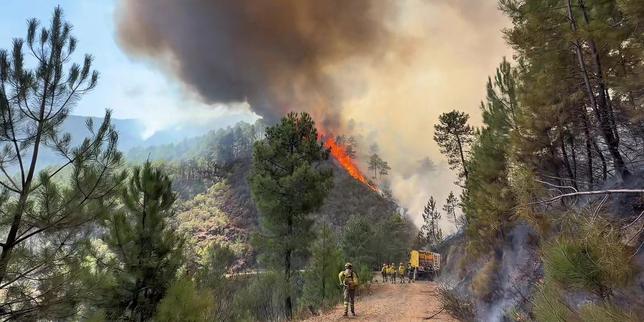
The smoke rising over the Sierra Oeste this August is not merely a seasonal nuisance. It is the visible signature of a structural failure in how Spain manages its wildlands. As a new fire tears through the terrain near Aldea del Fresno, forcing thousands of residents into mandatory confinement, the immediate crisis serves as a brutal reminder that the catastrophe of July—when tens of thousands were displaced across the region—was not a singular event. It was a prologue.
The current blaze, which has triggered Level 2 of the regional forest fire plan known as INFOMA, marks yet another escalation in a summer defined by relentless heat and administrative strain. With temperatures hovering near 36 degrees Celsius and erratic winds pushing the flames toward populated zones, the response has shifted from prevention to containment. Nine aerial firefighting units are currently battling the advance, yet the reality remains clear. The scorched earth in the outskirts of Madrid has become a recurring casualty of an environment that can no longer sustain the pressure of compounding heatwaves.
Observers often point toward climate shifts as the sole culprit for these disasters. This narrative is partially accurate but dangerously incomplete. The true vulnerability lies in the intersection of land abandonment and the accumulation of neglected biomass. Over the last several decades, rural flight has hollowed out the interior of the Iberian Peninsula. Fields that were once meticulously grazed or farmed—acting as natural firebreaks—have returned to dense, unmanaged scrub. When these overgrown areas meet the extreme drought conditions of 2026, they function as a wick.
Consider a hypothetical scenario where a single spark from an agricultural tool, or perhaps a discarded cigarette, ignites a patch of dry brush near a residential cluster. In a landscape characterized by fragmented ownership and thinning rural populations, there is no one on the ground to provide the initial suppression. By the time the blaze is detected, the fire has already gained the momentum required to crown and jump. This is not just a forest management issue. It is a logistical failure in a country where the capacity to fight fire is being outpaced by the frequency and ferocity of the ignitions.
The economic and social toll is staggering. Beyond the immediate destruction of homes and the disruption of local economies, the state is forced into a cycle of emergency spending. Funds that should be directed toward long-term landscape restoration and the promotion of sustainable silviculture are instead diverted to the temporary, high-cost deployment of aircraft and ground crews. It is a reactionary treadmill. Spain is spending fortunes to put out fires that are, in many cases, a predictable outcome of leaving millions of hectares in a state of suspended neglect.
Furthermore, the social fabric of these communities is fraying. When residents of towns like Aldea del Fresno are told to remain confined or are forced to evacuate for the second time in two months, the psychological cost is profound. Trust in the ability of authorities to maintain safety is eroding. The frequent activation of mobile alert systems, while effective for immediate warnings, underscores a persistent state of alarm that is fundamentally unsustainable.
A hard-hitting assessment of the situation reveals that the current reliance on rapid-response tactics is nearing its functional limit. Water-bombing aircraft are effective, but they are a defensive tool that ignores the offensive necessity of changing what is on the ground. True safety requires a complete pivot toward landscape-scale management. This implies returning livestock to the mountains, supporting rural farmers as stewards of the terrain, and aggressively reducing the fuel loads that have built up over years of neglect.
The political will to enact such systemic change is often absent. Policies involving land use are notoriously difficult to harmonize across provincial borders, and the economic incentives for farmers to operate in fire-prone zones remain weak. However, the alternative is a future where the perimeter of the capital remains under constant siege. The fires are not accidents of nature. They are the result of a deliberate, long-term withdrawal from the management of the land.
Until there is a reckoning with the state of the Spanish interior, the pattern will persist. We are witnessing the conversion of productive agricultural regions into high-risk disaster zones. The emergency alerts pinging on phones throughout the Sierra Oeste are not just warnings for the night; they are messages from an ecosystem that has reached its breaking point.
The fires will eventually be contained, as they have been before. But unless the strategy moves beyond the horizon of the next emergency, the flames will return with even greater intensity, and the charred perimeter will only continue to creep closer to the city itself. Fix the landscape, or prepare to watch it burn.