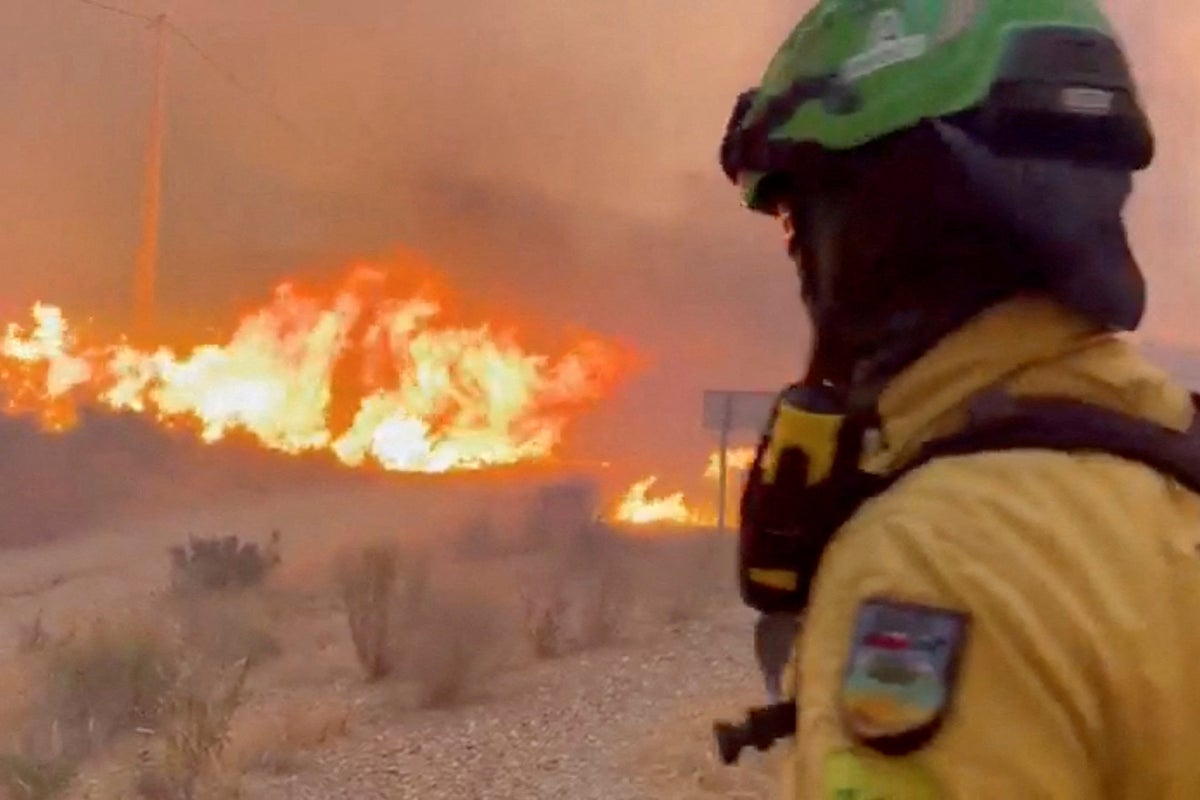
The British media loves a predictable summer script. Every July and August, newsrooms dust off the same template: terrifying flames, panicked holidaymakers fleeing resorts, and a frantic count of UK citizens caught in the crosshairs. The recent reporting on wildfires spreading near Spanish holiday destinations, featuring headlines tracking "Britons feared dead," follows this exact formula. It frames the Mediterranean fire season as an unprecedented, unpredictable monster suddenly invading paradise.
It is a comforting narrative for a reader. It sets up a clear villain—nature gone wild—and clear victims. Learn more on a related topic: this related article.
It is also entirely wrong.
The lazy consensus dominating the news cycle treats these fires as sudden acts of God or simple consequences of a shifting climate. By focusing purely on the immediate terror of evacuation and the tragic potential loss of life, mainstream reporting completely misses the structural rot behind these blazes. Having spent years analyzing European disaster management systems and working alongside forestry engineers in the Iberian Peninsula, I have seen how the real crisis is obscured by cheap sensationalism. Further reporting by TIME highlights comparable perspectives on the subject.
The reality is far more uncomfortable. The Mediterranean is not burning because of a sudden stroke of bad luck. It is burning because European land policy has spent half a century setting a trap, and the international tourism industry is happily walking right into it.
The Myth of Pristine Nature and the Fire Suppression Paradox
The first and most damaging misconception peddled by the press is that a burning forest is an unnatural tragedy. When the media shows footage of a pine forest exploding into flames near a Costa Brava resort, the subtext is always that a pristine ecosystem is being destroyed.
This ignores basic ecology. The Mediterranean basin is an ecosystem born from fire. Species like Aleppo pine (Pinus halepensis) and various scrub oaks (Quercus) are pyrophytic. They have evolved not just to survive fire, but to use it to reproduce. Some pine cones remain tightly closed for years, waiting for the intense heat of a blaze to melt their resin and release their seeds into the nutrient-rich ash. Fire is as essential to this environment as rain is to a rainforest.
For decades, however, Spain and its neighbors have operated under a flawed policy of total fire suppression. Every minor blaze is choked out immediately to protect villas and tourist infrastructure.
This creates what forestry experts call the fire suppression paradox. By aggressively extinguishing every small, natural fire, we prevent the ecosystem from clearing out dead wood, dry brush, and undergrowth. Over decades, this fuel load builds up to catastrophic levels. The forest floors of southern Europe are currently choked with fuel, transformed into literal powder kegs.
When a fire finally breaks out during a dry spell, it is no longer a manageable surface fire that clears brush. It becomes a mega-fire—a crown fire that leaps across treetops, generates its own weather systems, and defeats even the most advanced aerial firefighting fleets. We have traded frequent, low-intensity fires for infrequent, uncontrollable disasters. The media blames the weather; the real culprit is a legacy of broken ecological management.
The Toxic Intersection of Rural Abandonment and Tourist Real Estate
To understand why these fires are suddenly threatening British holidaymakers, you have to look at the economic shifts in the Spanish countryside over the last sixty years.
Historically, the Mediterranean hillsides surrounding popular holiday destinations were not dense, continuous forests. They were a patchwork of small agricultural plots, olive groves, vineyards, and pastures grazed by goats and sheep. This human activity created natural firebreaks. If a fire started in one valley, it starved of fuel when it hit a cleared pasture or a plowed field.
That economy is gone. The rise of mass tourism in the mid-20th century drew young populations away from rural agriculture and into coastal service jobs. Millions of hectares of farmland were abandoned.
Without human management, the brush crept back in. The hillsides reforested naturally, but without the diversity or spacing of an old-growth forest. Instead, they became continuous, dense stands of highly flammable scrub and young pines.
At the same time, the real estate market exploded. Developers built urbanizations, hotels, and holiday villas directly into these newly overgrown hillsides. This zone is known as the Wildland-Urban Interface (WUI).
[ Abandoned Farmland ] ──> [ Dense, Unmanaged Brush ] ──> [ Overgrown Hillsides ]
                                                                 │
                                                                 ▼
[ Mega-Fire Scenario ] <── [ Unstoppable Crown Fire ] <── [ WUI Development ]
This is where the tragedy occurs. British tourists are not being hunted down by wildfires in the wilderness; they are staying in properties built inside a continuous fuel source. The media calls it a natural disaster, but it is actually a failure of urban zoning. Local municipalities have permitted developers to build cul-de-sacs deep into highly flammable pine forests with only one narrow road for access and evacuation. It is a blueprint for disaster, executed for the sake of a sea view.
Dismantling the Ignorant Tourist Premise
When a crisis hits a holiday hotspot, the coverage heavily favors the perspective of the confused, victimized traveler. We hear stories of families being forced out of their hotel rooms at midnight, clutching their passports, complaining about the lack of communication from local authorities.
Let us look at this with brutal honesty. The relationship between mass tourism and local environmental reality is profoundly broken.
Millions of tourists arrive in southern Europe every summer with zero understanding of the territory they are visiting. They demand manicured green lawns in regions facing multi-year droughts. They use water indiscriminately, draining local aquifers and lowering the water table, which further stresses the surrounding vegetation and makes it even more susceptible to catching fire.
Worse, many of these fires are started by human negligence within the tourist zones themselves. Tossed cigarette butts, illegal barbecues on windy days, and sparks from vehicles or construction equipment are responsible for a massive percentage of ignitions.
The media frames the lack of English-language warnings as a failure of Spanish emergency services. In reality, local civil protection agencies are often stretched to their absolute limits trying to evacuate thousands of temporary residents who have chosen to stay in high-risk zones without ever checking fire risk maps, learning local emergency protocols, or paying attention to municipal bans on outdoor burning. Expecting a local government in a rural province to provide bespoke, real-time concierge crisis management for every non-Spanish speaker who ignored the local geography is absurd.
The Cost of the Wrong Solution
The current strategy for dealing with this crisis is throwing money at firefighting technology. Spain, France, and Greece boast some of the most sophisticated aerial firefighting units in the world. They deploy massive fleets of Canadair water bombers, heavy helicopters, and elite ground crews.
It looks spectacular on the evening news. A plane scooping water from the sea and dropping it onto a wall of flame makes for great television.
It is also an incredibly inefficient way to solve the problem. Relying on suppression is treating the symptoms of a terminal disease while ignoring the cause. Water bombers can only operate during daylight hours, cannot fly in extreme winds, and are completely ineffective against high-intensity crown fires where the heat evaporates the water before it even hits the fuel.
Every Euro spent on buying and maintaining a multimillion-dollar aircraft is a Euro taken away from preventive forestry management.
Instead of paying to fight fires when they are already threatening a resort, governments need to fund the mechanical thinning of forests, the creation of strategic firebreaks around urbanizations, and the reintroduction of prescribed burning during the winter months.
Prescribed burning is highly unpopular with the tourism industry. Resort owners do not want their guests seeing blackened hillsides or smelling smoke in February, fearing it hurts the brand. So, the political class kicks the can down the road, opting for the visual spectacle of summer firefighting rather than the gritty, unpopular work of winter prevention.
The Hard Reality for Future Travelers
The consensus suggests that with a bit more coordination and better luck, the Mediterranean holiday can continue unchanged. That is a delusion.
If you choose to rent a villa perched on a pine-covered hillside in southern Europe during the peak of summer, you are accepting a distinct, measurable risk. You are positioning yourself inside a fire-dependent ecosystem that has been mismanaged for fifty years, surrounded by dense fuel, in a zone with limited evacuation routes.
Blaming the local government when the inevitable happens is a deflection. Expecting the media to give you an accurate picture of why the land is burning is a waste of time. The fires will continue to get larger, faster, and more destructive until the focus shifts away from sensationalized casualty watches and toward the difficult work of altering how we zone, build, and manage European land.
Until that shift occurs, the annual spectacle of summer evacuations will remain a permanent fixture of the holiday season. The only question left is whether travelers will continue to act surprised when the match finally strikes.