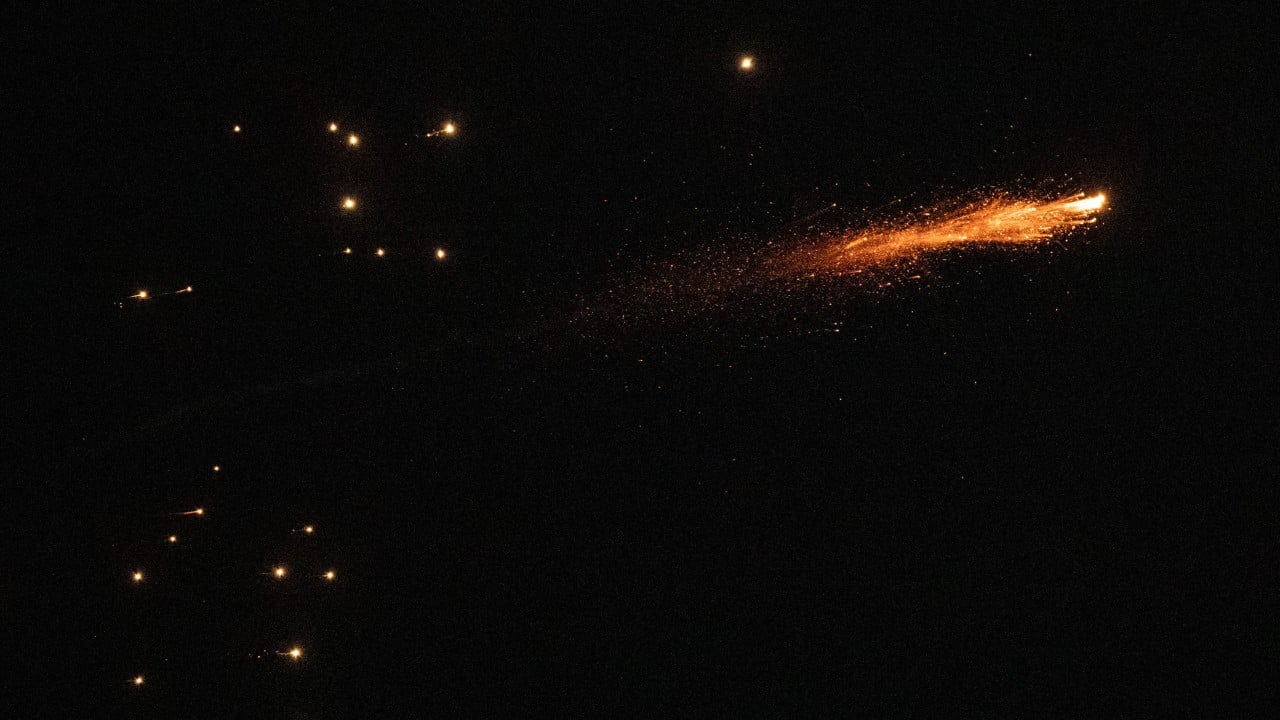
A young technician sits in the glowing blue dimness of a Combat Direction Center, deep within the steel bowels of a U.S. Navy destroyer. This is the Aegis Combat System—the most sophisticated shield ever forged by human hands. For decades, it has been the ultimate security blanket for the American carrier strike group. It is designed to track hundreds of threats at once. It is a masterpiece of logic, math, and radar.
The technician watches a blip. In the old world, that blip behaved according to the laws of traditional ballistics. It went up, it reached an apex, and it came down. You could calculate its arrival time to the millisecond. You could intercept it. Meanwhile, you can find other events here: The Cold Truth About Russias Crumbling Power Grid.
But in this hypothetical encounter off the coast of Iran, the math breaks. The blip isn't arching. It is screaming through the upper atmosphere at five times the speed of sound, and then, it turns. It maneuvers. It skips like a stone across a pond of air. The Aegis system, for all its billions of dollars in development, sees a ghost it wasn't built to catch.
This is the "hypersonic nightmare" China predicted. And it isn't just a white paper anymore. To see the bigger picture, we recommend the recent report by USA Today.
China has spent years whispering that the American military is a giant with a glass chin. Their argument is simple: the U.S. has invested everything in massive, expensive platforms—aircraft carriers that cost $13 billion—while the East has invested in the "bullets" that can sink them from a thousand miles away. If a conflict over the Persian Gulf or the Strait of Hormuz breaks out, we might find out that the era of the surface ship ended years ago, and we just haven't realized it yet.
The physics of a hypersonic missile are terrifyingly basic. When something travels at Mach 5 or faster, it generates a sheath of plasma around itself. This isn't just a firebal; it’s a shroud that absorbs radar waves. By the time the defense systems on a ship realize the missile has dropped below the horizon, the window to react has shrunk from minutes to seconds.
Seconds.
Think about the time it takes to draw a breath. In that span, a hypersonic missile has traveled over a mile. By the time an officer can shout a command, the impact has already occurred. This isn't a battle of wills or a test of bravery. It is a slaughter of the slow by the fast.
Beijing’s military analysts have been remarkably vocal about this vulnerability. They see the U.S. military’s reliance on the Carrier Strike Group as a historical vestige, much like the cavalry was to the early 20th-century general. They believe that in a high-intensity conflict with Iran—a nation that has increasingly closer defense ties with both Beijing and Moscow—the theoretical "invincibility" of the American fleet will vanish in a plume of seawater and twisted magnesium.
Consider the Iranian coastline. It is a jagged, mountainous fortress overlooking one of the most vital chokepoints on Earth. If Iran deploys hypersonic technology—either developed domestically or "borrowed" through tech-sharing agreements—the tactical map of the Middle East is rewritten overnight. Suddenly, the U.S. Fifth Fleet isn't a projection of power. It's a collection of targets.
The psychological toll on the sailors aboard those ships is the invisible cost of this technological shift. We ask 19-year-olds to maintain systems that they are told are the best in the world. But deep down, in the hushed corners of the mess hall, there is a growing awareness that the math has changed. You can be the best pilot or the sharpest radar operator in history, but you cannot beat physics. If a weapon moves faster than your computer can "think," you are already a memory.
The Pentagon isn't blind to this. There is a frantic, quiet scramble to catch up. Billions are being diverted into directed-energy weapons—lasers—because light is the only thing that moves fast enough to stop a hypersonic glide vehicle. But lasers require immense power, clear skies, and a level of cooling that current ship hulls struggle to provide. We are trying to bolt the future onto the past.
There is a deep, unsettling irony here. The United States pioneered hypersonic research in the 1960s. We walked away from it because it was too expensive and the engineering was too volatile. We chose the stability of the status quo. Meanwhile, our rivals looked at our carriers and saw a weakness. They saw a way to win a war without ever having to match our budget. They realized that you don't need to build a better sword if you can build a faster arrow.
The prediction from China isn't just about missiles. It’s about the collapse of an American military philosophy that has reigned since 1945. That philosophy says: "If we are big enough and loud enough, no one will dare to swing."
But the silence of a hypersonic weapon is its most lethal quality. It doesn't scream like a jet engine. It doesn't leave a massive, loitering signature on a long-range screen. It just arrives.
If a conflict with Iran becomes the proving ground for these weapons, the world will watch in real-time as the symbols of American hegemony are tested against the cold, hard reality of Mach 10. We may find that the nightmare isn't the war itself, but the realization that the shield we spent a century building is made of paper.
The technician in the CDC stares at the screen. The blip is gone. It didn't disappear because it was destroyed. It disappeared because it moved too fast for the refresh rate of the monitor. He waits for the system to recalibrate, for the logic to return, for the world to make sense again.
Outside, the ocean is flat and gray, hiding everything that is coming for us.