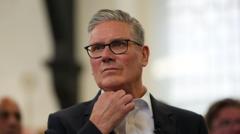
Keir Starmer wants you to believe that Britain is back at the heart of Europe. After a bruising set of local elections in May 2026, the Prime Minister has doubled down on a "reset" with the EU to save his flailing premiership. But look past the warm handshakes in Brussels and the reality is much colder. While Starmer talks about rebuilding relationships, he’s still clinging to the same Brexit red lines—no single market, no customs union, and no free movement—that make "being at the heart" of anything a mathematical impossibility.
The European Union isn't a social club where you get a better seat just by being polite. It’s a rigid legal bloc. For the officials in Brussels, Starmer’s rhetoric feels like "Brexit-lite" with a smile. They’ve heard the "best of both worlds" pitch before. This time, the stakes are higher because the UK is trying to navigate a world of shifting US alliances and a rising China, all while keeping its own tech and farming sectors from revolting.
The problem with being a little bit European
Starmer’s current strategy is basically a series of "mini-deals." He’s pushing for a security pact, an SPS (sanitary and phytosanitary) agreement for food, and a youth mobility scheme. On paper, these sound like common sense. In practice, they're proving to be a nightmare to negotiate.
Take the food deal. To get rid of those £200 Export Health Certificates that are killing small British exporters, the UK has to agree to follow EU food standards. This isn't just about the shape of bananas. It’s about chemicals like glyphosate. The EU is moving toward banning or strictly limiting this weedkiller, while many UK farmers rely on it to keep costs down. If Starmer signs the deal, he risks a civil war with the farming lobby. If he doesn't, the border friction stays. You can't have your cake and eat it, even if that cake is now subject to strict EU labeling laws.
The AI trap and the regulatory divide
There’s a massive elephant in the room that most people aren't talking about: Artificial Intelligence. Britain currently has a "light-touch" approach to AI that has attracted billions in investment from Silicon Valley. The EU, meanwhile, has the AI Act—a massive, safety-first rulebook that Silicon Valley hates.
As Starmer tries to align more closely with Europe for the sake of trade, he’s running straight into a wall built by his own Department for Science, Innovation and Technology. Ministers there are terrified that "closer ties" means "stricter rules." If the UK adopts the EU’s regulatory culture to appease Brussels, it might lose the very edge that makes it attractive to companies like OpenAI or Microsoft. It's a zero-sum game. You either align with the EU’s safety-first model or you stick with the US-style innovation model. Trying to do both usually results in satisfying no one.
Youth mobility or a backdoor to free movement
The biggest bone of contention right now is the Youth Experience Scheme. Starmer wants young Brits to be able to work and study in Europe again, and the EU is happy to oblige—provided the UK plays by their rules. Brussels wants a scheme that looks a lot like the old free movement, just with an age cap.
Starmer is terrified of the "free movement" label. With Reform UK surging in the polls and accusing Labour of "reversing Brexit," any deal that looks like a soft border is political suicide. But the EU has no reason to offer a "UK-only" special deal. They have 27 members to think about. Why should they give Starmer a win that helps his polling if it undermines the integrity of their single market?
The security pact is the only real win
If there's one area where the reset is actually working, it's defense. With the Russian threat looming and uncertainty over US commitment to NATO, both sides are desperate for a formal security partnership. This is the one place where Britain’s "soft power" and military intelligence actually give it leverage.
- Joint procurement of defense tech via the EU’s SAFE programme.
- Formalized intelligence sharing on cross-border crime and migration.
- Coordinated sanctions against hostile states.
But even here, money is the sticking point. The EU wants a financial contribution for the UK to access its defense funds. Starmer, facing a cost-of-living crisis at home, is hesitant to write a big check to Brussels.
What happens if the reset fails
Honestly, Starmer is running out of time. His "doubters" within the Labour party—including big hitters like Angela Rayner—are already pointing out that incremental changes aren't fixing the economy. The GDP boost from these mini-deals is estimated to be fractions of a percent. That's not enough to fund the NHS or fix the housing crisis.
If you’re a business owner or a traveler, don't expect the "good old days" to return anytime soon. The border will remain a headache. The regulations will continue to diverge. The "heart of Europe" is currently a very lonely place for a Prime Minister who is trying to stay in the room without paying the entry fee.
Stop waiting for a "grand bargain" that fixes everything. It isn't coming. Instead, watch the specific sector deals. If the SPS agreement goes through by the end of 2026, it will be a sign that Starmer has finally chosen a side: alignment over sovereignty. Until then, we’re just stuck in the departure lounge.
Starmer's struggle with EU relations
This video provides a direct look at Prime Minister Starmer's recent efforts to bridge the gap with Europe amidst domestic political pressure.