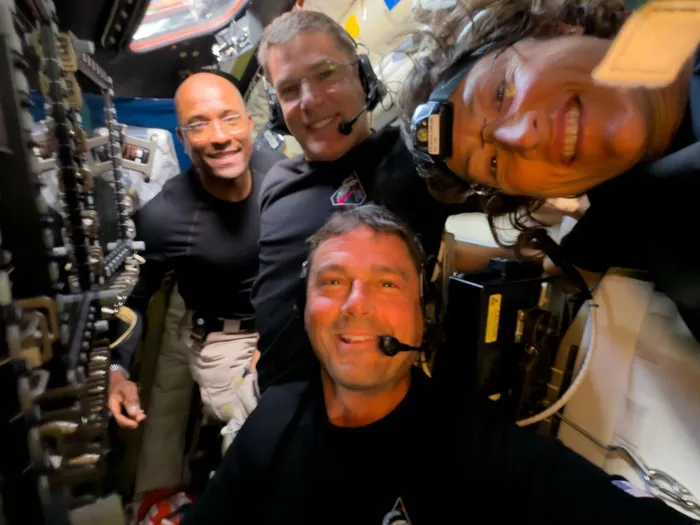
The air inside the hangar at Kennedy Space Center doesn't smell like the future. It smells like ozone, floor wax, and the nervous sweat of a thousand engineers who haven't slept since Tuesday. It is a sterile, echoing cavern where the silence is heavy with the weight of four human lives. When Donald Trump stood before the Artemis II crew recently, he wasn't just looking at pilots or scientists. He was looking at the first group of people in over half a century who will see the far side of the moon with their own eyes.
He called the mission spectacular. He spoke of Mars as if it were a neighboring town just waiting for a highway to be paved. But behind the political theater and the flashing cameras, there is a visceral, terrifying reality to what is happening on the Florida coast. We are building a bridge out of math and fire.
Reid Wiseman, Victor Glover, Christina Koch, and Jeremy Hansen. These are the names of the bridge-builders. They aren't superheroes from a comic book; they are people who have families, favorite coffee mugs, and a shared understanding that they are about to sit on top of a controlled explosion.
The Orion spacecraft is a marvel of engineering, a pressurized shell designed to keep the vacuum of space at bay. Think of it as a tiny island of Earthly atmosphere tossed into a freezing, radiation-soaked ocean. Every bolt has been checked. Every line of code has been scrubbed. Yet, when the engines ignite, all that logic disappears into a roar that shakes the very marrow of your bones.
The mission is simple in its geometry but staggering in its stakes. Artemis II will not land. It will perform a lunar flyby, a gravitational slingshot that will hurl these four humans around the moon and back toward home. It is a dress rehearsal for the return of boots on the ground, a necessary step before we can even dream of the red dust of Mars.
There is a specific kind of silence that happens during a launch. It’s the moment after the countdown hits zero, but before the sound waves actually reach the spectators. For a heartbeat, you see the fire, but the world is mute. In that gap, you realize how fragile we are. We are biological machines made of water and carbon, trying to survive in a place that wants to boil our blood.
We have grown used to the "dry" nature of space news. We see the infographics and the orbital trajectories and our eyes glaze over. We forget that inside those metal tubes, people are breathing recycled air and watching the Earth shrink until it can be covered by a thumb held at arm's length. That perspective shift isn't just a technical achievement. It’s a psychological haunting.
The previous administration's focus on Mars isn't just about flags and footprints. It’s about the survival of the species. If Earth is a single point of failure, then Mars is the backup drive. But the distance to Mars is a nightmare of logistics. While the moon is a three-day trip, Mars is a multi-month journey through the deep black. To get there, we have to master the moon first. Artemis II is the laboratory where we prove we still have the stomach for the long dark.
Consider the heat shield. On the way back, the Orion capsule will hit the atmosphere at 25,000 miles per hour. The friction turns the air into plasma, a searing shroud of fire that reaches 5,000 degrees Fahrenheit. The only thing standing between the crew and incineration is a layer of sacrificial material that chars and erodes by design. It is a shield made of faith and chemistry.
When the President spoke of the "spectacular" nature of the trip, he was touching on the American obsession with the frontier. We are a restless people. We have always looked at the horizon and wondered what was on the other side. But the frontier has changed. It’s no longer about mountains or oceans. It’s about the physics of escape velocity.
The critics often ask why we spend billions on the stars when the dirt beneath our feet is so troubled. They point to the poverty, the heat, and the friction of our daily lives. It’s a fair question. Why look up when there is so much to fix down here?
The answer isn't found in a budget report. It’s found in the eyes of a child watching a rocket rise. It’s found in the way a global audience holds its breath during a docking maneuver. We go because the act of reaching for the impossible forces us to be better than we are. It demands a level of precision, cooperation, and courage that we rarely see in our political or social lives. In the vacuum of space, there is no room for tribalism. There is only the mission.
Mars is the ultimate prize, a rust-colored world that once had rivers and perhaps even life. It is a mirror of what Earth could become, or what it once was. But the path to Mars is littered with the ghosts of failed missions and the cold reality of radiation. To get a human to the Red Planet, we have to reinvent everything: how we eat, how we sleep, and how we keep our minds intact during the long isolation.
Artemis II is the psychological bridge. It proves that we can still leave the safety of Low Earth Orbit. For decades, we stayed close to home, orbiting the planet like a child playing in a backyard. Now, we are opening the gate. We are heading into the woods.
The crew knows this. When you listen to Victor Glover talk about the mission, he doesn't focus on the glory. He focuses on the responsibility. He knows that his face will be the one children see in history books fifty years from now. He knows that the success of this mission determines whether the Mars program lives or dies in a committee room in Washington.
The stakes are invisible because they are long-term. If we fail now, we might not try again for another century. We might become a species that stopped looking up, a civilization that decided the risks were too high and the rewards too distant. That is a quiet, slow kind of death.
But the steel is being bent. The fuel is being refined. The flight controllers are practicing their cadences, learning to stay calm when the telemetry starts to flicker. This isn't just a political talking point or a photo op in a hangar. It is the beginning of the second age of discovery.
The moon is no longer a destination; it is a shipyard. It is the place where we will learn to mine ice, build habitats, and launch the true deep-space vessels of the future. By eyeing Mars next, we are acknowledging that the moon is just the first step on a very long stairs.
The next time you see a headline about Artemis, don't look at the numbers. Look at the people. Think about the four individuals who will watch the Earth rise over the lunar horizon, a blue marble hanging in the absolute nothingness. They will feel the fragility of our world more deeply than any poet or philosopher ever could.
They are our scouts. They are going ahead to make sure the way is clear. And when they return, splashing down in the Pacific under a canopy of parachutes, they will bring back more than just data. They will bring back the proof that we are still capable of doing things that scare us.
The fire is ready. The math is done. The only thing left is the courage to let go of the ground.