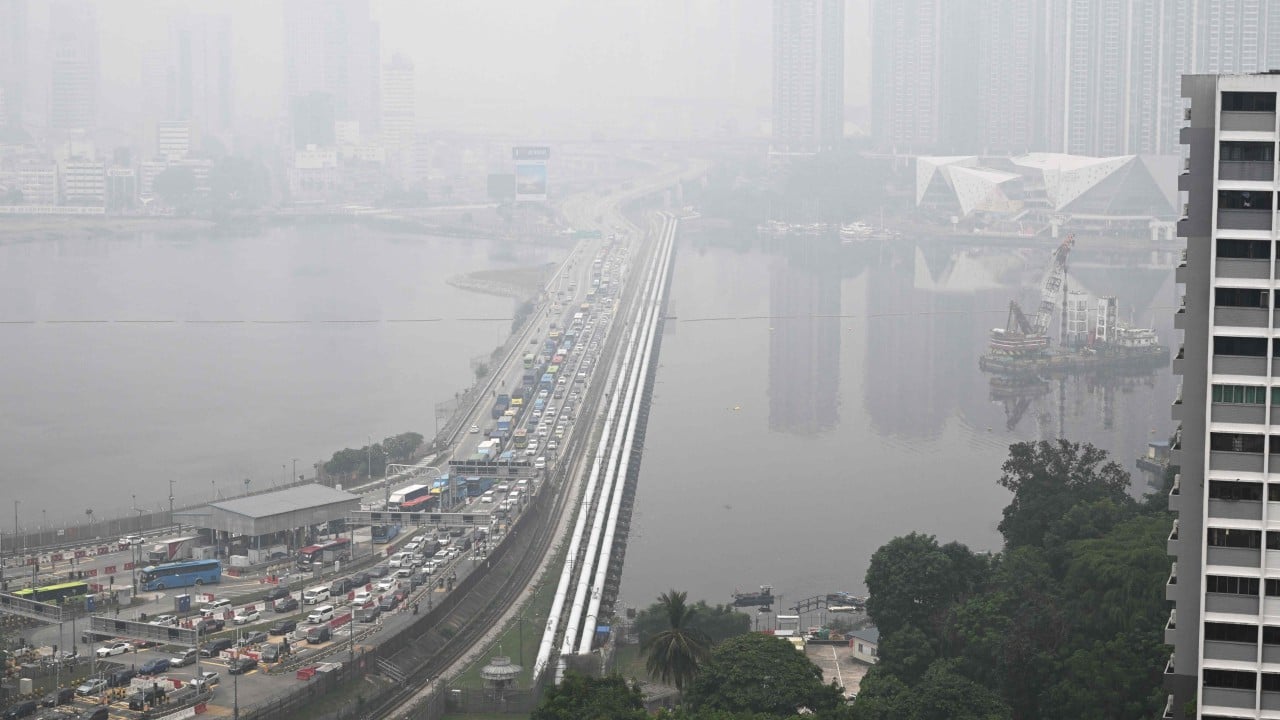
Every time the Johor-Singapore Causeway turns into a parking lot, the finger-pointing starts before the tailpipe smoke even clears.
Rumors fly on Telegram groups about a mysterious blackout at Woodlands Checkpoint. Hours later, Singapore’s Immigration & Checkpoints Authority (ICA) steps up with an official statement denying any power outage, instead blaming scheduled maintenance, heavy traffic, or a few broken-down lorries. The mainstream press dutifully transcribes the press release, slaps a headline on it, and moves on.
Both sides are dead wrong.
The rumor mill is chasing ghosts, and the official press releases are selling you a comforting fiction. A blackout didn't cause the gridlock, and neither did a couple of overheated engines or routine lane closures. Those are merely the sparks. You are staring at a structural, economic, and architectural inevitability that no amount of backup generators or tow trucks can ever fix.
If you want to understand why over 300,000 people routinely lose hours of their lives on a 1.056-kilometer strip of asphalt, stop reading government bulletins and look at basic queueing theory.
The Lie of the Single Point of Failure
In logistics and infrastructure planning, we have a bad habit of looking for dramatic, singular villains. When a system collapses, human psychology demands a broken switch, a blown transformer, or a stalled semi-truck. It makes us feel safe. If the problem is a power cut, the solution is an uninterruptible power supply. If the problem is a broken-down vehicle, the solution is faster recovery teams.
I have spent fifteen years auditing cross-border supply chains and high-density transit corridors across Southeast Asia. I have watched governments burn hundreds of millions of dollars upgrading server racks and paving extra feeder lanes, only to watch the exact same bottlenecks reform within forty-eight hours.
Why? Because when a corridor operates at 99% capacity during peak hours, you do not have a transit system. You have a standing wave waiting to break.
In traffic engineering, this is known as capacity drop—a phenomenon documented extensively by researchers like Carlos Daganzo and the late Gordon Newell. When a highway approaches maximum flow, the distance between vehicles shrinks to the point where a single driver tapping their brakes creates a shockwave that travels backward at roughly 15 to 20 kilometers per hour.
You do not need a blackout to trigger a four-hour jam at Woodlands or Tuas. You just need one heavy goods vehicle shifting gears too slowly on an incline, or three passport scanners experiencing a three-second network latency spike at 6:15 AM. Once the flow breaks down, the throughput capacity of the checkpoint actually drops by 10% to 15%. Even after the obstruction is cleared, the queue cannot dissipate until demand drops below that newly crippled capacity.
Blaming maintenance or breakdowns for the Causeway jam is like blaming a single snowflake for an avalanche. The snowpack was already unstable. The authorities know this, which is why they point to localized, temporary operational hiccups rather than admitting the uncomfortable truth: the physical geometry of the border cannot handle the economic reality of the region.
The Economic Arbitrage Trap
Let’s look at the actual engine driving this chaos. It isn't poor infrastructure management; it is ruthless, undeniable currency arbitrage.
With the Singapore Dollar trading at historic highs against the Malaysian Ringgit—hovering comfortably above the 3.4 to 3.5 mark in recent years—the economic gravity pulling Malaysian workers south is overwhelming. A daily wage in Singapore, even in entry-level retail, construction, or logistics, translates into upper-middle-class purchasing power across the Strait of Johor. Conversely, Singaporeans flood north every weekend because their dollar buys three times the food, fuel, and retail therapy in Johor Bahru.
This creates a synchronous, bidirectional tidal wave. Unlike a normal commuter city where traffic flows into the core in the morning and out in the evening, the Causeway gets hammered in both directions simultaneously.
- The Morning Crush: Tens of thousands of Malaysian motorcyclists and bus commuters surge south between 4:30 AM and 8:00 AM, colliding with commercial freight trucks trying to beat peak-hour surcharges.
- The Evening Reverse: Those exact same workers head north while Singaporean day-trippers return south, creating a gridlock pinch point on both sides of the Johor Strait.
- The Weekend Inversion: Friday nights and Sunday evenings turn the border into a pressure cooker of leisure travelers, completely overwhelming immigration halls designed for predictable weekday flows.
When mainstream outlets publish articles debating whether ICA’s servers went down or whether a lane was closed for resurfacing, they completely miss the macroeconomic forest for the operational trees. You cannot optimize your way out of a 3.5x currency differential using QR codes and automated e-gates. Every time the authorities shave ten seconds off immigration clearance, latent demand immediately fills the vacuum. Economists call this induced demand. Make the border 20% faster, and 20% more people decide to commute daily instead of renting a room in Jurong.
The jam is not a bug in the system. The jam is the market-clearing price commuters pay to access that currency arbitrage. Instead of paying with money, they pay with three hours of their lifespan every single day.
What People Are Actually Getting Wrong
If you look at the questions travelers obsess over online every time a massive jam hits the news, you see the exact same flawed premises repeating over and over. Let's dismantle them.
"Did a power outage shut down the immigration counters?"
No, and it almost never does. Modern border checkpoints like Woodlands and Sultan Iskandar Building run on Tier-3 style redundant power architectures, complete with uninterruptible power supplies and instant-kickover diesel generators. When travelers see dark screens or frozen kiosks, they assume the grid failed. What actually happens 99% of the time is an application-layer timeout or a biometric database bottleneck. When 40,000 people scan their thumbs and faces within a thirty-minute window, back-end verification servers queue the requests. To the frustrated commuter standing in a non-air-conditioned hall, a frozen screen looks identical to a blackout. Calling it a power cut is just commuter shorthand for "the tech stopped moving."
"Why don't they just open all the counters?"
This is the favorite armchair critique of every stranded motorist. People look at closed booths and assume sheer laziness or bureaucratic incompetence. In reality, border throughput is rarely bottlenecked by the number of physical booths; it is bottlenecked by downstream merge capacity and security risk profiling.
Imagine a scenario where ICA and Malaysia’s Immigration Department open 100% of their car and motorcycle lanes at full tilt during a massive surge. Within twelve minutes, the connecting viaducts—the Bukit Timah Expressway (BKE) on the south side and the Eastern Dispersal Link (EDL) on the north—would lock up completely. Once the exit arteries choke, cars cannot physically leave the inspection bays. Opening more booths when the exit road is blocked doesn't increase flow; it just moves the parking lot fifty meters forward while exposing border officers to extreme security vulnerabilities. Furthermore, Customs and Narcotics officers rely on behavioral profiling and random secondary inspections. If you turn a high-security international border into an unmonitored toll booth, you invite contraband, smuggling, and security breaches.
"Will the RTS Link finally kill the Causeway jam?"
The Johor Bahru–Singapore Rapid Transit System (RTS) Link, slated to carry up to 10,000 passengers per hour per direction once operational, is being hailed as the silver bullet. It won't be. It will provide massive relief for bus and foot commuters, stripping away a chunk of the pedestrian crush. However, it does nothing for commercial freight lorries, nothing for private vehicles carrying families and groceries, and nothing for the hundreds of thousands of motorcyclists who rely on door-to-door mobility that a single train station at Bukit Chagar and Woodlands North cannot replicate. Worse, history shows that once the RTS pulls commuters off the buses, drivers who previously avoided the Causeway will jump back into their cars, re-congesting the asphalt within months.
The Uncomfortable Trade-Offs Nobody Admits
I have to be honest about the flaw in my own structural critique: knowing that the Causeway jam is an inevitable byproduct of induced demand and queueing physics doesn't help you when you are trapped in a Grab car with a dying phone battery and a screaming toddler.
In fact, my perspective comes with a bleak downside. If you accept that infrastructure expansion and IT upgrades only trigger more induced demand, you have to accept that true free-flowing traffic on the Causeway is mathematically impossible as long as the economic gap between Singapore and Johor remains wide and border controls exist.
To actually eliminate the jam, governments would have to implement policies that are politically suicidal:
- Dynamic Congestion Pricing at the Border: Charging a $30 SGD surge toll during peak hours would instantly clear the Causeway. Queueing theory proves that pricing out the bottom 15% of elastic demand restores free-flow speeds for everyone else. Neither government will do this because it would spark outrage among working-class commuters and crush cross-border retail.
- A True Schengen-Style Open Border: Eliminating routine passport and customs checks entirely would turn the Causeway into a standard bridge. This is a non-starter for national security, immigration control, and sovereignty reasons.
Because neither side will pull those levers, both governments are stuck playing a perpetual game of whack-a-mole—deploying QR code clearances, adding contra-flow lanes, and issuing defensive press releases whenever a maintenance crew or a stalled truck tips the fragile system into chaos.
How to Actually Beat the System
Stop waiting for ICA or the Malaysian authorities to fix the Causeway. They can't. And stop refreshing news sites to see if there was a power cut, because the root cause doesn't matter when you are already stuck in the queue.
If you have to cross this border regularly, treat it like a high-stakes logistics operation rather than a normal commute:
- Abandon Intuition on Timing: Everyone knows to avoid 7:00 AM on a Monday and 6:00 PM on a Friday. What amateurs miss is the post-rush rebound. When a massive jam clears around 10:30 AM, thousands of drivers watching traffic cameras all decide to leave at 10:45 AM simultaneously, creating a secondary phantom jam by 11:30 AM. Cross during the dead zones: 1:30 PM to 3:30 PM on weekdays, or after 11:30 PM.
- Master the Modal Shift: Never take a private car or a cross-border taxi during peak windows if you are traveling solo or as a couple. Once a car enters the viaduct approach, you have zero optionality. Foot passengers using the factory bus lanes or automated e-gates can bypass gridlocked vehicular lanes entirely, especially when walking across the Causeway during total vehicular standstills—a common tactic among seasoned regulars that cuts a four-hour ordeal down to forty-five minutes.
- Read the Upstream Arteries, Not the Checkpoint: By the time checkpoint cameras show red, you are already trapped. Watch the traffic flow on the BKE before the Woodlands exit and the Skudai Highway/EDL merge points. If the upstream feeders are braking, the checkpoint hit capacity twenty minutes ago. Turn around, grab a coffee, and wait out the shockwave.
The next time a headline tells you that Singapore denied a power cut and blamed maintenance for a five-hour border nightmare, don't buy the distraction. The lights are on. The servers are running. The system isn't broken—it is performing at the exact limit of physical reality.