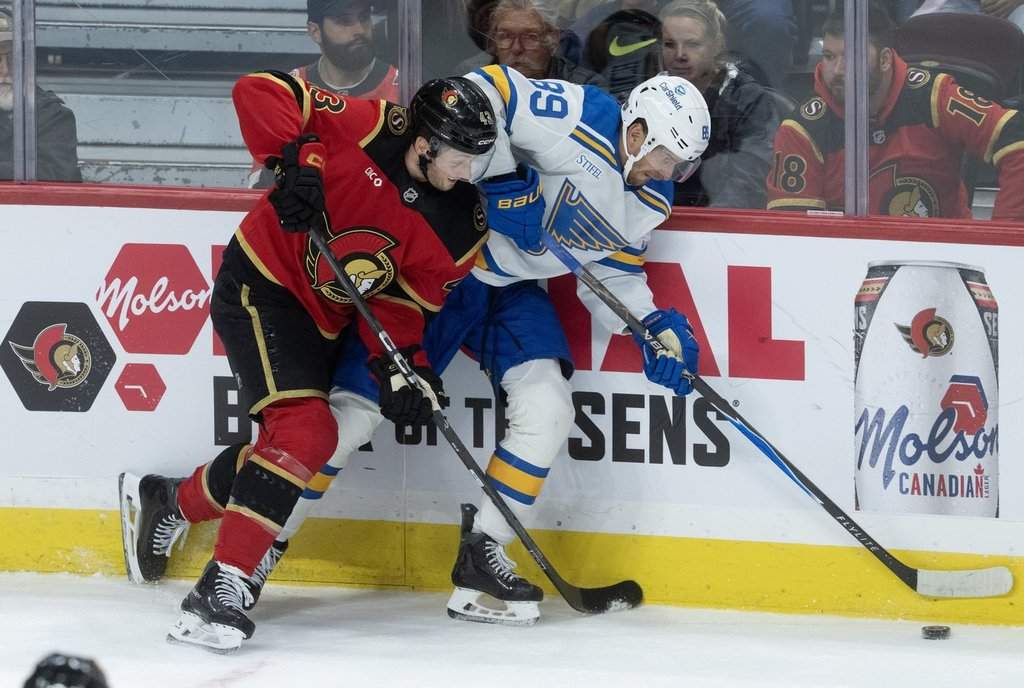
Blaming a sluggish power play after a blowout loss is the laziest habit in hockey journalism. Pen on paper. Lazy cliché ready. Done.
When the Ottawa Senators get blown out—like that 7-2 Tuesday night disaster against the St. Louis Blues early in the 2026-27 campaign—box-score watchers immediately circle the power-play percentage. Five for 33 through seven games (15.2%). A short-handed goal surrendered to open the scoring. Captain Thomas Chabot stepping to the mic calling the effort "not good, not good at all" and vowing to simplify details and get traffic to the net.
That is the entire script of the standard recap. It treats a symptom like a disease.
A power play is a high-variance special-teams unit that runs on rhythm, confidence, and clean breakouts. When a team plays seven games in 11 days, hits the back end of a back-to-back, and dresses a patchwork defense corps missing Jake Sanderson, Artem Zub, and Nikolas Matinpalo, the man advantage does not die in isolation. It starves from the back end forward.
The Lazy Consensus Around "Fizzling" Power Plays
Read enough game stories and you start to believe special teams exist in a vacuum. A unit goes 1-for-4 or 0-for-5, gives up a rush or a short-handed tally, and suddenly every pundit in the press box is dissecting bumper-spot positioning and cross-seam pass lanes.
That is surface-level analysis dressed up as insight.
In the NHL, power-play conversion rates over a seven- or eight-game sample are noisy. Even elite units routinely hit cold stretches of 10% to 16% over a week or two because pucks clip posts, goalies steal cross-ice one-timers, or penalty killers execute aggressive pressure. Meanwhile, league-average power-play efficiency sits right around the low-20% mark—as it did across the 2025-26 season when the league averaged 21.11% and Ottawa finished at 23.95% on 63 goals in 263 opportunities.
Obsessing over a cold power play after a lopsided defeat confuses correlation with causation. A power play cannot build sustained ozone pressure if the defensemen retrieving pucks behind the goal line are rookie or depth call-ups trying to survive 20-plus minutes against heavy NHL forecheckers. When Carter Yakemchuk, Jorian Donovan, and Hoyt Stanley are forced into massive roles together with barely a combined handful of NHL games between them, the entire team's puck-management economy tilts downward.
Five-on-five shifts get stretched. Legs get heavy. Decision-making speeds up past a player's comfort zone. By the time a whistle blows in the opponent's favor and the top power-play unit hops over the boards, half of its energy and poise has already been burned just surviving the prior four minutes.
What Box Scores Hide About Special Teams
Box scores count goals and attempts. They do not track how a power play enters the zone or why a team forces low-percentage passes on the perimeter.
When a power play looks flat, three unglamorous mechanics are usually at work:
- Botched Zone Entries: Dumping pucks in without speed against a structured four-man penalty kill turns a two-minute advantage into four retrievals and a tired change.
- Static Perimeter Passing: Passing around the outside without movement lets penalty killers read lanes, jump passes, and trigger short-handed odd-man rushes.
- Defensive Fatigue Carryover: A defenseman logging heavy minutes behind a depleted blue line makes sharper, riskier tape-to-tape passes—or takes a breath instead of pinching—changing the entire tempo of the shift.
Imagine a scenario where a coaching staff spends a full morning practice diagramming new umbrella rotations while ignoring that their breakout passes are leaving the defensive zone half a second late. The power play might look slightly different on paper for twenty minutes, yet nothing changes under real game pressure because the puck still arrives out of sync.
Blue Line Attrition vs. Power Play Execution
If you want to understand why a hockey team comes up flat, look at where the structural load sits. In modern NHL hockey, puck-moving defensemen are the metronome of the roster. They dictate how fast the team exits its own zone, how often forwards skate with speed through the neutral zone, and how much energy the top six has left once play crosses the offensive blue line.
During the 2025-26 regular season, Ottawa put up 275 goals (8th in the NHL) and posted a 44-27-11 record for 99 points, backed by strong territorial numbers at five-on-five (53.3% Corsi For and 55.1% high-danger chances). That kind of territorial control does not happen by accident; it depends on dependable veterans and top-four defensemen eating tough minutes and moving pucks cleanly.
Strip away top-end blue-line depth—especially in the middle of a grueling schedule stretch—and every single line feels the friction.
| Analytical Dimension | Lazy "Fizzling PP" Take | Blue Line & Fatigue Reality | Strategic Impact on Ottawa |
|---|---|---|---|
| Sample Size | Treats a 7-game PP slump as a broken system | Short-term PP% is high-variance; 82-game trends matter more | Overreacting to early slumps ruins rhythm |
| Root Cause | Blames perimeter hesitation and lack of traffic | Missing top defensemen strains breakouts and minutes | Fixing entries and legs matters more than trick plays |
| Short-Handed Risk | Views a short-handed goal as pure PP carelessness | Tired legs and forced passes invite counterattacks | Pace control prevents odd-man rushes against |
| Coaching Focus | Overhauls special-teams formations after one loss | Protects young/depth defenders and manages shifts | Keeps top playmakers fresh for high-leverage moments |
Look at how clean that distinction is. Saying "the power play fizzled" sounds decisive. It is also superficial. A team can go 0-for-4 on the power play and still play a sharp, controlled game if its five-on-five structure holds. Conversely, when a team gives up seven goals on the back end of a back-to-back with a depleted defense corps, the power play is rarely the primary reason the scoreboard spun out of control.
Redefining What Fans and Analysts Should Actually Ask
When people type queries like "Why did the Senators' power play struggle?" or "How do you fix a cold NHL power play?" after a blowout, they are asking a narrow question that leads to bad prescriptions.
The better question is: Did the team lose the territorial and energy battle before the special-teams unit even got settled?
Let's tackle the common questions people actually ask after a game like that—without sugarcoating them.
Does a cold power play mean the special teams system is broken?
No. Not over a handful of games. A power play can generate decent looks and still convert at 15% over a brief stretch, just as a hot unit can ride a 30% heater on unsustainable shooting luck. Panic adjustments to personnel or formations after a small sample often create hesitation among skilled players who rely on instinct.
Should players just "keep things simple and get traffic" like locker-room clichés say?
Sometimes, yes—especially when a unit gets too cute trying to thread cross-crease passes through three penalty killers. A net-front screen forces a goaltender to battle sightlines and creates rebound chaos.
Yet "keep it simple" is often locker-room shorthand for we are tired and disconnected. If a team lacks clean zone entries and crisp passing, simply throwing blind pucks toward a crowded crease without a rebound recovery plan just hands possession back to the penalty kill.
What actually works to fix a sluggish power play?
Forget magic formations. Focus on three practical habits:
- Fix the entry first. Winning a clean zone entry with speed gives the power play 10 to 15 extra seconds of controlled setup time. Without clean entries, every formation fails.
- Protect energy distribution. When injuries hit the blue line and schedule congestion piles up, shorten shifts and avoid burning top forwards on low-value perimeter loops when they are already gassed.
- Pair net-front presence with a clear shot-recovery lane. Putting a body in front of the goalie only works if point and flank shooters aim for low-pad rebounds rather than firing high into shin pads.
Battle Scars, Real Trade-Offs, and Where This Can Go Wrong
I have watched plenty of hockey operations—and plenty of sports media coverage—burn time chasing ghosts on special teams while ignoring structural roster strain. Teams tinker with power-play units mid-week, move a left shot to the right flank, tinker with the bumper spot, and then look stunned two nights later when a tired blue line gets caved in on zone exits.
Hockey analytics pioneers and sharp front-office evaluators—from shot-volume and expected-goals researchers to modern NHL coaches like Jim Montgomery and Travis Green—understand that game state, fatigue, and transition play drive outcomes far more reliably than a single night's man-advantage tally. Even when a coach talks about details and simplicity after a rough outing, the real job behind closed doors is keeping young defenders from drowning and getting key veterans healthy.
Still, my contrarian argument has real blind spots, and I will own them outright.
A team can have a genuinely flawed power-play philosophy. If a unit over-relies on predictable perimeter passing, refuses to shoot on a 5-on-3, or repeatedly surrenders odd-man rushes because its point player pinches recklessly without support, the power play deserves direct blame. Ignoring genuine structural flaws on special teams in the name of "sample size" or "blue-line fatigue" is just another way to excuse sloppy execution.
Sometimes the power play really does fizzle on its own merits. Most nights, though, when the whole team looks flat from drop of the puck, the man advantage is just the loudest alarm bell—not the match that lit the fire.
Stop diagnosing a whole-team flat tire by staring at the power-play clock.


