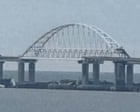
Everyone loves a good Hollywood explosion.
When plumes of black smoke curled over the Kerch Strait in October 2022—and again in July 2023—pundits across Washington, London, and Kyiv tripped over themselves to declare a massive psychological blow against Vladimir Putin. They called the Crimean Bridge a "symbol of Putin’s rule." They obsessed over the humiliation of the Kremlin. They wrote endless breathless profiles about the bridge being Putin’s personal vanity project, damaged right after his 70th birthday. Read more on a connected subject: this related article.
They completely missed the point.
Treating the attacks on the Kerch Bridge as an exercise in political theater isn't just lazy journalism; it is a profound misunderstanding of modern warfare. Framing these strikes around "symbolism" insults the cold, ruthless mathematical precision of Ukrainian military intelligence. Kyiv didn't burn through scarce, high-risk covert assets and experimental naval drones just to hurt a dictator's feelings. Additional reporting by The Washington Post highlights similar views on this issue.
They did it to break a logistics artery. And if you look at the steel, concrete, and rail tonnage rather than the television optics, you realize the symbolism narrative actually obscures the far more brutal reality of how this war is being won and lost.
The Myth of the Psychological Knockout
Military history is littered with commanders who fell in love with symbolic targets and lost campaigns because of it. I have watched defense analysts and policy planners waste millions of dollars in wargaming simulations chasing "cognitive effects" and "symbolic victories" against authoritarian regimes, only to realize that autocrats do not lose wars because they feel embarrassed. They lose wars when their trucks run out of diesel and their artillery batteries run out of shells.
Let’s dismantle the "symbolism" argument immediately.
Yes, Putin drove a Kamaz truck across the bridge when it opened in 2018. Yes, Russian state television treated the 12-mile span as a monument to imperial restoration. Does any of that stop a 152mm howitzer from firing in Zaporizhzhia? No.
When the Security Service of Ukraine (SBU) and the Ukrainian Navy hit that bridge, they weren't aiming at Putin’s ego. They were aiming at throughput capacity.
The lazy consensus assumes that because a target has high visibility, its primary value is propaganda. That is backwards. High-value infrastructure is almost always wrapped in nationalist propaganda precisely because it is vital to the state's survival. By calling the bridge a "symbol," Western commentators accidentally adopted the Kremlin's framing—reducing a critical military supply line to a mere monument.
The Physics of the Bottleneck
To understand why the Kerch Bridge actually matters, stop reading political op-eds and start reading civil engineering manuals and railway timetables.
The Russian military is, fundamentally, a railroad army. Unlike the U.S. military, which relies heavily on palletized truck transport and airlift, Russian doctrine depends on dense rail networks to move massive volumes of heavy equipment, ammunition, and fuel. As military logistics experts like Trent Telenko and researchers at the Royal United Services Institute (RUSI) have repeatedly documented, once Russian forces get more than 60 to 90 miles away from a functioning railhead, their offensive capability collapses.
Look at a map of the northern Black Sea coast. Russia has only two ways to feed its entire southern front in Crimea and occupied Kherson and Zaporizhzhia:
- The "Land Bridge": A single coastal highway and a vulnerable railway running from Rostov-on-Don through Mariupol and Melitopol. For most of the war, that rail line sat well within range of Ukrainian HIMARS and Storm Shadow missiles.
- The Kerch Strait Bridge: A 19-kilometer dual-road and double-track rail bridge connecting mainland Russia directly to the Crimean peninsula.
Before October 2022, the Kerch Bridge carried the overwhelming bulk of heavy military rail freight into Crimea, which then acted as the primary staging base and logistics hub for the entire southern theater.
When you look at the engineering of the strikes, the cold operational logic jumps off the page.
The October 2022 Truck Bomb
On October 8, 2022, a massive explosion tore through the roadway section of the bridge, collapsing two spans of the westbound road deck. At the exact same moment, a fuel train was passing on the parallel railway bridge. The blast ignited seven fuel tankers, roasting the steel box girders of the rail span at temperatures exceeding 1,000 degrees Celsius.
Pundits focused on the dramatic collapse of the road spans. Engineers looked at the scorched steel of the rail bridge.
Heat compromises the structural integrity of steel permanently. Even though Russia rushed repairs and reopened a single track to limited traffic within weeks, the weight capacity and speed limits on that rail span were severely degraded for months. Russia couldn't run heavy, full-length military freight trains across it at normal operational tempo. They had to use lighter loads, slower speeds, and wider intervals.
The July 2023 Sea Baby Strike
Nine months later, on July 17, 2023, Ukraine hit the bridge again. This time, there was no truck bomb. The SBU deployed "Sea Baby" unmanned surface vessels (USVs)—remote-controlled, explosive-laden speedboats skimming just above the waterline.
They slammed straight into the concrete support pilings of the road bridge.
Why target the pilings instead of the deck? Because repairing a bridge deck is a relatively straightforward modular swap. Repairing or replacing a foundational support pier driven deep into the seabed mud of the Kerch Strait is a civil engineering nightmare. It requires specialized marine cranes, cofferdams, pile drivers, and months of calm weather—all within reach of Ukrainian reconnaissance drones and long-range strike systems.
Dismantling the "People Also Ask" Fallacies
Whenever the Kerch Bridge trends in the news, the public asks the same three predictable questions. Every single one of them is built on a flawed premise.
"Why hasn't Ukraine destroyed the bridge completely?"
This question assumes destroying a 12-mile reinforced concrete and steel bridge is like blowing up a wooden footbridge in a movie. It isn't.
Modern arch and box-girder bridges are over-engineered to withstand hurricanes, earthquakes, and maritime collisions. Dropping a single warhead—even a 500-kilogram warhead like the one on a British Storm Shadow or French SCALP cruise missile—onto a reinforced concrete bridge deck punches a neat hole right through it. It doesn't bring the span down. To permanently sever a structure like the Kerch Bridge from the air, you would need dozens of precision-guided bunker-busting munitions hitting the exact same support piers simultaneously, bypassing layers of Russian S-400 air defenses, Pantsir point-defense systems, radar-reflecting barges, and submerged anti-drone nets.
Ukraine didn't have the munition stockpile to waste 40 cruise missiles on one bridge when those missiles were needed to destroy Russian command bunkers and ammunition depots. Instead, Kyiv adopted an asymmetric strategy: inflict maximum structural disruption at minimum cost.
"Did the strikes actually stop Russian supplies?"
No. And anyone claiming they completely starved the Russian army is lying to you.
This is the necessary caveat to the contrarian view: Ukraine’s strikes on the Kerch Bridge were an operational success, not a war-winning silver bullet.
Russia adapted. When the bridge was choked, Moscow pivoted to large amphibious landing ships—the Ropucha-class vessels—to ferry military trucks and cargo across the Kerch Strait. They forced civilian traffic onto ferries and rerouted heavy military convoys along the coastal road through occupied Mariupol. Later, Moscow built a brand-new railway line running closer to the Sea of Azov coast in occupied Donetsk and Zaporizhzhia specifically to bypass the Kerch bottleneck.
If your metric for success is "zero Russian bullets reached the front," the strikes failed.
If your metric for success is cost imposition, the strikes were a masterclass.
"Was the bridge worth the risk?"
Look at the cascading chain reaction triggered by those two attacks.
Because the Kerch Bridge was compromised, Russia had to use its Black Sea Fleet landing ships as glorified cargo ferries. That put those warships into predictable transit patterns in confined waters. What happened next? Ukrainian naval drones and cruise missiles systematically hunted down and sank or crippled a huge portion of Russia’s amphibious fleet, including the Novocherkassk, the Caesar Kunikov, and the Minsk.
Meanwhile, forcing Russian logistics onto the southern coastal highway exposed thousands of fuel trucks and ammunition convoys to Ukrainian artillery, drones, and partisan sabotage. Russia also had to strip scarce S-300 and S-400 air defense batteries away from the front lines and redeploy them around the Kerch Strait just to guard a half-broken bridge.
You don't need to drop the bridge into the sea to win. You just need to make defending and operating it so expensive that the enemy bleeds resources everywhere else.
The Real Lesson of the Kerch Strait
The coverage of the Kerch Bridge exposes a massive blind spot in how modern observers consume war news. We are addicted to spectacle. We want clean narratives about pride, humiliation, and symbolic turning points because spreadsheets of rail tonnage and concrete curing times don't make good headlines.
Imagine a scenario where the Kerch Bridge had zero political value—where Putin had never visited it, state media had never mentioned it, and it was just an anonymous industrial span built in the 1970s.
Ukraine would have attacked it in the exact same way, on the exact same timeline, with the exact same weapons.
Because in war, geography is undefeated, and logistics is king. The SBU operatives who rigged a truck with hexogen explosives and the engineers who piloted Sea Baby drones through choppy Black Sea swells weren't trying to win a PR war. They were executing a cold, calculated campaign of attrition against the physical arteries of an invading army.
Stop measuring military strikes by how badly they bruise an autocrat's ego. Measure them by how many tons of steel, fuel, and artillery shells never reach the trench line.