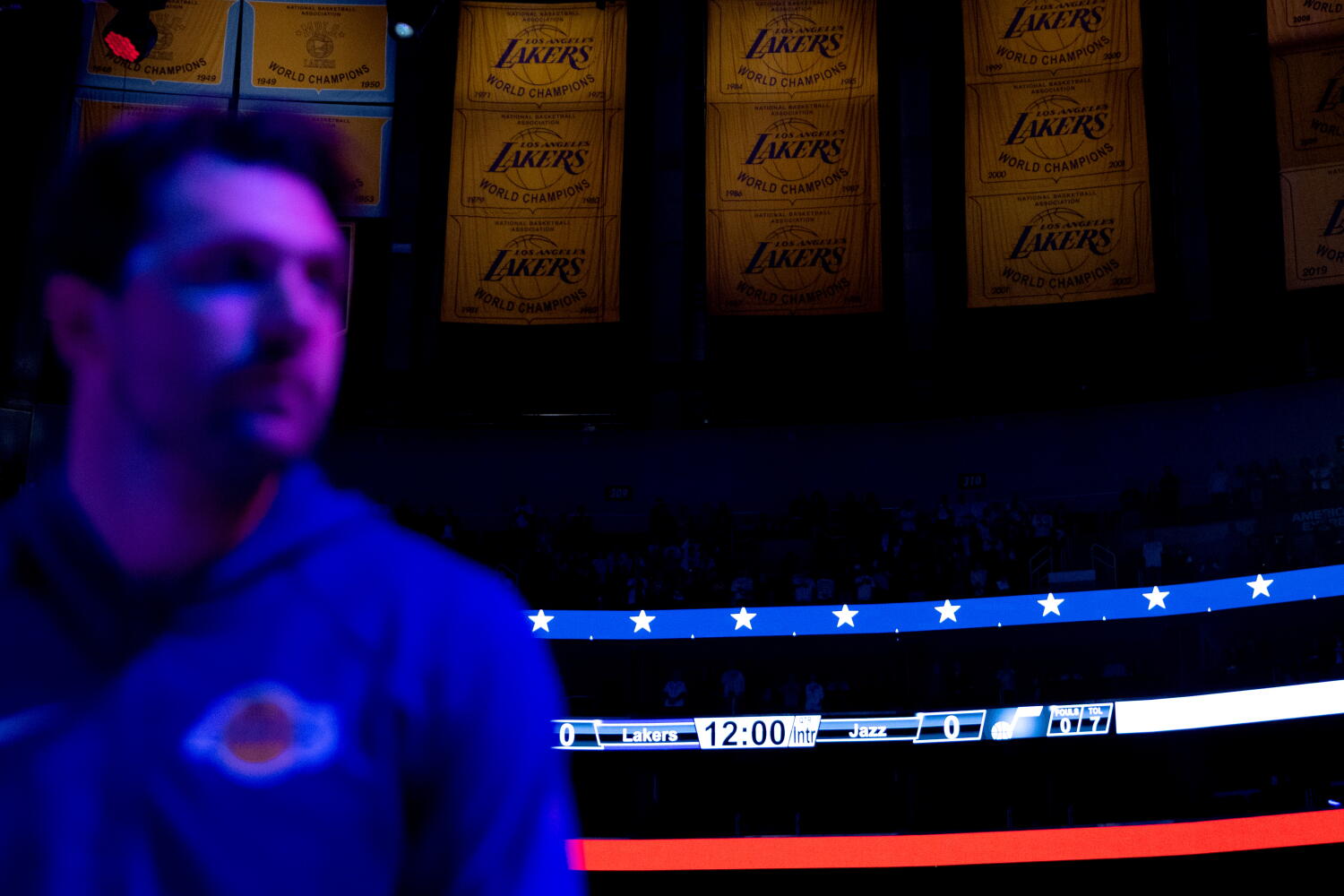
Mainstream sports media loves a comfortable lie. They see a marquee franchise string together a few early wins, survive a flat shooting night in Salt Lake City, and immediately rush to crown them a legitimate title threat.
It is lazy analysis. Worse, it completely misunderstands how modern basketball actually works.
When columnists tell you that one frigid shooting night against the Utah Jazz doesn't change the reality that the Los Angeles Lakers are legit, they are selling you a comforting bedtime story. They want you to believe that variance is the only enemy, that cold shooting streaks are merely statistical hiccups, and that underlying talent will inevitably triumph over an eighty-two-game grind.
They are asking the wrong question. The real issue isn't whether the Lakers can survive a bad night in November. The real question is why a roster built on razor-thin margins requires near-miraculous shooting efficiency just to tread water against bottom-tier Western Conference rebuilding projects.
The Variance Trap and the Myth of the "Off Night"
Every basketball pundit loves to hide behind shooting variance. When a team bricks thirty three-pointers, the standard talking head response is a dismissive wave of the hand. Make-or-miss league, they say. Law of averages, they preach.
That is a fundamental misunderstanding of shot quality versus shot quantity.
True shooting variance—the kind documented extensively by analytics pioneers like Daryl Morey and Seth Partnow—only stabilizes over massive sample sizes when the underlying shot profile is structurally sound. If a team generates wide-open corner threes through relentless ball movement and rim pressure, a cold night is indeed an anomaly. You trust the process because the geometry of the floor is broken in your favor.
The Lakers do not consistently generate that geometry.
When Los Angeles goes cold against a team like Utah, it isn't a random statistical glitch. It is the direct consequence of stagnant half-court offense, heavy reliance on contested mid-range pull-ups, and a spacing profile that allows opposing defenses to pack the paint with impunity. Calling a structural spacing flaw "one frigid night" is like watching a car engine overheat in traffic and blaming the weather instead of a broken radiator.
I have sat in front-office war rooms and watched executives talk themselves into bad rosters using this exact excuse. They look at a loss to a lottery-bound team, filter out the three-point percentage, and convince themselves they actually won the tactical battle. It is a multi-million-dollar delusion. By the time April arrives and playoff defenses tighten the screws, those "anomalous" cold nights suddenly become a four-game sweep.
Why Box Score Watching Masks Structural Decay
To understand why the "Lakers are legit" narrative falls apart under scrutiny, you have to look past the surface-level wins and examine the mechanics of how those wins are manufactured.
The Free Throw Disparity Crutch
For years, Los Angeles has survived offensive droughts by living at the free-throw line. Generating foul calls is a legitimate skill, especially for physical downhill drivers. However, relying on whistle frequency as a primary offensive engine is notoriously volatile.
In the postseason, officiating crews swallow their whistles. Physicality increases. Contact that draws a foul on a Tuesday night in Utah becomes a no-call in a Western Conference semifinal. When a team's offensive rating is artificially propped up by free-throw rate rather than pure half-court creation, their efficiency craters the moment the whistle tightens.
Transition Reliance vs. Half-Court Reality
Regular-season basketball is sloppy. Teams turn the ball over, fail to get back on defense, and surrender easy transition buckets. The Lakers feast on this chaos. When they can get stops and run, they look like world-beaters.
Playoff basketball is a half-court war of attrition. Every possession is scripted. Transition opportunities dry up, forcing teams to execute sets against set, switch-heavy defenses for twenty-four seconds at a time. Against a set defense, the Lakers' lack of dynamic perimeter creation becomes glaringly obvious. You cannot out-transition a disciplined contender four times in seven games.
Defensive Effort vs. Defensive Scheme
Pundits point to defensive spurts as proof of legitimacy. Yes, when fully locked in, Los Angeles can muster stretches of suffocating perimeter defense. The flaw in this logic is assuming that maximum-effort defensive scrambling is sustainable across four playoff rounds.
Great defensive teams rely on scheme and personnel, not desperation. They have elite point-of-attack stoppers backed by versatile rim protectors who can clean up mistakes without sacrificing rebounding position. When a team has to expend maximum physical energy just to contain a young, developing Jazz backcourt, they are burning fuel they will desperately need in May.
Dismantling the "People Also Ask" Narrative
Whenever the Lakers stumble against an inferior opponent, the same tired debates flood sports talk radio and search bars. Let's tear down the premises of these questions with brutal honesty.
"Are the Lakers actual championship contenders this year?"
No. Contenders do not possess glaring, unfixable weaknesses in their primary rotation. A contender has multiple avenues to win a game when their primary star is neutralised. Los Angeles operates on a tightrope where a single injury or a week-long shooting slump threatens to crater their entire season."Should the Lakers panic after losing to a rebuilding team like the Jazz?"
Panic is for fans; urgency is for front offices. They shouldn't panic over a single result, because the result itself is irrelevant. They should panic over the process that produced the result. If the tape shows stagnant off-ball movement, lazy closeouts, and an inability to punish drop coverage, ignoring it because "it's early" is malpractice."How do the Lakers fix their three-point shooting woes?"
You don't fix shooting in the gym mid-season. That is a fairy tale. Shooting is a talent acquisition problem, not a coaching problem. Either you have players who command gravitational respect from defenses thirty feet from the hoop, or you don't. You cannot scheme a career thirty-two percent shooter into Klay Thompson.
The Heavy-Hitter Standard of Legitimacy
If we want to define what "legit" actually means in the modern NBA, we have to look at the standards set by genuine dynasties and modern champions. Look at how Sam Presti built the Oklahoma City Thunder, or how Brad Stevens constructed the Boston Celtics.
Notice the common denominator. Neither organization built a roster praying for shooting variance to break their way.
Boston didn't just acquire shooters; they acquired five-out versatility where every single player on the floor could dribble, pass, shoot, and defend multiple positions. When Boston has a frigid shooting night, they still win because their mathematical advantage—generating more threes and restricting opponents' rim attempts—remains intact. Their floor is higher than most teams' ceilings.
Oklahoma City prioritized relentless length, defensive playmaking, and decision-making speed. Every player on the court can attack a closeout. They don't rely on one or two aging superstars to manufacture every single look from scratch.
Now compare that blueprint to Los Angeles. The Lakers are still trying to win a modern space-and-pace arms race using heavy-isolation, two-big-adjacent, paint-clogging principles from a decade ago. Calling them legit ignores the entire tactical evolution of the sport over the last ten years.
The Counter-Intuitive Blueprint for Real Contention
If the Lakers' front office actually wants to join the ranks of legitimate contenders, they need to abandon the incremental tinkering that defines their current strategy. Role-player shuffling around the margins will not close the gap between a play-in team and a championship favorite.
Embrace Math Over Star Power
Stop chasing washed-up name recognition and expiring contracts. Every roster spot must be evaluated through the lens of modern spacing and defensive switchability. If a player cannot shoot at a league-average clip or guard three positions, they are unplayable in high-leverage playoff minutes.Weaponize Pace Deliberately, Not Accidentally
Instead of hoping for opponent turnovers to spark transition offense, install a strict shot-clock mandate. Force the ball across half-court in under three seconds and initiate primary actions before the defense can load the strong side. Speed exposes athletic deficiencies in opponents; slow play exposes shooting deficiencies in yourself.Accept the Downside of Volatility
To be fair, leaning entirely into high-variance three-point volume and hyper-aggressive switching comes with its own massive risk. You will lose ugly games when the shots don't fall, and smaller lineups will occasionally get battered on the offensive glass by physical frontcourts. Look at the Houston Rockets during their peak Harden years—when the math failed, it failed spectacularly on the biggest stage. Yet, that calculated risk is the only mathematical path for a talent-deficient roster to punch above its weight class. Playing it safe guarantees a respectable, mediocre second-round exit.
Stop Grading on a Curve
The biggest disservice sports media does to its audience is grading legacy franchises on a curve. Because the jerseys are iconic and the stars are household names, mediocre basketball is routinely repackaged as "gritty resilience."
Imagine a scenario where the exact same roster—identical offensive rating, identical defensive metrics, identical shooting splits—played in Charlotte or Portland. Nobody would be writing columns defending their legitimacy after a bad loss in Utah. They would be labeled a play-in treadmill team desperately in need of a teardown.
Laundry does not win playoff series. History does not guard the perimeter.
When a team shows you who they are through broken floor spacing, sluggish half-court execution, and an inability to separate from lottery-bound opponents, believe them. The box score against the Jazz wasn't an aberration to be brushed aside. It was a preview of the exact wall this roster will slam into the moment the games actually matter.