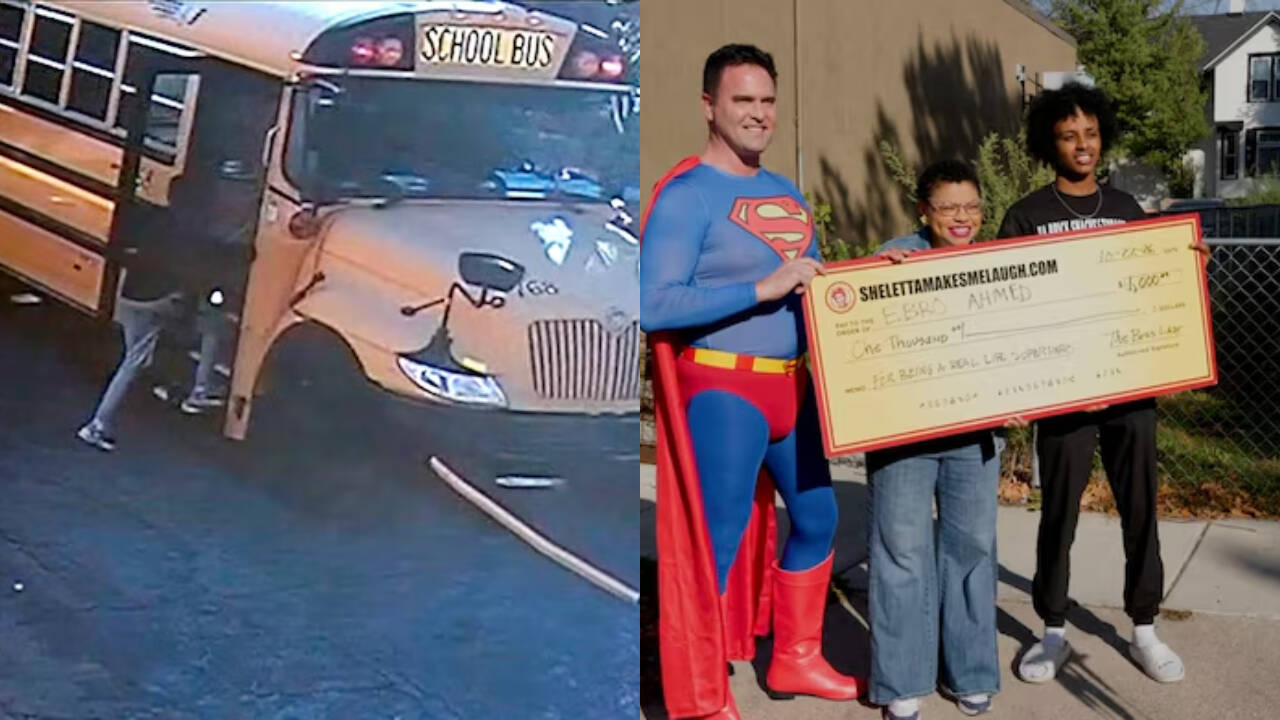
Every local news outlet in the country ran the exact same feel-good script this week. A quick-thinking bystander in Minnesota saw a school bus drifting out of control after the driver suffered a medical emergency, sprinted alongside the rolling chassis, forced open the door, and hit the brakes to save 19 children.
Cue the tears. Cue the local hero awards. Cue the breathless headlines praising human bravery.
Here is the truth nobody in the media wants to say out loud. That viral rescue was not a triumph of the human spirit. It was a catastrophic failure of transportation engineering, fleet management, and basic safety redundancy that came within inches of ending in a mass casualty event.
When we turn systemic negligence into a heartwarming human-interest story, we give every school district, bus manufacturer, and regulatory body in America a free pass to do nothing. You cannot build a public transit safety model around hoping an Olympic-caliber sprinter happens to be standing on the exact street corner where a driver has a heart attack.
The Anatomy of the Lazy Consensus
Mainstream journalism loves a hero narrative because heroes are simple. A hero requires zero investigation into procurement budgets, aging driver demographics, or outdated vehicle telemetry. If a bystander saves the day, the story has a neat, happy ending, and everyone goes home feeling good about their community.
I have spent years consulting on commercial fleet safety and municipal risk management, and I have seen organizations burn millions of dollars on reactive public relations while ignoring basic preventative mechanics. Every time an incident like this happens, the industry leans on what safety engineers call the "heroism trap."
The heroism trap works like this:
- A predictable mechanical or human failure occurs.
- An extraordinary individual intervenes against impossible odds.
- Leadership praises the individual's bravery instead of firing the people who allowed the single point of failure to exist.
- Nothing changes until the next time—when no hero is standing on the sidewalk.
Let us look at the actual physics and logistics of what happened in Minnesota. A commercial vehicle weighing upwards of 25,000 pounds was rolling down a public roadway with 19 minors inside and zero active control. The fact that a pedestrian was able to catch up to the vehicle, manually override the pneumatic or mechanical door mechanism from the exterior, climb the steps, bypass an incapacitated adult in the driver's seat, and engage the air brakes is a statistical miracle.
Miracles are not a safety strategy.
Why School Buses Are Decades Behind Modern Commercial Fleets
If you buy a mid-tier consumer sedan today, it comes standard with automatic emergency braking, lane-keep assist, driver attention monitoring, and forward collision warning. If the driver passes out at the wheel of a modern luxury car, infrared cameras track their eye movement, issue audible and tactile warnings, and eventually bring the vehicle to a controlled stop in its lane while turning on the hazard lights.
Meanwhile, the yellow school buses carrying our children are frequently operating on chassis designs and safety standards rooted in the 1990s.
In the heavy-duty trucking and transit industries, Advanced Driver Assistance Systems (ADAS) and driver incapacitation protocols have been standard discussion points for over a decade. Organizations like the National Transportation Safety Board (NTSB) have repeatedly issued recommendations for collision avoidance systems and enhanced vehicle safety technology across commercial passenger vehicles. Yet school districts consistently lag behind private logistics companies like UPS, FedEx, and Amazon.
Why? Because school districts operate on razor-thin municipal budgets, and voters rarely scrutinize the line items for fleet modernization until a tragedy hits the front page.
The Myth of the Indestructible Yellow Box
Parents suffer from a massive cognitive bias regarding school buses. Because the buses are big, heavy, and painted bright yellow, people assume they are inherently safe.
They are safe in a traditional crash scenario due to compartmentalization—the passive safety design where closely spaced, high-backed, energy-absorbing seats protect children during an impact. Compartmentalization works great when another car hits the bus.
Compartmentalization does nothing when the bus itself becomes an unguided missile because the person holding the steering wheel lost consciousness.
The Demographic Time Bomb Behind the Wheel
To understand why driver incapacitation is not a freak occurrence, you have to look at who is actually driving these routes.
The school bus industry is facing a severe, chronic labor shortage. Because the job offers split shifts—two hours in the morning, two hours in the afternoon—and modest pay without full-time corporate benefits, it does not attract twenty-something career drivers.
Instead, the American school bus fleet relies overwhelmingly on retirees.
According to data from the U.S. Bureau of Labor Statistics and industry surveys from organizations like School Bus Fleet, the median age of a school bus driver in the United States is well over 55, with a massive percentage of the workforce over the age of 65.
Let us be brutally honest about the medical reality of this demographic:
- Higher baseline risk: Drivers over 60 face significantly higher statistical probabilities of sudden cardiac events, strokes, diabetic emergencies, and syncope (fainting).
- The Department of Transportation (DOT) physical loophole: While commercial drivers must pass a DOT medical examination at least every two years, a standard physical is a snapshot in time. Passing a blood pressure check in October does not prevent an arrhythmia in March.
- Fatigue and split-shift stress: Waking up at 4:30 AM to run a morning route, returning home, and going back out at 2:00 PM wreaks havoc on circadian rhythms and cardiovascular health.
We have built a system that staffs high-stakes, zero-margin-for-error driving jobs with an aging population, and then we act shocked when a driver collapses at the wheel.
Dismantling What People Get Wrong About Bus Safety
When a story like the Minnesota rescue goes viral, the public immediately asks the wrong questions. They focus on the peripheral details rather than the structural root causes.
Why didn't the kids just stop the bus themselves?
This is the most common armchair quarterback critique. People ask why one of the 19 children didn't just run up to the front and hit the brake pedal.
First, children are conditioned from kindergarten to stay in their seats, never touch the driver's controls, and obey authority. Expecting a ten-year-old to instantly override years of behavioral conditioning during a sudden crisis is absurd.
Second, modern school buses use air brakes, not the hydraulic brakes found in a family minivan. An air brake system feels completely foreign to an untrained person. If you do not know where the parking brake valve (the yellow diamond-shaped push-pull knob) is located on the dashboard, or how much pressure a treadle valve requires, panicking in the driver's well is just as likely to make the situation worse.
Aren't school bus drivers already screened for health issues?
Yes, they hold a Commercial Driver's License (CDL) with a Passenger (P) and School Bus (S) endorsement, which requires a DOT medical certificate.
However, the DOT medical exam is a regulatory floor, not a guarantee of daily fitness. Drivers routinely hide minor symptoms—chest tightness, dizziness, vision changes—because failing a DOT physical means losing their livelihood immediately. Without continuous, non-invasive biometric monitoring or vehicle-based incapacitation sensors, the district has no idea a driver is in distress until the bus jumps a curb.
Isn't upgrading all school buses too expensive for taxpayers?
This is the classic municipal excuse, and it collapses under basic math. A single severe school bus crash involving medical negligence or mechanical failure results in tens of millions of dollars in litigation, settlements, medical costs, and skyrocketing insurance premiums.
Spending $3,000 to $5,000 per vehicle on aftermarket driver-monitoring cameras and automatic emergency braking retrofits is a rounding error compared to the liability of one fatal crash. Districts do not lack the money; they lack the political will to prioritize unseen preventative tech over visible community projects.
The Technology That Should Have Stopped That Bus Automatically
If a driver collapses, the vehicle should not rely on a bystander running a 4.4-second forty-yard dash to intervene. The technology to prevent a runaway bus already exists, is commercially available, and is deployed across other sectors right now.
1. Dead-Man Switches and Capacitive Steering Wheels
Railroads have used dead-man switches—devices that automatically apply the brakes if the operator becomes incapacitated and releases pressure—for over a century. In modern automotive engineering, this has evolved into capacitive torque sensors built directly into the steering wheel rim.
If the vehicle is in drive and the steering wheel detects zero micro-adjustments or grip pressure for more than five seconds, the system triggers an escalating cabin alarm. If the driver does not respond within another three seconds, the vehicle automatically engages hazard lights, slowly reduces throttle, and applies controlled braking to bring the bus to a halt.
2. Interior AI Driver-Monitoring Systems (DMS)
Companies like SmartDrive, Samsara, and Mobileye already deploy inward-facing optical sensors in commercial trucking fleets. These systems do not just record video; they use edge computing to analyze head posture, eye closure, and slumping.
If a driver slumps over the wheel or their eyes remain closed while the vehicle is moving above 5 mph, the system instantly registers an incapacitation event. Paired with modern brake-by-wire actuators, the bus can execute a safe stop without human intervention.
3. Standardized Emergency Stop Buttons in the Cabin
Every passenger train and subway car in the developed world has a clearly marked emergency brake handle or button accessible to passengers. Almost no American school bus has an equivalent passenger-accessible emergency stop mechanism.
Imagine a scenario where a brightly lit, protected emergency stop button is mounted on the front bulkhead—out of reach of accidental bumps, yet clearly visible and labeled for older students or bus aides. Pressing it triggers a controlled deceleration sequence and automatically dials 911 with the bus's exact GPS coordinates.
The Downsides of the Technological Fix
Let us be completely transparent about the trade-offs here, because pretending a technological overhaul is frictionless would be dishonest.
Automating emergency stops on massive passenger vehicles introduces real engineering risks. If an AI camera misinterprets a driver looking down at a clipboard as a medical emergency and slams on the air brakes in the middle of a 55-mph highway, you risk a catastrophic rear-end collision or unrestrained children flying out of their seats.
Furthermore, strict biometric monitoring and inward-facing cameras are deeply unpopular with drivers. When you are already struggling to hire and retain CDL drivers, telling them an algorithm will track their eyelids every second of their shift accelerates turnover. Unions push back hard against constant surveillance, and false alarms can erode driver trust in the equipment.
These are valid engineering and labor hurdles. They are not excuses to accept runaway buses as an unavoidable act of God. You solve false positives with multi-sensor fusion—requiring both a steering-wheel grip loss and an optical slump detection before engaging a gradual, hazard-lit deceleration rather than a violent brake slam.
What Needs to Happen Tomorrow Morning
If you are a parent, a school board member, or a fleet director, stop sharing the viral clip of the Minnesota rescue and start asking uncomfortable questions at your next district meeting.
- Audit the fleet's active safety features. Find out what percentage of your district's buses have Automatic Emergency Braking (AEB) and Electronic Stability Control (ESC). If the answer is zero, demand a timeline for retrofitting or replacement specifications.
- Mandate driver-incapacitation protocols in new RFPs. When a school district puts out a Request for Proposals to buy new buses from manufacturers like Blue Bird, Thomas Built Buses, or IC Bus, the district dictates the spec sheet. Stop buying bare-bones base models and make capacitive steering sensors and automatic stop-assist mandatory requirements.
- Train the riders, not just the drivers. Run realistic emergency drills with students that go beyond climbing out the back emergency door. Teach older students riding the bus where the air brake valve is, how to use the two-way radio to call dispatch, and how to turn on the hazard flashers if the driver is unresponsive.
- Overhaul driver wellness and shift structures. Stop treating bus drivers like disposable part-time labor. Combine morning and afternoon driving shifts with mid-day district roles—maintenance, administrative support, cafeteria logistics—to offer full-time salaries and comprehensive preventative healthcare. Healthier, well-rested drivers have fewer sudden medical emergencies.
The Real Lesson of Minnesota
The man in Minnesota deserves every ounce of gratitude those 19 families are giving him. He saw a crisis, acted without hesitation, and prevented a nightmare.
He did his job as a decent human being. Everyone else—the regulators who allow outdated safety standards to persist, the districts that prioritize cheap procurement over active collision avoidance, and the media outlets that turn a brush with death into a cozy bedtime story—failed theirs.
The next time a school bus driver's heart gives out on a busy road, there will not be a track star waiting on the curb to play hero. Build the fail-safes into the machine before luck runs out.


