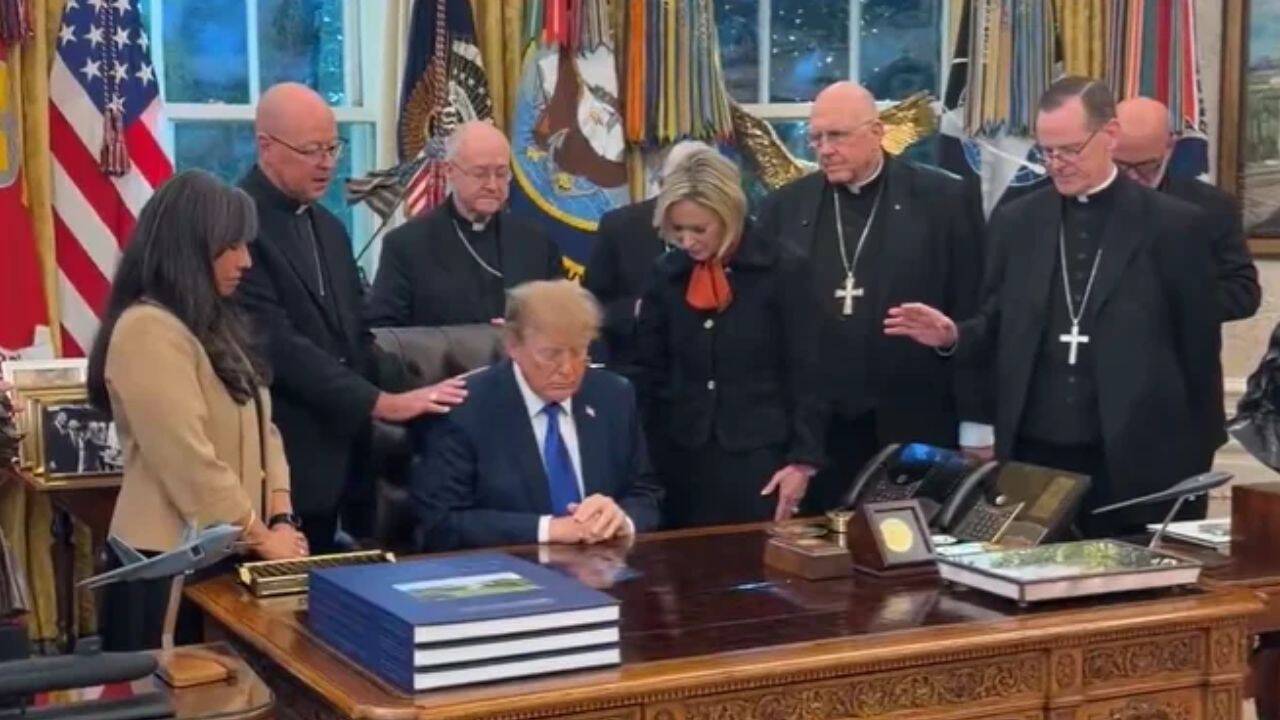
The press corps is hyperventilating over a cropped photo again.
An archbishop says a prayer moment with Donald Trump was "manipulated" for midterm campaign fodder. The White House hits back, defending the administration's framing. Legacy media outlets immediately assemble their fainting couches, filing thousands of words treating this skirmish like a newly discovered Watergate tape.
They are completely missing the point. Worse, they are actively participating in the exact machine they claim to expose.
If you read the standard coverage of this dust-up, you get the same lazy consensus every single time: a cynical political operation exploited a sacred religious moment, a pious clergy member got blindsided, and the public is being deceived by shadowy digital trickery.
That narrative is comforting, simple, and entirely divorced from how modern political communications and institutional public relations actually operate.
Nobody in that room was an innocent bystander. Nobody was tricked. What you are watching is a masterclass in mutual brand management disguised as a moral controversy.
The Myth of the Ambushed Clergy
Let’s dismantle the primary fiction first: the idea that high-ranking religious officials walk into rooms with a sitting or former president surrounded by professional photographers and somehow fail to realize they are creating campaign assets.
I have spent years watching political advance teams, comms directors, and institutional PR handlers choreograph these exact interactions down to the millimeter. Nothing happens by accident when a principal steps into a room with a pool camera.
Before any bishop, pastor, or rabbi gets within ten feet of a president, three distinct layers of clearance have already occurred:
- The Advance Check: Staffers dictate where the guest stands, which angle favors the principal, and where the ambient lighting hits best.
- The Framing Agreement: Religious leaders bring their own communications directors. They know the visual grammar of the Oval Office, the Roosevelt Room, or a campaign holding area. Laying hands on a political leader's shoulder while bowing heads is the single most recognizable visual trope in American evangelical and conservative Catholic media.
- The Distribution Reality: Every photo taken by an official staff photographer is explicitly designed for rapid deployment across social channels, fundraising emails, and digital ad buys.
When an archbishop apologizes days later—after the image has already racked up millions of impressions and dominated a news cycle—that apology is not a sudden awakening to a grand deception. It is audience segmentation management.
The clergy member needed the proximity to power to signal relevance to their conservative flock and secure access for future policy lobbying. Then, when the blowback arrived from the progressive wing of their diocese or the secular press, they issued a strategic mea culpa to pacify the critics.
They got the photo. They got the access. Then they got the absolution from the press for apologizing. That isn't being manipulated. That is playing both sides of the board and walking away with every chip on the table.
Why the White House Defense Was Pure Reflex
On the other side of the ledger, political commentators love to paint the White House’s defense of the image as desperate damage control.
Wrong again.
In modern political warfare, defending a controversial religious photo is not a defensive crouch; it is an engagement multiplier.
Think about the mechanics of the attention economy. If the White House had apologized, admitted the framing was overly partisan, or deleted the post, the story would have died in four hours. By standing firm and defending the authenticity of the prayer moment, the comms team accomplished three things simultaneously:
- Forced the opposition to attack prayer: Visually, the critics are now arguing against a photo of people bowing their heads. To a core voter base, the nuance of "context manipulation" evaporates instantly. All they see is the secular media attacking a man for praying.
- Locked in the persecution narrative: Nothing bonds a political movement faster than a shared enemy questioning the sincerity of their faith.
- Extended the shelf life of the asset: Every news article critiquing the White House defense had to embed or describe the original image, delivering free earned media to the exact demographic the midterms require.
Political strategists like Karl Rove and David Axelrod built entire empires on understanding this exact dynamic decades before TikTok existed. You do not run from a visual controversy when the visual itself reinforces your core brand identity. You lean into the punch so the cameras keep rolling.
The Real Meaning of "Manipulation" in Political Media
The press loves the word "manipulated" because it sounds nefarious. It conjures images of deepfakes, AI-generated crowds, or maliciously doctored audio.
In reality, 99% of political "manipulation" is simply selective framing—the exact same tool every major newspaper editor uses every morning when choosing which photo goes above the fold.
Consider the mechanics of any political photograph:
- Cropping: Removing a skeptical onlooker from the edge of the frame turns an awkward group mingling into an intimate one-on-one moment.
- Timing: Firing a motor drive at 20 frames per second guarantees that out of 100 shots of a person blinking, coughing, or mid-sneeze, one frame will look like stoic, Lincoln-esque contemplation.
- Captioning: A photo of two men bowing their heads means nothing on its own. Add three words of copy about "praying for the nation," and the viewer's brain fills in the emotional backstory.
Imagine a scenario where a major news outlet photographs a politician walking past a protest. If the photographer uses a wide lens, you see twelve protesters and forty journalists. If the photographer uses a 400mm telephoto lens, compression makes those twelve protesters look like an angry mob surrounding the candidate. Both photos are 100% real. Both are completely unedited. Both manipulate your perception of reality.
Calling a political team out for selective framing while ignoring how legacy newsrooms curate their own visual narratives is pure theater.
Dismantling the Wrong Questions
When a controversy like this hits the bloodstream, search engines light up with the same predictable queries. Let's look at why the standard questions miss the mark entirely.
Did the campaign cross an ethical line using a religious moment for midterms?
This question assumes there is a clean, historical firewall between American religion and partisan campaigning. There isn't. From Abraham Lincoln’s Second Inaugural Address to Lyndon B. Johnson’s use of religious rhetoric during the Civil Rights era, to Jimmy Carter’s Sunday school photo-ops, American presidents have always used faith as a political instrument. Asking whether a modern campaign crossed a line by posting a prayer photo is like asking if a swimmer got too wet in the pool. The water is the entire point of the exercise.
Should religious leaders refuse photo-ops with politicians?
If religious leaders refuse proximity to political power, they forfeit their seat at the table when legislation affecting their schools, hospitals, charities, and tax exemptions gets written. You cannot demand that churches advocate for the poor, fight for religious liberty, or lobby for moral causes while simultaneously demanding they never appear in a room with the people who sign the bills. The friction between prophetic distance and political access is permanent. Pretending there is a clean opt-out is naive.
How can voters tell when a political image is staged?
Stop asking if a political image is staged. Every single public image of a national politician is staged. Even the "candid" shots of a candidate eating a cheesesteak in Philadelphia or rolling up their sleeves on a tarmac are the result of advance scouting, lighting checks, and deliberate wardrobe choices. The smarter question isn't "Is this fake?" The smarter question is: "Who paid to put this in front of my eyeballs, and what emotional reaction are they trying to buy?"
The Uncomfortable Downside of Cynical Optics
Does this mean political teams can manufacture infinite religious photo-ops without consequence?
Hardly. And pretending this strategy is foolproof would be dishonest.
When campaigns over-rely on manufactured piety, they run straight into the law of diminishing returns. Voters aren't stupid. They have built-in radar for performative sincerity. When a candidate who never steps foot in a sanctuary suddenly floods the zone with bowed-head photography six weeks before an election, the core base might applaud, but the persuadable middle rolls its eyes.
Worse, it creates institutional blowback. Every time a religious leader gets burned by partisan framing—or feels forced to issue an awkward apology to clean up a political mess—the next three clergy members on the advance team's call sheet hesitate before saying yes. Over a four-year cycle, burning through institutional partners leaves an administration isolated, forced to rely on second-tier surrogates who bring enthusiasm but zero institutional credibility.
Even the sharpest comms shop eventually discovers that you can't deposit photo-ops in a legislative bank if the institutions behind them stop taking your calls.
How to Actually Read a Political Controversy
If you want to stop getting played by outrage cycles, stop reading the quotes and start tracking the incentives.
Whenever a political scandal erupts over a photo, a quote, or a staged moment, run it through a simple four-step filter before you share it, argue about it, or let it raise your blood pressure:
- Identify the primary beneficiary: Who gained reach, fundraising dollars, or institutional cover from this story trending? Usually, it is both sides of the fight.
- Look at the timing: Did this outrage happen organically in real time, or did it magically surface 48 hours later right before a major news dump or fundraising deadline?
- Separate the visual from the text: Mute the video. Strip the caption. Look strictly at the raw image. If the image itself is unremarkable, you are being manipulated by the commentary, not the camera.
- Watch what gets buried: Every loud controversy over optics functions as a smoke screen. While cable panels spend four hours dissecting a prayer photo, check the Congressional Record or the Federal Register to see what quiet policy shift just slipped past the goalposts unnoticed.
The archbishop got his access and his public absolution. The White House got its viral religious visual and a week of free earned media. The press got its clicks, its outrage panels, and its moral superiority.
The only people who actually got manipulated are the ones who thought this was a real fight.