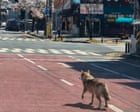
Hundreds of police officers, firefighters, and "expert" trackers are currently trampling through the South Korean brush to find a single escaped wolf. The media is feeding you a narrative of terror. They want you to believe a bloodthirsty predator is stalking the suburbs of Seoul. They are framing this as a public safety crisis.
They are wrong.
The crisis isn't that a wolf is loose. The crisis is that we still pretend these high-security animal prisons are "conservation." This massive manhunt is a performance. It’s a multi-million dollar theater production designed to mask the incompetence of zoo management and the absurdity of keeping a wide-ranging apex predator in a glorified concrete box.
The Myth of the Big Bad Wolf
Let’s dismantle the first lie: the danger.
If you look at the data—actual data, not Grimm’s Fairy Tales—wolves are statistically less dangerous to humans than domestic dogs, vending machines, or falling coconuts. According to the World Wildlife Fund and various ecological studies, healthy wild wolves generally avoid human contact at all costs. They don't want your latte. They don't want your toddler. They want to be anywhere you are not.
The panic in South Korea is built on a "lazy consensus" that assumes any animal with teeth is a ticking time bomb. In reality, the wolf is likely terrified, dehydrated, and looking for a place to hide from the sirens and helicopters. By treating this like a hunt for a serial killer, authorities increase the likelihood of a violent confrontation. When you corner a frightened animal with a mob of amateur trackers, you create the very danger you claim to be preventing.
The Zoo Industrial Complex is Failing
Why did the wolf leave? The "competitor" reports focus on the mechanics of the escape—a broken latch, a hole in a fence, a human error. These are symptoms. The disease is the environment itself.
I’ve consulted with facility managers and wildlife biologists who admit behind closed doors that most mid-tier zoos are running on 1970s infrastructure and shoestring budgets. We call them "educational facilities," but what exactly are we learning? We’re learning what a depressed, neurotic animal looks like when it’s stripped of its $50 \text{ km}^2$ natural territory.
Imagine a scenario where a human is locked in a bathroom for twenty years. If they find a way out, do we call it a "security breach" or a desperate bid for survival?
The South Korean zoo in question is now under fire for its safety protocols. But the real failure isn't the lock; it's the logic. We spend millions to keep these animals captive, and then millions more to hunt them down when they try to live. This is a massive waste of taxpayer resources. If we actually cared about the species, that money would be flowing into habitat restoration in the DMZ or the Siberian wilderness.
The Search Party Incompetence
The "hundreds of searchers" mentioned in the news are largely useless.
I’ve seen this play out in various "escaped animal" scenarios globally. You have police officers who have never tracked anything more elusive than a stolen Kia, and firefighters whose training is focused on structural integrity, not canine behavior. They are loud. They smell like tobacco and cologne. They are driving the wolf further into the mountains or, worse, deeper into urban density where a tragedy actually could happen.
Tracking is an art of silence and scent. A massive search party is a blunt instrument. It is a political move to make the public feel safe, even though it makes the situation more volatile. If they wanted to catch the wolf, they would send three people and a dozen trail cams. They aren't looking for the wolf; they're looking for a photo op that says "We Are Doing Something."
Stop Asking if the Wolf is Dangerous
The "People Also Ask" section of your brain is probably wondering: Can a wolf kill a human? Yes. So can a Honda Civic.
The better question is: Why is the wolf in the city in the first place? We have sanitized our world so much that the mere presence of nature sends us into a collective panic. We want the "National Geographic" experience from the safety of a glass partition. The moment the glass breaks, we lose our minds. This escape is a glitch in our artificial reality. It reminds us that we cannot fully domesticate the wild, no matter how many fences we build.
The Cost of the Performance
Let’s talk numbers. The cost of deploying hundreds of personnel, air support, and emergency services over several days is astronomical.
- Personnel salaries/overtime: Estimated $150,000+$ per day.
- Equipment and fuel: $40,000+$ per day.
- Economic loss (closed parks, diverted traffic): Millions.
All of this to capture one animal that would likely die of old age in the woods without ever biting a soul. We are burning capital to maintain the illusion of control.
The Brutal Truth
If the South Korean authorities actually catch this wolf, it won't be a victory for "public safety." It will be a return to a failed status quo. The wolf will be returned to the same cage that it just proved was inadequate. It will likely be sedated, poked, and prodded, and the zoo will issue a press release about "improved secondary containment."
The contrarian take is this: Let it go.
South Korea has the terrain. If the wolf is capable of surviving in the wild, let it. Monitor it via GPS if you must, but stop the circus. The risk to the public is negligible compared to the risk of a botched capture attempt that ends with a dead wolf and a traumatized neighborhood.
We are so obsessed with the "danger" of the animal that we forget the danger of the system. The zoo system is an antiquated relic of colonial curiosity that serves no biological purpose in the 21st century. Every time an animal escapes, it is a vote of no confidence in their captors.
Stop hunting the wolf. Start looking at the people holding the keys. They are the ones who put everyone at risk by pretending that a wild animal can be a permanent resident of a city. The wolf isn't the intruder; the zoo is.
Your fear isn't based on biology. It’s based on the realization that your walls are thinner than you thought. If you can't handle a single wolf in the woods, you aren't as in control of your "safe" urban world as you'd like to believe.
The wolf is just a mirror. And right now, it’s showing us how ridiculous we look.