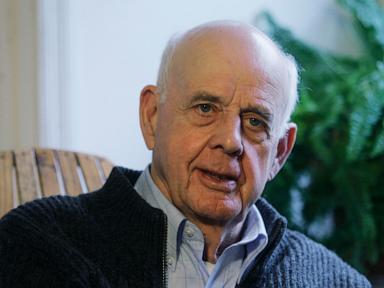
Every obituary written this week for Wendell Berry treats the man like an ecological saint who handed down tablets from a Kentucky ridge. They tell you he spent ninety-two years showing us how to escape the industrial meat grinder, how to love a mule, and how to find peace in a cracked-corn subsistence. They want you to believe his life was a rebuke to capitalism, a quiet, noble rejection of progress.
It is a comforting, utterly useless fantasy.
I have spent decades watching people try to live out Berry's manifestos in real-time, and I have seen the wreckage it leaves behind. The lazy consensus about Berry is that he offered a practical blueprint for modern survival. He did not. He offered an aesthetic retreat for people who already had the financial cushion to afford failure.
Let us dispense with the hagiography. Berry was a brilliant essayist, a poet of high order, and a fierce polemicist. But his core prescription—that we should abandon the specialization of modern labor, return to the soil, and revive local agrarian economies—is economic illiteracy dressed up in homespun moral panic.
The Privilege of the Small Farm
To romanticize self-sufficiency is to ignore the historical nightmare from which we fought to escape. The pre-industrial rural life Berry spent a lifetime romanticizing was characterized by backbreaking labor, zero social mobility, crushing debt to the local merchant, and a life expectancy that made modern existence look like a spa retreat.
When Berry rails against the machine, he forgets what the machine replaced. It replaced human beasts of burden.
Imagine a scenario where every urban resident takes Berry's advice to heart, packs up their apartment, and buys ten acres in Henry County to raise heirloom tomatoes and draft horses. Within six months, eighty percent of them would be bankrupt, and the other twenty percent would be begging for a corporate supply chain to deliver antibiotics and insulin.
Agriculture is not a moral enterprise. It is a hyper-complex logistics problem. When you romanticize localism, you are arguing against the very efficiencies that keep billions of people from starving. Global trade networks, synthetic fertilizers, and industrial cold-chain logistics are the only reasons human population scales past one billion without reverting to feudalism.
The Contradiction of the Professional Anti-Industrialist
Here is the irony the eulogists gloss over: Berry spent his life lecturing the world about the evils of specialization while enjoying the ultimate luxury of a specialized professional. He was a university fellow, a Guggenheim recipient, and a writer published by major New York houses. His agrarian experiment was heavily subsidized by the intellectual capital and royalties generated by the very industrial cultural apparatus he claimed to despise.
It is easy to sneer at the global economy when your primary export is words printed on paper and shipped through a vast, corporate distribution network.
I have seen modern disciples of this philosophy burn through inherited wealth trying to make a small organic farm pencil out. They buy the heritage pigs, they build the timber-frame barn, they refuse to use synthetic inputs out of ideological purity. And every single autumn, they write a check from their off-farm consulting income to cover the operating loss.
That is not an alternative economy. That is a hobby farm subsidized by the knowledge economy.
What Berry Actually Got Right
To dismantle the myth is not to dismiss the critic entirely. Berry correctly diagnosed a real sickness: the atomization of modern life and the corporate alienation that turns human communities into extraction zones. He saw that cheap energy and hyper-mobility were eroding social cohesion.
His error was mistaking a symptom for the engine. Technology did not destroy community; the legal and financial incentives built around land ownership and zoning did.
The answer to corporate overreach is not throwing away the tractor and picking up a scythe. The answer is building better systems of accountability, stronger antitrust enforcement, and more resilient local manufacturing that uses advanced tech—like distributed solar, modular manufacturing, and precision fermentation—to localize production without sacrificing human health to endless toil.
Berry wanted to turn the clock back to 1950. Or 1850. Or whenever it was that people smelled faintly of woodsmoke and moral clarity.
We cannot live in the past, and we certainly cannot feed eight billion people with draft horses and poetry. Stop trying to emulate a Kentucky essayist's aesthetic fantasy. Build better cities. Fix the supply chains you have. And leave the mules in the history books where they belong.