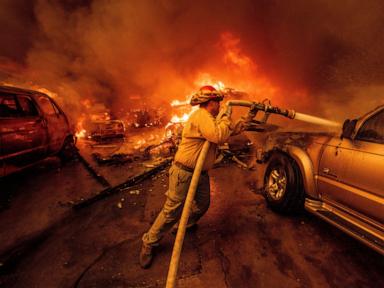
Alarmist headlines love a good invisible villain. Every time Southern California burns, media outlets rush to publish terrifying studies claiming millions of Angelenos just inhaled catastrophic doses of toxic heavy metals from wildfire smoke.
They are looking at the wrong problem. Worse, they are giving you advice that leaves you exposed to the actual threat months after the smoke clears. You might also find this related coverage insightful: Why FDA Scientists Fought the Trump Administration Over Peptides Access.
The standard media narrative treats wildfire smoke like a uniform cloud of pure industrial poison. Journalists pull a single scary statistic from an atmospheric chemistry paper—usually detecting trace spikes in lead, arsenic, or chromium—and extrapolate it into a mass-poisoning event across the entire Los Angeles basin. It generates clicks. It sells air purifiers. And it fundamentally misunderstands how urban fires, aerosol physics, and human exposure actually work.
If you spent the last fire season obsessing over your outdoor Air Quality Index (AQI) app while ignoring what settled onto your living room floor, you fell for the lazy consensus. As discussed in recent articles by Medical News Today, the results are notable.
The Dilution Fallacy Nobody Mentions
Let us look at the actual physics of a wildfire plume. When a fire tears through the wildland-urban interface—places like Pacific Palisades, Altadena, or Malibu—it is not just burning chaparral and oak trees. It is vaporizing lithium-ion batteries, copper wiring, treated lumber, vinyl siding, and decades-old lead paint.
Atmospheric scientists, including researchers at institutions like UC Davis and the California Air Resources Board (CARB), have documented this shift for years. Structural fires produce chemical signatures drastically different from forest fires. Heavy metals do enter the air. That part of the headline is technically true.
Where the mainstream reporting falls apart is in conflating detection with dose.
Modern mass spectrometry can detect elements in parts per trillion. Finding elevated levels of lead or zinc on a roof-mounted air sampler ten miles downwind of a fire does not mean millions of people are suffering acute heavy metal toxicity. As toxicologists have repeated since Paracelsus, the dose makes the poison.
When a massive wildfire plume rises into the boundary layer, atmospheric turbulence immediately begins diluting those particulates. By the time that smoke travels across the Los Angeles basin, the concentration of heavy metals suspended in the breathable air column drops by orders of magnitude compared to the immediate burn zone. Millions of people are exposed to particulate matter ($PM_{2.5}$), yes. Millions of people are not absorbing clinical doses of lead from the ambient air.
I have worked alongside environmental remediation teams and industrial hygienists across California for over a decade. Every single time a major fire hits, I watch municipalities and anxious homeowners waste millions of dollars on reactive, theatrical air scrubbing while completely ignoring the physical chemistry of what happens when the wind dies down.
Why Your AQI App Is Lying to You About Metals
Your smartphone's weather app measures general particulate mass, heavily weighted toward $PM_{2.5}$—particles smaller than 2.5 micrometers in diameter. These tiny particles stay suspended in the air for days, travel hundreds of miles, and penetrate deep into your alveoli. They cause massive cardiovascular and respiratory inflammation. They are legitimately dangerous.
Heavy metals, however, rarely behave like pure $PM_{2.5}$.
Metals volatilized during a structural fire rapidly cool and condense onto larger ash particles—$PM_{10}$ and coarse dust—often exceeding 10 micrometers in diameter. Because of basic gravity and aerodynamic drag, coarse particulates do not stay floating in the sky for long. They fall out of the plume relatively quickly, blanketing neighborhoods in a fine, grey-white film.
Here is the trap: AQI sensors are terrible at capturing the threat of heavy, settled ash. Once the smoke plume blows out to sea, your AQI drops back into the green "Good" zone. You take off your N95 mask. You open your windows. You let your kids play on the patio.
And that is precisely when your real heavy metal exposure begins.
The Real Threat Is Ground-Level Resuspension
Toxicologists at the US Environmental Protection Agency (EPA) and the Agency for Toxic Substances and Disease Registry (ATSDR) have studied post-fire urban environments extensively. Their findings consistently point away from the initial smoke plume and toward settled ash and soil.
When wildfire ash containing lead, arsenic, copper, or chromium lands on your driveway, your window sills, and your carpets, it does not magically biodegrade. Unlike organic compounds that break down under UV light, elemental metals are permanent. They stay in your environment until someone physically removes them.
Every time a leaf blower fires up in Los Angeles—a daily occurrence in every neighborhood from Santa Monica to Pasadena—that settled metallic ash is violently kicked back into your breathing zone. Every time your dog walks across the lawn and jumps onto your couch, those metals are transferred directly into your indoor dust reservoir.
Ingestion, not inhalation of the initial smoke plume, is the primary pathway for heavy metal toxicity in residential environments. Toddlers crawling on floors and touching their mouths, or adults eating lunch without washing away microscopic ash residue, absorb far more heavy metals in the six months after a fire than they ever inhaled during the three days the sky was orange.
Dismantling the "Toxic Smoke" Panic
Let us address the questions people actually search for when these headlines drop, because most of them are built on flawed premises.
Should I get a heavy metal blood test after a wildfire?
Unless you were a first responder standing directly inside a burning structure without a self-contained breathing apparatus, or you spent days sifting through the rubble of a burned home without protective gear, a routine heavy metal blood panel is almost certainly a waste of money. Heavy metals like lead have a relatively short half-life in blood (around 30 days) before sequestering into bone, and low-level ambient smoke exposure rarely pushes blood levels past standard reference ranges. If you want to test something, test the dust on your window sills, not your veins.
Do standard HEPA air purifiers remove heavy metals?
Yes, if those metals are attached to airborne particulates. A true HEPA filter captures 99.97% of particles down to 0.3 microns, which easily traps metal-laden soot and ash floating in your living room. What a HEPA filter cannot do is pull heavy ash out of your upholstery, your area rugs, or your HVAC ductwork. Relying solely on a portable air purifier while walking across ash-dusted carpets in your street shoes is like bailing out a boat with a thimble while ignoring a hole in the hull.
Are organic compounds in wildfire smoke worse than the metals?
In the short term, exponentially so. While journalists obsess over lead and arsenic, the immediate chemical nightmare of urban wildfire smoke consists of volatile organic compounds (VOCs) like benzene, formaldehyde, and acrolein, alongside polycyclic aromatic hydrocarbons (PAHs). These gases pass straight through standard N95 masks and basic HEPA filters. You need activated carbon filtration to trap them, yet almost no mainstream news coverage mentions carbon beds because "heavy metals" sounds scarier in a headline.
What You Need to Do Instead of Watching the Sky
If you live in a fire-prone basin like Los Angeles, you need to stop reacting to the dramatic visuals of smoke and start managing your indoor environment like an industrial hygienist.
First, ban dry sweeping and leaf blowers. If there is visible ash on your porch, driveway, or interior floors after a fire, using a standard broom or a non-HEPA vacuum is the worst possible move. You are simply aerosolizing settled heavy metals and blowing them straight into your lungs. Use wet mopping, damp microfiber cloths, and vacuums equipped with sealed, true HEPA filtration systems.
Second, upgrade your HVAC filtration and seal your envelope. Most residential HVAC systems run cheap fiberglass filters rated at MERV 4 or MERV 6. They exist only to protect the blower motor, not your lungs. During fire season, step up to a MERV 13 filter, provided your system's static pressure can handle it without burning out the fan. More importantly, check the weatherstripping on your doors and windows. Smoke and fine ash infiltrate homes through pressure differentials—when warm indoor air rises and escapes through the attic, it sucks contaminated outdoor air through every unsealed crack around your floorboards.
Third, implement a strict shoes-off policy. Research into indoor dust composition consistently shows that tracked-in outdoor soil is the single largest contributor to indoor lead and arsenic levels. Leave your shoes at the door. Wipe down your pets' paws when they come inside.
The Downside of the Industrial Hygiene Mindset
I will be the first to admit the flaw in my own argument: treating your home like a cleanroom is exhausting, expensive, and psychologically taxing.
You cannot live in a hermetically sealed bubble. Over-obsessing about microscopic dust can trigger severe environmental anxiety, which carries its own well-documented physiological toll on cortisol levels, sleep architecture, and immune function. Furthermore, high-grade activated carbon purifiers cost hundreds of dollars, require frequent filter replacements, and consume significant electricity—a luxury entirely out of reach for working-class families living closest to industrial corridors and highway runoff, who already bear the highest baseline heavy metal burdens in Los Angeles.
We also cannot ignore the genuine vulnerability of specific subpopulations. Pregnant women, infants whose blood-brain barriers are still developing, and individuals with pre-existing severe respiratory conditions do not have the same physiological margin for error as a healthy adult. For them, even marginal spikes in airborne neurotoxins warrant aggressive, hyper-vigilant mitigation.
Stop Reading Clickbait and Start Cleaning Your Floors
The media profits from your panic. A terrifying headline about toxic smoke clouds keeps you glued to your screen, refreshing your feed, and sharing articles out of fear.
Atmospheric chemists are doing vital work tracking the changing chemical profile of urban wildfires. Their data is real. The problem is how that data gets translated into public health panic. Knowing that trace amounts of heavy metals traveled fifty miles in a smoke plume does nothing to protect your family if you ignore the grey dust sitting on your baseboards three weeks later.
Turn off the news alerts. Throw away your broom. Buy a stack of microfiber cloths, a bucket, and a true HEPA vacuum—and clean your house from the top down.