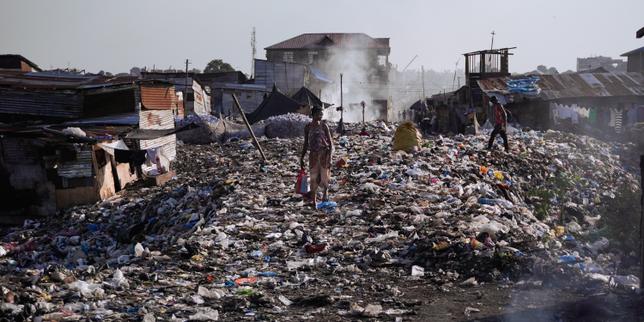
The standard humanitarian narrative regarding Kinshasa’s Mama Nzénzé slum is a masterclass in missing the point. You’ve read the reports: the tragic imagery of families "perched on mountains of trash" to escape the rising waters of the Congo River, the inevitable mention of cholera, and the hand-wringing over "inhumane" conditions. These stories treat the waste under Mama Nzénzé as a passive tragedy. They see a pile of garbage. They should be seeing a sophisticated, albeit desperate, engineering feat that the formal state was too incompetent to provide.
Western observers and local elites look at these settlements and see a mess to be cleared. I’ve spent enough time in rapid-growth urban environments to know that what looks like a disaster is often a grassroots adaptation to systemic failure. The residents of Mama Nzénzé aren't just victims of pollution. They are the only ones actually building infrastructure in a city where the "formal" budget disappears into a black hole of administrative graft.
The Infrastructure of the Ignored
Most people assume that building a house on trash is a sign of ultimate defeat. It isn't. In the context of Kinshasa’s floodplains, it is a calculated choice. The soil in these regions is often unstable, saturated, and prone to liquefaction during the heavy rains that define the local climate. Traditional fill dirt is expensive. It requires trucks, logistics, and capital that the average Kinshasa resident—surviving on less than $2 a day—cannot access.
Garbage, however, is free. It is abundant. When compacted correctly, certain types of non-organic waste—plastics, textiles, and rubber—create a surprisingly resilient, buoyant substrate. This isn't "living on trash." It’s a decentralized reclamation project. While the city government fails to build levees or install drainage, the residents are literally raising the elevation of their lives using the only material the city provides in surplus: its own refuse.
The tragedy isn't that they are using waste. The tragedy is that we haven’t provided the chemical or mechanical tools to make that waste safe. If we stopped trying to "relocate" these people—which never works and only creates new slums further out—and instead provided simple binders or stabilizing agents, we could turn these "trash mountains" into viable, hardened land in a matter of months.
Why the "Health Crisis" Argument is Lazy
"Everyone is sick." That’s the headline. It’s a factual statement used to support a flawed solution. The assumption is that if you remove the trash, you remove the sickness. This ignores the biological reality of the region. The primary killers in Kinshasa aren't just "trash"; they are waterborne pathogens and mosquito-borne viruses that thrive in stagnant water.
If you remove the "trash mountain" without fixing the underlying drainage of the entire Congo Basin urban area, you don't get a clean neighborhood. You get a swamp. A swamp is a far more efficient breeding ground for malaria and typhoid than a dry pile of compacted plastic. By elevating their homes, the residents of Mama Nzénzé are actually attempting to escape the dampness that breeds the most lethal threats. They are trading the risk of dermatological infections and respiratory issues for the lower risk of drowning or contracting high-load malaria in the lowlands.
It’s a brutal trade-off. But it’s a rational one. The "experts" who suggest they just move are ignoring the economic geography. These people live on trash because they need to be near the markets, the ports, and the informal labor hubs. Moving to a "clean" government-built housing project 40 kilometers outside the city is a death sentence for their livelihoods.
The Scavenger Economy is the Future of Recycling
The world’s most advanced circular economies aren't happening in San Francisco or Stockholm. They are happening in places like Mama Nzénzé and the Zabbaleen districts of Cairo. In the West, "recycling" is a subsidized luxury where we put things in blue bins and hope for the best. In Kinshasa, recycling is a high-stakes, high-efficiency extraction industry.
Every piece of waste added to the foundation of these homes has been picked over. Metal is gone. High-value plastics are gone. What remains is the "tailings" of the urban waste stream.
Instead of sending in NGOs to hand out soap and pamphlets, we should be deploying micro-industrial technology. Imagine a scenario where we provide small-scale, solar-powered plastic extruders to these neighborhoods. Suddenly, the "trash" isn't just fill-dirt; it becomes the raw material for interlocking bricks, roofing tiles, and drainage pipes.
The Fallacy of Formalization
The common "solution" offered for Mama Nzénzé is formalization: register the land, build paved roads, and install a centralized waste management system. This is a fantasy. The Congolese state does not have the fiscal capacity or the political will to manage a city of 17 million people using 20th-century European models.
When you try to "formalize" a slum, you usually just end up displacing the poorest residents. The moment a road is paved, the land value rises. Slum-lords or government officials swoop in, "clear" the area, and build mid-level apartments that the original residents can’t afford. The "problem" isn't solved; it’s just pushed three miles down the river.
We need to embrace "Radical Incrementalism." This means:
- Bio-stabilization: Distributing specific fungi or bacteria that can break down organic waste faster within the trash piles without releasing toxic methane plumes.
- Waste-to-Energy: Deploying small-scale anaerobic digesters that turn the organic portion of the neighborhood’s waste into cooking gas, reducing the need for charcoal (which is destroying the Congo’s forests).
- Floating Architecture: Acknowledging that the river will win. Instead of fighting the flood with trash, we should be helping these communities transition to amphibious housing technologies.
The Discomfort of the Truth
The hardest pill for the international community to swallow is that Mama Nzénzé is a glimpse of the future, not a relic of the past. As climate change accelerates and the global population centers in the "Global South" explode, more people will be living in these liminal spaces—between land and water, between waste and resource.
If we keep looking at these communities through the lens of pity, we keep offering useless solutions. We offer "aid" when we should be offering "investment." We offer "cleaning" when we should be offering "processing."
The residents of Mama Nzénzé are already engineers and urban planners. They just don't have your degrees, and they're working with a much worse toolkit. The status quo thinks they need to be saved from their environment. I’m telling you the environment needs to be upgraded to match their resilience.
Stop looking for the "end" of the slum. Start looking for the beginning of the modular, waste-built city. It’s already there. It’s just smells bad and makes you feel guilty, so you refuse to see it.
The people of Mama Nzénzé don't need a fundraiser. They need a supply chain. They are already standing on the foundation of their own survival; we just need to help them make that foundation out of something better than last month's discarded water bottles.
Build the extruders. Distribute the binders. Get out of the way.



