Every time archaeologists pull a glass vial or a tarnished piece of metal out of the volcanic ash in Italy, the press releases call them "treasures."
They aren't.
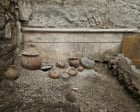
When researchers recently unearthed a perfume bottle, a child’s necklace, and an assortment of household items inside a plaster cast of a wooden wardrobe in Pompeii’s Regio V, media outlets immediately spun the discovery into a sentimental fairy tale. They framed these objects as glittering, priceless relics of a vanished golden age. That narrative is lazy, historically inaccurate, and actively obscures what makes this discovery actually worth reading about.
If you want to understand ancient Rome, stop looking at these items through the lens of a modern jewelry heist. Start looking at them as the mundane, everyday clutter of a middle-class family who had zero idea their world was about to end.
The Lie of the "Treasure" Narrative
Walk into any museum gift shop or read any mainstream archaeology headline, and you will see the same tired trope. Everything dug out of the ground is labeled a treasure. It is a cheap rhetorical trick designed to generate clicks by triggering our obsession with gold, royalty, and hoarded wealth.
In the field of classical archaeology, this obsession with "treasures" has ruined entire sites. Early excavators in the 18th and 19th centuries—men working under Bourbon patronage—literally hacked through painted frescoes and smashed common pottery just to get to marble statues and gold coins. They threw away the real history because they were blinded by shiny objects.
I have watched junior researchers and public relations teams make the exact same mistake today. They take a phenomenal piece of archaeological context—a preserved wooden cabinet from the House of the Lararium—and cheapen it by hyping up a child’s pendant and a glass unguentarium.
Calling a Roman perfume bottle a treasure is like digging up a suburban bathroom cabinet from 2026 and calling a half-empty bottle of drugstore cologne and a plastic beaded bracelet the crown jewels of the twenty-first century.
What Was Actually Inside That Cabinet
Let’s look at the hard, unvarnished facts of what the Archaeological Park of Pompeii actually documented inside that wooden wardrobe:
- Glass and terracotta vessels: Standard containers used for oils, ointments, and cosmetics.
- A child’s necklace: Likely made of bronze or glass paste, functioning as a protective amulet rather than high-end luxury jewelry.
- Everyday tableware: Plates, bowls, and ceramic cups stored alongside personal grooming items.
- Bone and metal fragments: Hairpins, hinges, and basic domestic hardware.
Notice what is missing? Solid gold bullion. Imperial signet rings. Rare imported gemstones from India.
The true value of this find has nothing to do with the intrinsic worth of the objects. It lies entirely in the archaeological context—the exact spatial relationship between mundane items frozen in time by the pyroclastic surge of Mount Vesuvius in 79 AD.
Why Plaster Casts Matter More Than Gold
To appreciate why this wardrobe is a massive deal for historians, you have to understand the mechanics of how Pompeii died.
Unlike Herculaneum, which was instantly carbonized by blistering thermal shock, Pompeii was buried under meters of pumice and fine volcanic ash. Over the centuries, organic materials—human bodies, wooden doors, beds, and storage cabinets—rotted away beneath the hardened ash, leaving behind hollow voids.
In 1863, Italian archaeologist Giuseppe Fiorelli pioneered the technique of pouring liquid plaster into these voids. When the ash was chipped away, the exact shape of the vanished object or person emerged.
When excavators applied this Fiorelli method to the voids in the House of the Lararium, they didn't just find objects lying on the dirt. They reconstructed the physical shelves and doors of a Roman wardrobe that collapsed during the eruption.
This is the nuance the mainstream headlines miss. We already have thousands of Roman perfume bottles in museum basements from London to Cairo. You can buy authentic Roman glass vials at reputable antiquities auctions for a few hundred dollars. They are not rare.
What is rare is knowing precisely how a lower-middle-class Roman family organized their living space. Seeing plates stacked right next to cosmetic vials and a child's protective charm tells us that space in this household was tight. They didn't have a separate dining pantry and a dedicated dressing room. They shoved their dinnerware and their personal hygiene products into the exact same wooden cupboard.
The Reality of Roman Hygiene and Cosmetics
The media loves to romanticize the "perfume bottle" found in the wardrobe, conjuring images of wealthy Roman matrons lounging in marble baths, dabbing exotic floral essences onto their wrists.
Here is the brutal reality of ancient Roman hygiene: cities like Pompeii smelled horrific.
Without modern sanitation, open sewers, tanneries using human urine to process leather, and thousands of people living in cramped quarters without daily showers, heavy oils and perfumes were not a luxury. They were chemical warfare against body odor and street stench.
Roman perfumes were not alcohol-based sprays like modern fragrances. They were thick, oily infusions made by steeping botanicals—like rose, iris, saffron, or myrrh—in olive oil or almond oil. Because oil goes rancid quickly in the Mediterranean heat, people bought them in tiny, narrow-necked glass vessels called unguentaria or balsamaria.
The narrow neck wasn't an artistic choice. It was functional engineering designed to dispense a single drop of thick oil at a time and minimize exposure to air.
Furthermore, cosmetics and medicinal ointments were heavily overlapping categories in the first century AD. Pliny the Elder, writing in his Naturalis Historia just years before Vesuvius erupted, documented hundreds of oil-based concoctions used simultaneously to mask odor, treat skin lesions, and ward off infections. That "perfume bottle" in the wardrobe was just as likely a topical medicine for rashes as it was a beauty product.
The Child’s Necklace Was Not Fashion
The second item hyped in every press summary is the "child’s necklace." Again, modern readers immediately project 21st-century sentimentality onto it. They picture a doting parent buying a cute accessory for their kid.
In ancient Rome, children didn't wear jewelry for fashion. They wore it for survival.
Infant and child mortality rates in the Roman Empire were staggering. Roughly 30% to 50% of children died before reaching puberty due to infectious diseases, malnutrition, and basic injuries. Parents lived in a state of constant, low-grade terror that their offspring would be snatched away by fever or bad luck.
To combat this, Roman children wore apotropaic amulets—objects believed to have the magical power to deflect the "Evil Eye" (invidia) and ward off malignant spirits.
For wealthy boys, this was the bulla, a hollow pouch made of gold sheet containing protective charms. For girls, it was often a lunula, a crescent-shaped pendant honoring the moon goddess Luna. For families without the wealth to afford gold, these protective necklaces were forged from cheap bronze, bone, or colored glass beads.
Finding a child’s necklace tucked into a household wardrobe isn't a heartwarming fashion detail. It is stark physical evidence of parental anxiety in an era before antibiotics. It shows a family relying on folk magic and cheap metallurgy to keep their kid alive in a brutal world.
Why People Ask the Wrong Questions About Pompeii
Whenever a major excavation update drops from Pompeii, search engines light up with the same predictable questions. If you actually want to understand the site, you have to dismantle the flawed premises behind what people are asking.
"Are there still undiscovered treasures in Pompeii?"
This is the wrong question because it assumes Pompeii is a giant Easter egg hunt waiting to be finished. Roughly one-third of the ancient city remains unexcavated—about 22 hectares still buried under volcanic debris.
However, modern archaeologists are actively avoiding digging up the rest of the city. Excavating Pompeii is a death sentence for the ruins. The moment painted frescoes and plaster walls are exposed to modern air, sunlight, acid rain, and tourist humidity, they begin to disintegrate.
The current directorate at Pompeii, led by Gabriel Zuchtriegel, focuses almost entirely on securing the borders between the excavated and unexcavated zones to prevent structural collapses. The wardrobe findings happened not because researchers were hunting for "treasures," but because they were conducting essential stabilization work in Regio V to keep earthen embankments from caving in.
"Why didn't the people in that house take their belongings when they fled?"
People assume the eruption of Vesuvius was a sudden, instantaneous explosion where everyone died in five seconds while eating dinner. That is a myth created by Hollywood disaster movies.
The eruption lasted roughly 18 to 20 hours. It began around noon with a massive column of ash and pumice raining down on the city. For hours, pumice stones fell like heavy hail, gradually accumulating on roofs until the weight caused timber beams to snap.
Thousands of residents fled during those early hours, taking whatever portable wealth they could carry. The people who stayed behind—and the items left inside that wooden wardrobe—tell a different story. Either the residents fled in a panic during the first roof collapses and abandoned their everyday clutter, or they huddled inside, convinced the storm would pass, until the lethal pyroclastic surges hit the following morning and killed everyone instantly.
You don't grab cheap terracotta plates and a half-empty oil bottle when the roof is caving in. You leave the wardrobe closed and run for your life.
The Dark Side of Celebrating Everyday Clutter
I will admit the obvious flaw in my own argument: nobody clicks on an article titled "Archaeologists Document Mid-Tier First-Century Storage Habits."
If museums and researchers don't use romantic language like "treasures" and "priceless relics," public funding dries up. Tourism drops. The Italian Ministry of Culture relies heavily on media sensationalism to justify the millions of euros spent maintaining a sprawling, crumbling 66-hectare open-air ruin. Without the fairy-tale narrative, the money stops flowing, and the site rots.
Even prominent classical historians like Mary Beard have had to balance rigorous academic reality with accessible storytelling to keep the public engaged with Roman social history. If calling a bronze pendant a treasure gets ten million people to read about ancient domestic life, the PR teams will argue the ends justify the means.
That is a valid practical defense, but it comes at a steep intellectual cost. When we flatten history into a collection of pretty, sanitized "treasures," we erase the real human beings who lived there. We turn complex, struggling, superstitious, foul-smelling, deeply relatable people into cartoon characters living in a marble theme park.
How to Actually Read Archaeological News
Stop falling for the press-release hype cycle. The next time a major discovery is announced from Pompeii, Herculaneum, or any ancient site, apply a simple filter to separate the PR fluff from the actual science:
- Ignore the adjectives. Strip away words like stunning, priceless, treasure, exquisite, and mysterious. Look strictly at the material composition (terracotta, bronze, glass, bone) and the physical dimensions.
- Look for the "in situ" status. Ask whether the object was found in situ—in its original resting place—or in a rubble pile. A cracked clay pot found in its original kitchen corner is infinitely more valuable to science than a pristine gold coin found in a random trench.
- Check the neighborhood. Pompeii was not a monolithic rich resort town. It was a gritty port and agricultural hub with massive wealth inequality. Check which Regio (district) the find came from. Regio V was a dense, mixed-use area where modest workshops rubbed shoulders with mid-sized homes. Context dictates meaning.
- Follow the preservation work, not the digging. The real breakthroughs in modern archaeology happen in the lab and through non-invasive tech—like LiDAR, ground-penetrating radar, and plaster casting—not from men swinging pickaxes.
The House of the Lararium wardrobe isn't a treasure chest. It is something infinitely better: a brutally honest snapshot of an ordinary family's messy, anxious, unglamorous Tuesday morning right before the sky fell. Stop insulting their memory by pretending they were living in a jewelry store.