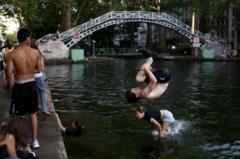
Every time a heatwave strikes Europe, the global media collective runs the exact same photo essay. You have seen it a thousand times: sun-drenched locals leaping into the Canal de l’Ourcq, children splashing in fountains under the Eiffel Tower, and copy-pasted headlines about Parisians "cooling off" during a meteorological red alert.
It is a charming, pastoral image of urban resilience. It is also a complete lie.
As an urban infrastructure analyst who has spent a decade studying how European metros adapt to climate shifts, I am exhausted by this lazy romanticism. These fluff pieces frame wild urban swimming as a triumphant return to nature or a quirky cultural fix. In reality, diving into a historic industrial canal during a severe heat peak is a desperate, structurally flawed reaction to catastrophic urban planning. We are cheering for a symptom while the patient suffocates.
The Toxic Reality of Canal Water Dynamics
Let’s dismantle the biggest myth first: that urban waterways during a heatwave are safe, natural cooling stations. They are not. They are stagnant, high-temperature chemical stews.
When a "red alert" heatwave hits Paris, ambient temperatures routinely breach 40°C (104°F). Under these conditions, small, slow-moving water bodies like the Canal de l’Ourcq or the Canal Saint-Martin experience rapid thermal spikes. This is basic fluid thermodynamics. High water temperatures combined with intense sunlight trigger a massive spike in cyanobacteria (blue-green algae) blooms.
Furthermore, Paris relies heavily on a combined sewer system. This means wastewater and stormwater flow through the same pipes. When a heatwave is broken by a sudden, violent summer thunderstorm—a frequent occurrence in Central France—the system overflows. Raw sewage bypasses treatment facilities and dumps directly into the canals and the Seine.
[Intense Heatwave] ➔ Spikes Water Temperature ➔ Algae Growth & Low Oxygen
       ↓
[Summer Storm] ➔ Combined Sewer Overflow ➔ Raw Sewage Dumps into Canal
       ↓
[The Result] ➔ High Concentrations of E. coli, Enterococci, and Leptospirosis
Swimming in these canals during a red alert exposes you to severe pathogens:
- Escherichia coli (E. coli): Indicates direct fecal contamination, causing severe gastrointestinal distress.
- Intestinal Enterococci: Hardier than E. coli, surviving longer in warm canal environments.
- Leptospirosis: A bacterial disease transmitted via rat urine, highly prevalent along the stone embankments of Paris. It enters through small cuts or mucous membranes, leading to potential kidney damage.
When a media outlet publishes a photo of a teenager diving into a Paris canal during a heatwave, they aren’t showing you a lifestyle hack. They are showing you someone playing microbiological Russian roulette.
The Microclimate Fallacy
"But at least it cools the city down," the commentators argue. Wrong again.
Water bodies only provide a microclimatic cooling effect if they have sufficient surface area and are paired with extensive vegetation to facilitate evapotranspiration—the process by which water is transferred from the land to the atmosphere by evaporation and by transpiration from plants. Concrete-banked canals running through dense stone neighborhoods do not function like natural lakes.
The heat island effect of Paris is notoriously aggressive. The city’s famous Haussmann architecture relies on dense, zinc-roofed limestone buildings that absorb solar radiation all day and radiate it back out all night. A narrow ribbon of slow-moving water trapped between hot stone quays acts as a heat sink, not a coolant. The humidity immediately above the water rises, suppressing the human body's ability to cool itself through sweating.
The data proves this. Microclimate monitoring shows that the cooling benefit of the Paris canals extends barely 30 meters from the water’s edge. Beyond that narrow strip, the oppressive heat remains completely unchanged.
The Class Divide of Urban Thermal Comfort
The media's obsession with canal swimming masks a much uglier truth about European urban planning: the brutal disparity in thermal comfort.
I have audited residential energy profiles across Paris, and the data is stark. Air conditioning is historically rare in Parisian apartments, viewed as an American excess or an aesthetic stain on historic facades. But when a red alert hits, the wealthy do not swim in the Canal de l’Ourcq. They retreat to heavily insulated suburban properties, air-conditioned luxury hotels, or private clubs.
The people leaping into the canals are predominantly working-class residents, often from the high-density, low-income neighborhoods of the 19th and 20th arrondissements, or the adjacent northeastern suburbs like Seine-Saint-Denis. They are fleeing cramped, top-floor "chambres de bonne" (former maid’s rooms) that turn into literal brick ovens during a heatwave, reaching interior temperatures upwards of 45°C.
Framing canal swimming as a romantic cultural tradition sanitizes a failure of public infrastructure. It tells low-income residents that their primary defense against lethal heatwaves is a dangerous, illegal dip in industrial runoff, rather than a systemic right to cooled public spaces, green infrastructure, and retrofitted housing.
Dismantling the "People Also Ask" Assumptions
To truly fix how we talk about this, we have to look at the fundamentally flawed questions people ask during these heat crises.
Can you swim in the canals of Paris legally?
No. Except for highly regulated, structurally managed events like "Paris Plages" at the Bassin de la Villette—where the water is continuously monitored and filtered—swimming in the Paris canals is strictly prohibited by prefectural decree. The police issue fines for a reason: the underwater mechanics of these canals are incredibly hazardous. They feature active commercial barge traffic, hidden metallic debris, and unpredictable lock currents that can trap a swimmer underwater in seconds.
Is the Seine clean enough to swim in now?
Despite the massive multi-billion-euro cleanup campaign ahead of major international sporting events, the answer remains highly conditional. While heavy filtration basins have significantly reduced baseline bacterial counts, the river remains highly volatile. A single heavy rainfall event can render the water toxic within hours. Treating a major river system as a permanent public swimming pool without structural, ongoing industrial filtration is an illusion.
How does Paris handle heatwaves?
The current strategy relies heavily on defensive, low-tech measures: opening air-conditioned public halls, extending park hours, and distributing water. While these steps prevent immediate mortality, they are passive. They do not alter the physical landscape of the city, which remains fundamentally unequipped for the realities of modern climate volatility.
Stop Visualizing Solutions; Build Structural Shade
If jumping in the water is a trap, what is the actual alternative? The solution requires stripping away the aesthetic obsession with historic preservation and fundamentally altering the urban fabric.
Paris does not need more public fountains or temporary beaches. Paris needs to kill the asphalt.
Urban Surface Albedo Comparison (Reflectivity Index)
-----------------------------------------------------------
Traditional Asphalt        | █░░░░░░░░░░░░░░ (0.05 - 0.10)
Haussmann Zinc Roofs       | ████░░░░░░░░░░░ (0.20 - 0.25)
Permeable Green Pavement   | ██████████░░░░░ (0.60 - 0.70)
Engineered Cool Pavement   | ██████████████░ (0.80+)
The city must aggressively transition to high-albedo (highly reflective) surfaces and permeable green infrastructure. We need to tear up the stone and asphalt along the banks of the canals and replace them with deep-soil linear forests. Trees don’t just block the sun; they actively drop the local air temperature through transpiration. A mature tree canopy can lower surface temperatures by up to 12°C compared to bare pavement.
We also must address the architectural elephant in the room: the zinc roofs. Those iconic, grey roofs look beautiful in movies, but they are thermal catastrophes. They account for a massive percentage of the city's night-time heat radiation. If Paris wants to survive the next decade of summer red alerts, it must mandate the retrofitting of these roofs with reflective coatings or green roofing systems, historic aesthetics be damned.
The Downside We Have to Accept
Let's be brutally honest about the cost of this contrarian approach. If we strip away the romanticized narrative of the spontaneous urban swimmer and enforce strict canal bans while aggressively transforming the city, we destroy the classic postcard image of Paris.
Transforming the quays into dense urban forests means blocking historic sightlines. Retrofitting Haussmann buildings means altering iconic facades. It will cost billions, anger preservationists, and make the city look like a massive construction zone for a decade.
But the alternative is far worse. The alternative is continuing to treat a lethal infrastructure failure as a picturesque photo opportunity. Stop clapping for the people jumping into the toxic canals. Start demanding a city that doesn't force them to jump in the first place.