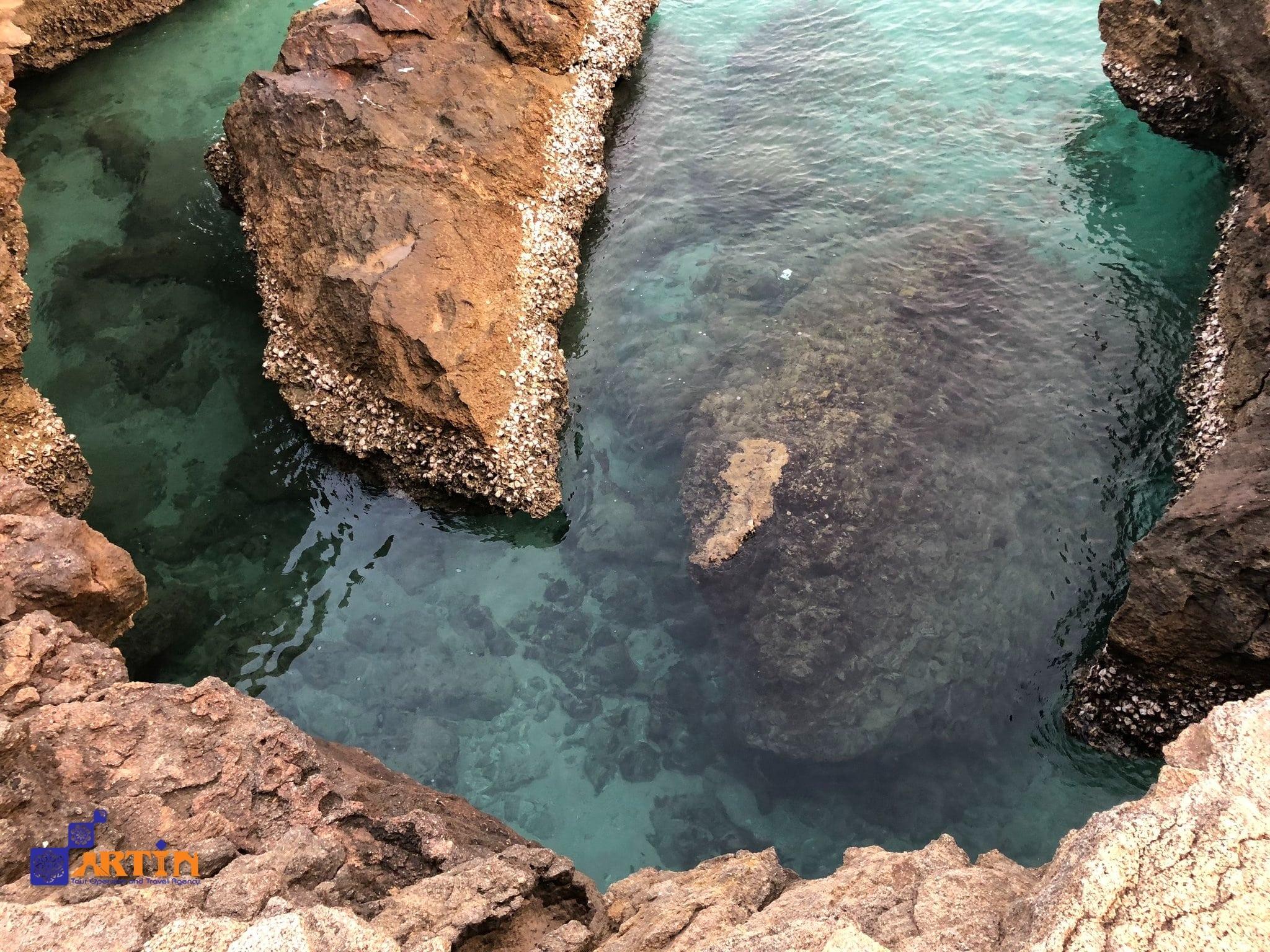
The Strait of Hormuz is not a binary switch for global energy flow but a managed bottleneck where the Iranian military has transitioned from surface-level harassment to a permanent, subterranean structural advantage. At the center of this transition is Qeshm Island. Unlike traditional naval bases that rely on visible piers and reinforced concrete hangars, Qeshm has been re-engineered into a geological fortress. This process, defined here as Strategic Calcification, utilizes the island’s unique salt diapirism and sedimentary layers to mask a sophisticated Anti-Access/Area Denial (A2/AD) network that effectively nullifies superior carrier strike group optics.
The Geological Arbitrage of the Namakdan Massif
The primary defensive utility of Qeshm is not its size, but its lithology. The island sits atop a series of salt domes and Neogene sedimentary rock. For an engineering force, these formations offer a specific "Hardness-to-Effort" ratio that is superior to the granite or basalt found in other regional mountain ranges.
The Namakdan salt dome, located on the southwestern portion of the island, provides a natural shield against kinetic penetrators. Salt is uniquely suited for hardened storage for three reasons:
- Self-sealing properties: Under pressure, salt exhibits plastic flow, meaning micro-fissures caused by nearby seismic shocks or conventional bunker-busters can naturally "heal," maintaining the structural integrity of the interior chambers.
- Thermal Regulation: Constant internal temperatures protect the volatile solid-fuel components of the Fateh-110 and Zolfaghar missile classes, which degrade under the extreme surface heat of the Persian Gulf.
- Signal Attenuation: The sheer density of the overburden—often exceeding 300 meters of rock and salt—creates a literal "black hole" for ground-penetrating radar and high-frequency ELINT (Electronic Intelligence) attempts to map internal movement.
By moving assets into these "missile cities," the Iranian Revolutionary Guard Corps (IRGC) has shifted the cost-exchange ratio of any potential conflict. An adversary must utilize multi-million dollar bunker-buster munitions (like the GBU-57 MOP) simply to attempt a breach, while the defender maintains a low-cost, reusable launch platform.
The Three Pillars of the Qeshm A2/AD Framework
The military value of Qeshm is derived from its ability to synchronize three distinct tactical layers. If any one pillar is neutralized, the island remains a threat; if all three are active, the Strait of Hormuz becomes functionally impassable for unescorted commercial or mid-tier naval vessels.
1. Vector Displacement and Masking
Qeshm’s 135-kilometer length runs parallel to the Iranian coastline, creating a narrow "corridor" of water. This geography allows for Vector Displacement. Missile batteries do not need to be positioned on the coast where they are vulnerable. Instead, they are housed deep inland within the Namakdan tunnels and moved to "pop-up" launch points via internal rail systems or reinforced road galleries. By the time a satellite detects a thermal launch signature, the TEL (Transporter Erector Launcher) has already retreated back into the geological shield.
2. The Asymmetric Swarm Anchor
While the missiles provide the "long-range" threat, the island’s jagged coastline and mangrove forests (the Hara Forest) serve as a littoral screening force. This area acts as a docking and refueling station for fast-attack craft (FAC) and fast-inshore attack craft (FIAC). These vessels, often armed with C-704 anti-ship missiles or heavyweight torpedoes, utilize the island’s "radar shadows"—areas where high terrain blocks the line-of-sight of shipborne SPY-1 radars—to approach large targets undetected.
3. Integrated Sensor Fusion
Qeshm serves as the primary node for a redundant sensor net. This includes:
- HF Over-the-Horizon (OTH) Radar: Capable of detecting surface vessels far beyond the visual horizon by bouncing signals off the ionosphere.
- Passive Acoustic Arrays: Submerged hydrophones along the Qeshm-Hengam axis that track the acoustic signatures of nuclear-powered submarines and large tankers.
- Electro-Optical/Infrared (EO/IR) Towers: Hardened observation posts that provide real-time, non-emissive tracking, meaning they do not give off a signal that can be jammed or targeted by anti-radiation missiles.
The Logistics of Subterranean Survival
The transformation of Qeshm into an "Underground Missile City" requires more than just digging holes. It necessitates a closed-loop life support and operational system. Logistics within the Namakdan complex are governed by a Functional Compartmentalization strategy.
The tunnels are not a single continuous loop but a series of honeycombed cells. This design ensures that a single successful "lucky hit" or internal accident does not lead to a catastrophic chain reaction of explosions. Each cell contains its own independent power generation (likely shielded diesel generators), air filtration systems to scrub out chemical or biological contaminants, and significant fuel storage.
The movement of heavy ordnance, such as the Khalij Fars (Persian Gulf) anti-ship ballistic missile, requires reinforced floor slabs and specialized heavy-lift cranes integrated into the tunnel ceilings. These missiles, which reportedly have a range of 300 kilometers and use an infrared seeker for terminal guidance, give Qeshm the ability to strike targets not just in the Strait, but well into the Gulf of Oman.
The Economic Chokepoint: Quantifying the Risk
The strategic intent behind Qeshm is the weaponization of global trade volatility. The Strait of Hormuz is approximately 33 kilometers wide at its narrowest point, but the actual shipping lanes—split into inbound and outbound channels—are only two miles wide each, separated by a two-mile buffer zone.
The positioning of Qeshm allows Iran to apply a Kinetic Tax on global shipping. In a period of heightened tension, the mere activation of target-acquisition radars on Qeshm increases maritime insurance premiums (War Risk Surcharges) by 50% to 200% within 24 hours.
If the island's batteries were to engage, the physical bottleneck of the shipping lanes creates a "Target Rich Environment." A disabled VLCC (Very Large Crude Carrier) in the narrow channel doesn't just represent the loss of two million barrels of oil; it becomes a physical block, a 330-meter-long steel reef that obstructs all subsequent traffic. This creates a "Cascading Logistics Failure" where the global supply of oil drops by 20% near-instantaneously, with no viable alternative route (as the East-West Pipeline across Saudi Arabia lacks the capacity to absorb the total volume).
Limitations and Systemic Vulnerabilities
Despite the formidable nature of the Qeshm complex, it is not an invincible system. A data-driven assessment reveals three critical vulnerabilities that an opposing force would exploit.
First, the Ventilation Bottleneck. Subterranean facilities require massive air exchange to operate internal combustion engines and to keep human operators alive. These intake and exhaust vents are the "Achilles' Heel" of the Namakdan complex. They are difficult to hide from high-resolution thermal imaging and are susceptible to thermobaric weapons, which can use the facility’s own ventilation ducts to travel deep into the interior and consume all available oxygen.
Second, the Digital Signature. While the missiles are physically shielded, the command-and-control (C2) signals required to coordinate a synchronized strike are not. The transition from "dormant" to "active" status requires a massive spike in encrypted data traffic. Signal intelligence (SIGINT) can detect these spikes, providing a 15-to-30-minute early warning window that allows carrier groups to move into a defensive posture or launch pre-emptive electronic warfare strikes to jam the missile’s terminal seekers.
Third, the Supply Chain Dependency. Qeshm is an island. While it has significant internal stores, it is not self-sufficient for long-term high-intensity conflict. A sustained naval blockade that severs the link between Bandar Abbas and Qeshm would eventually deplete the island’s munitions and food supplies. The IRGC compensates for this by using "shadow shipping"—disguised civilian dhows and ferries—to move supplies under the cover of regular commerce.
Tactical Shift: From Deterrence to Denial
The evolution of Qeshm signals a shift in Iranian military doctrine. Historically, Iran relied on the threat of "closing the Strait" as a diplomatic bargaining chip. The construction of the Qeshm missile city suggests they have moved toward a Permanent Denial posture.
This is evidenced by the deployment of the Abu Mahdi cruise missile, which has a range of over 1,000 kilometers and features AI-enabled swarm capabilities. When launched from the protected interior of Qeshm, these missiles can be programmed to approach a naval task force from multiple vectors simultaneously, saturating the AEGIS combat system’s processing limit.
The island is no longer just a site of interest; it is the physical manifestation of a "Fortress Iran" strategy that seeks to make the cost of intervention in the Persian Gulf prohibitively high for any external power.
The strategic play for any actor opposing this buildup is not a direct kinetic assault on the Namakdan salt domes—a high-risk, low-reward endeavor. Instead, the focus must shift to Incentivized Redundancy. By accelerating the development of the trans-Oman pipelines and the UAE's Habshan-Fujairah line, the international community can reduce the "Strategic Premium" of Qeshm. When the Strait is no longer the only exit for 20 million barrels of oil a day, the geological fortress on Qeshm loses its ability to hold the global economy hostage, reverting from a global chokepoint to a localized tactical concern.