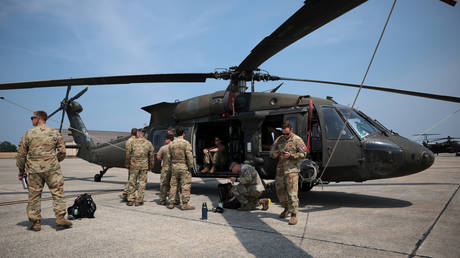
The internal deliberations within the U.S. Department of Defense regarding the deployment of airborne assets to the Iranian theater represent a shift from passive containment to active kinetic readiness. Reports indicating that the New York Times has uncovered high-level discussions about inserting the 82nd or 101st Airborne Divisions into the region suggest a strategic pivot designed to address specific Iranian asymmetric advantages. This move is not merely a show of force; it is a calculation of rapid-insertion logistics against the hardening of Iranian integrated air defense systems (IADS).
To analyze the viability of such an operation, one must move past the headlines and examine the three structural pillars of airborne intervention: the suppression of enemy air defenses (SEAD), the logistics of the "Airhead" establishment, and the tactical objective of the initial drop.
The Kinematics of Airspace Contested Environments
A primary constraint on any U.S. airborne operation in Iran is the density and sophistication of the Iranian IADS. Unlike previous conflicts in the Middle East, Iran possesses a multi-layered defense network, including the S-300PMU2 and domestic variants like the Bavar-373. These systems create a high-risk environment for slow-moving transport aircraft like the C-17 Globemaster III or the C-130 Hercules.
The operational success of an airborne drop hinges on the Probability of Ingress ($P_i$). This is a function of the electronic warfare (EW) support and the effective range of interceptor missiles.
$$P_i = 1 - (D_{sys} \times A_{eff})$$
Where:
- $D_{sys}$ represents the density of active tracking systems.
- $A_{eff}$ represents the lethality coefficient of the missile battery.
The U.S. military cannot drop paratroopers into a "hot" zone until the $P_i$ reaches a threshold that accounts for the potential loss of high-value transport assets. This necessitates a preliminary campaign of several days—or weeks—focused on "dead-eye" strikes against radar nodes and command-and-control (C2) centers. Without total air superiority, an airborne insertion is statistically likely to result in catastrophic airframe loss before the troops even reach the jump point.
Force Projection vs. Geographic Friction
The geography of Iran presents a unique set of obstacles for the 82nd Airborne. Unlike the flat deserts of Iraq, Iran is defined by the Zagros and Alborz mountain ranges. These features dictate the available drop zones (DZs) and significantly limit the mobility of light infantry once they hit the ground.
The strategic rationale for using airborne troops usually falls into one of two categories:
- Seizure of Critical Infrastructure: Capturing nuclear facilities (e.g., Fordow or Natanz) or oil terminals (Kharg Island) before they can be sabotaged or hardened further.
- Establishment of an Intermediate Staging Base (ISB): Creating a secure perimeter to allow for the landing of heavier armored forces via C-17s.
The second category creates a massive logistical bottleneck. An airborne brigade is "light" by design. They lack the heavy armor required to repel a sustained counter-attack by the Islamic Revolutionary Guard Corps (IRGC) Ground Forces, which utilize indigenous T-72 variants and rapid-response rocket artillery. The "window of vulnerability" is the time elapsed between the initial parachute drop and the arrival of heavy reinforcement.
This creates a Logistical Decay Function. The combat effectiveness of the airborne unit begins to drop the moment they land, as they expend limited ammunition, water, and medical supplies. If the air-bridge (continuous supply via aircraft) is interrupted by Iranian long-range drones or remaining SAM batteries, the unit risks isolation and defeat in detail.
The Asymmetric Counter-Response Matrix
Planners must account for the IRGC’s doctrine of "Mosaic Defense." This decentralized command structure allows local commanders to operate independently if central C2 is severed. For an airborne unit, this means they are not fighting a monolithic army, but a series of highly mobile, localized insurgencies equipped with Anti-Tank Guided Missiles (ATGMS) like the Dehlavieh.
Three primary risks dominate the IRGC counter-strategy:
- Saturation via Swarm UAVs: Large-scale use of Shahed-series loitering munitions against the Drop Zone during the assembly phase.
- Tunnel Warfare: Many Iranian strategic sites are buried deep within mountains. Airborne troops, lacking heavy earth-moving equipment or deep-penetration munitions, may find themselves "holding the lid" on a facility they cannot actually enter or neutralize.
- Proximal Escalation: The moment U.S. boots touch Iranian soil, the theater of operations expands. Hezbollah in Lebanon and various militias in Iraq and Yemen are triggered to strike U.S. regional hubs, forcing the diversion of the very air assets needed to protect the paratroopers.
Tactical Precision in Vertical Envelopment
If the NYT reports are accurate, the U.S. is likely looking at a "Joint Forcible Entry" (JFE) operation. This is a complex synchronized event involving the Air Force, Navy, and Army.
The first wave would likely involve the 75th Ranger Regiment to seize an airfield, followed immediately by the 82nd Airborne to expand the perimeter. The technical requirement for this is a "Compressed C2 Loop." Information from RC-135 Rivet Joint electronic intelligence aircraft must be fed directly to the jumpmasters and ground commanders in real-time to adjust DZs based on moving enemy threats.
The failure points of previous historical airborne operations (such as Operation Market Garden) were almost always rooted in two factors: "unrealistic reach" and "intelligence lag." In the Iranian context, "unrealistic reach" refers to dropping troops too far from the coast or from friendly bases in the Persian Gulf, making rescue or extraction nearly impossible if the mission goes south.
Weaponry and Technological Multipliers
To offset the lack of heavy armor, the U.S. would rely on technological superiority. This includes:
- NETMOD (Network Modernization): Giving every soldier real-time situational awareness of enemy positions via heads-up displays.
- Man-Portable Air-Defense Systems (MANPADS): Crucial for defending the DZ against Iranian attack helicopters like the Shahed 285.
- Loitering Munitions (Switchblade 600): Allowing paratroopers to strike Iranian armor from miles away without exposing their position.
The presence of these technologies changes the "Force Ratio" calculation. Historically, an attacking force needed a 3:1 advantage. With precision-guided man-portable systems, a light airborne unit can theoretically hold off a much larger mechanized force, provided they maintain a link to orbital or high-altitude surveillance.
Economic and Geopolitical Friction Points
Beyond the kinetic reality, the mere act of preparing an airborne jump has immediate economic consequences. The Strait of Hormuz, through which 20% of the world's oil passes, becomes a frontline. Insurance premiums for tankers would skyrocket, effectively imposing a "war tax" on the global economy before a single shot is fired.
The U.S. must also weigh the "Sovereignty Cost." An airborne insertion is an undeniable act of war. Unlike a drone strike or a cyber-attack, which offer a degree of plausible deniability or "gray zone" maneuvering, paratroopers on the ground represent an ultimate commitment. It forces the Iranian leadership into a "use it or lose it" scenario regarding their own strategic assets, potentially accelerating a move toward nuclear breakout as a final deterrent.
Operational Limitations and Structural Realities
There are no low-risk versions of this plan. The U.S. military is currently optimized for multi-domain operations, but the physical reality of moving thousands of humans through the air into a defended space remains the most dangerous maneuver in modern warfare.
The structural limitations of the airborne strategy include:
- Weather Dependency: High winds in the Iranian highlands can scrub a mission or cause high injury rates during the drop, reducing combat power before engagement.
- The "Iron Mountain" Problem: The sheer volume of fuel and batteries required to keep a modern digital soldier functioning is immense. An airborne unit is on a ticking clock the moment they disconnect from the C-17.
- The Exit Strategy: Airborne units are historically excellent at "taking" but poor at "holding" without significant mechanized support. There is a high risk of the unit becoming a political hostage if they cannot be reinforced or extracted.
The strategic play here is not to engage in a protracted ground war, but to use the airborne threat as a "Fleet in Being" tactic. By credibly signaling the ability to seize specific high-value targets (like the Bushehr reactor or the Bandar Abbas port), the U.S. forces Iran to fix its best units in defensive positions, preventing them from being used for offensive maneuvers elsewhere in the region.
The next phase of this escalation will likely be the movement of "Heavy Drop" platforms to bases in Oman or Diego Garcia. If these logistical precursors are observed, the transition from a "theoretical threat" to an "imminent operation" is confirmed. Watch for the deployment of C-17 squadrons to Al-Udeid Air Base as the primary indicator of a shift in the operational timeline.