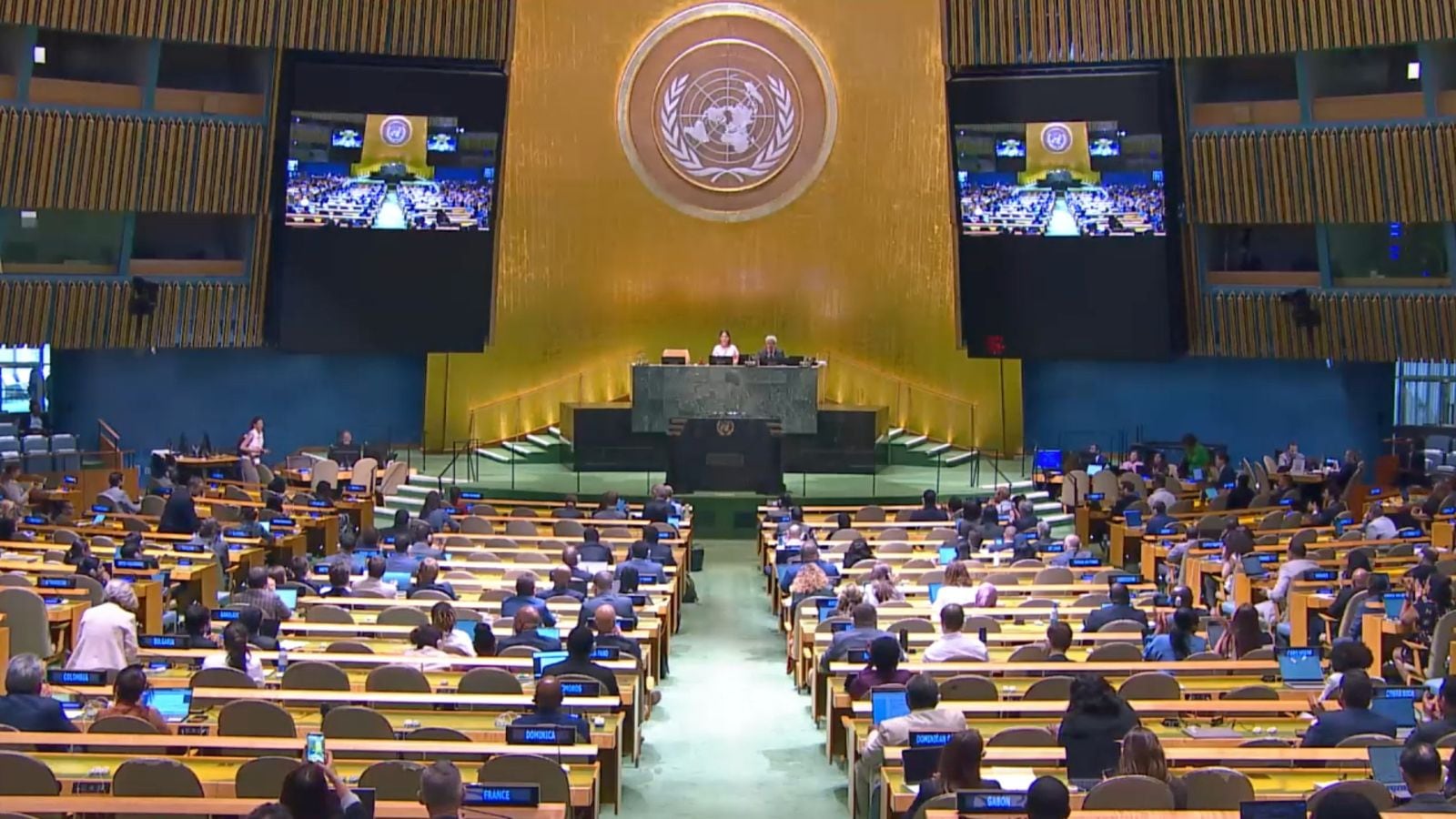
The failure of the United Nations Security Council (UNSC) to pass a resolution framing climate change as a standalone threat to international peace and security reveals a fundamental rift in how sovereign states quantify geopolitical risk versus environmental externalites. While the proposed resolution sought to centralize climate-related security threats under the UNSC’s purview, the opposing votes from the United States and Russia, alongside India’s abstention, were not mere denials of ecological data. Instead, these actions represent a calculated defense of national industrial autonomy and a rejection of a centralized, securitized approach to carbon management.
The core tension lies in the Strategic Autonomy Trade-off. By integrating climate change into the UNSC’s formal mandate, member states would essentially grant the Council the authority to impose sanctions or interventions based on environmental performance—a move that transforms a scientific challenge into a tool of coercive diplomacy.
The Structural Architecture of Opposition
To understand why the resolution collapsed, one must examine the specific institutional mechanics that the US, Russia, and India viewed as threats to their internal governance. The opposition can be categorized into three distinct analytical pillars.
1. The Jurisdictional Overlap Conflict
The United Nations Framework Convention on Climate Change (UNFCCC) currently manages global climate policy through a consensus-based model. Moving climate oversight to the Security Council shifts the decision-making power from a 193-nation inclusive body to a 15-member elite group.
- Mechanism of Centralization: The resolution proposed a "securitization" of climate change. In geopolitical theory, securitization occurs when an issue is moved out of the realm of standard politics and into the realm of emergency measures.
- The Risk of Precedent: Russia and India argued that allowing the UNSC to define "climate security" creates a legal bridgehead. If a drought or a carbon-intensive energy policy is labeled a "threat to peace," it theoretically justifies the use of Chapter VII powers, which include economic blockades or military action.
2. The Development-Emissions Paradox
India’s abstention is rooted in the mathematical reality of its energy transition. For developing economies, the relationship between GDP growth and carbon output follows a specific Energy-Density Curve.
- The Baseline Problem: India maintains that historical emitters (the West) must carry the burden of mitigation. By supporting a UNSC-led climate mandate, India risks a future where its necessary reliance on coal for industrialization is reclassified as a security violation by nations that have already completed their carbon-intensive growth cycles.
- Asset Stranding: Any global resolution that accelerates the phase-out of fossil fuels without providing a viable $100 billion annual financing mechanism—as promised in previous accords—creates a structural insolvency risk for emerging markets.
3. The Geopolitical Veto as a Risk Mitigation Tool
The US and Russian "No" votes, while often aligned for different reasons, both prioritized the preservation of the Veto Monopoly.
- The Russian Perspective: Moscow views the resolution as an attempt by the West to internationalize Russian domestic resources. If climate change is a security issue, then the management of the Siberian permafrost or Arctic shipping lanes becomes a matter of international oversight rather than Russian sovereignty.
- The US Position: Despite the current administration’s pro-climate rhetoric, the US security establishment remains wary of any international body that could legally restrict US military operations based on their carbon footprint. The US military is one of the largest single institutional consumers of petroleum in the world; a UNSC climate mandate could, in a future political cycle, be used to challenge US power projection.
Quantifying the Security-Climate Feedback Loop
The resolution's proponents argue that climate change is a "threat multiplier." This logic holds that environmental degradation leads to resource scarcity, which leads to migration, which leads to conflict. While this chain of causality is supported by ecological data, it lacks a precise Conflict Probability Coefficient.
The failure of the resolution stems from the inability to define the exact point where a weather event becomes a security event. Without a quantifiable threshold, the UNSC would be operating on subjective triggers.
Variable Analysis of Climate Conflict:
- Resource Scarcity ($S$): The delta between per capita water/food availability and the survival baseline.
- Governance Elasticity ($G$): The ability of a state's infrastructure to absorb economic shocks without collapsing into civil unrest.
- Migration Flux ($M$): The rate of trans-border movement triggered by unviable living conditions.
Critics of the resolution, including the dissenting powers, argue that the UNSC is equipped to handle $M$ (migration) and $G$ (governance failure), but is structurally incapable of addressing $S$ (resource scarcity) at its root. Therefore, integrating these variables into the Council’s mandate would lead to reactive military solutions for what are essentially proactive engineering and economic problems.
The Indian Neutrality Framework
India’s decision to abstain rather than vote "No" alongside Russia and the US is a tactical execution of Multi-Alignment Strategy. India recognizes the reality of climate change—it is one of the most vulnerable nations to monsoon variability—but it refuses to allow the "securitization" of the issue.
India’s logic follows a specific sequence:
- Step A: Acknowledge climate change as a global crisis (maintaining moral high ground).
- Step B: Reject the UNSC as the venue for climate policy (protecting sovereignty).
- Step C: Reiterate the principle of "Common but Differentiated Responsibilities" (ensuring economic room for growth).
By abstaining, India signals that it is not an obstructionist to climate action, but rather an opponent of the specific Institutional Architecture proposed. This distinction is critical for maintaining its leadership role in the Global South.
Technological and Economic Bottlenecks to Consensus
The primary reason global powers cannot reach a consensus on climate as a security issue is the lack of Decoupling Scalability. As long as national security remains tethered to energy-dense fossil fuels, a vote for climate security is a vote for national vulnerability.
| Factor | Security Implication | Economic Barrier |
|---|---|---|
| Energy Storage | Intermittent renewables create grid instability, a security risk. | Lithium/Cobalt supply chain monopolies. |
| Carbon Border Adjustments | Trade wars sparked by "carbon tariffs." | Lack of standardized carbon accounting. |
| Nuclear Sovereignty | Small Modular Reactors (SMRs) provide clean baseload but increase proliferation risks. | High capital expenditure and regulatory lag. |
The Displacement of Responsibility
The rejection of the resolution highlights a strategic move by the "Big Three" to prevent the Judicialization of Carbon. If the UNSC were to adopt climate change as a permanent agenda item, the next logical step would be the creation of an international "Climate Court" or an expansion of the International Criminal Court’s jurisdiction to include "ecocide."
Russia and the US, despite their polarized relationship, share a common interest in preventing the emergence of a global legal framework that could supersede national laws regarding land use, energy production, and industrial output. This shared interest in Westphalian Sovereignty outweighed their bilateral animosity in the UN chamber.
The Strategic Path Forward: Fractionalized Agreements
Since a centralized UN-led security mandate has failed, the global climate strategy will shift toward Plurilateralism—smaller, high-impact agreements between specific nations rather than universal resolutions.
The immediate result of this veto is the reinforcement of the UNFCCC’s "Pledge and Review" system under the Paris Agreement. This system is non-coercive, which satisfies the US, Russia, and India, but it lacks the enforcement teeth that the failed resolution’s proponents desired.
The strategic play for multinational organizations and sovereign states is to bypass the UN Security Council’s stalled framework and focus on the Commercialization of Decarbonization. Real security will not be found in a UN resolution, but in the development of "Carbon-Neutral Parity"—the point at which renewable energy becomes cheaper and more reliable than fossil fuels on a per-kilowatt basis without subsidies. Until that parity is reached, the UNSC will remain a site of theater rather than a driver of environmental policy.
The veto signals that for the world's major powers, the risk of a centralized global authority is currently viewed as greater than the risk of an unmitigated climate. Strategic planning must now account for a world where climate policy is fragmented, competitive, and driven by industrial capacity rather than international law.