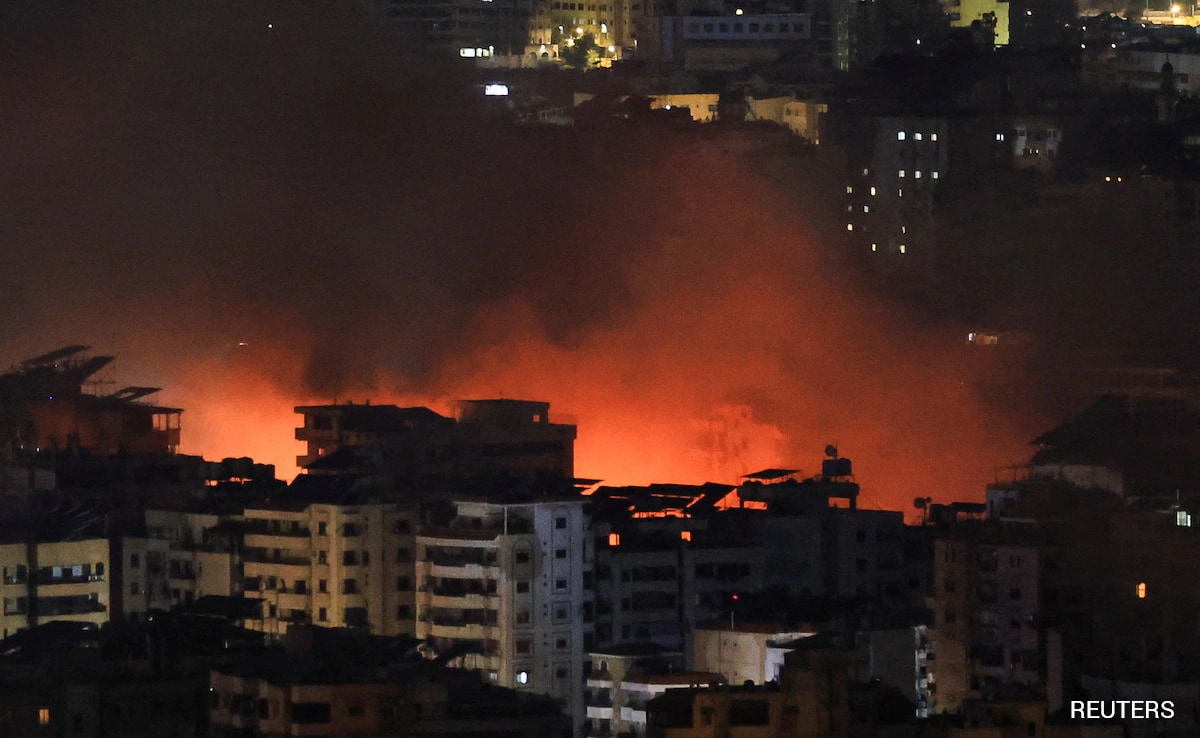
The transition from localized skirmishes to a regional theater of high-intensity conflict is defined by the breakdown of traditional deterrence and the introduction of advanced precision-strike payloads. As the conflict reaches its seventh day of sustained kinetic exchange, the strategic objective has shifted from signaling to the systematic degradation of adversary command-and-control (C2) infrastructure. The current operational environment is characterized by a three-tiered escalation ladder: urban decapitation strikes in Beirut, long-range ballistic penetration into new geographic sectors like Bahrain, and the neutralization of logistical nodes through aerial dominance.
The Mechanics of Urban Decapitation and Structural Degradation
The strikes in Beirut represent a calculated application of "Counter-Force" targeting, where the primary objective is not territorial gain but the elimination of leadership and high-value assets (HVAs). Unlike indiscriminate bombardment, these operations utilize specific kinetic profiles to minimize collateral damage while ensuring the destruction of subterranean bunkers.
The success of these operations depends on three distinct variables:
- Signal Intelligence (SIGINT) Dominance: The ability to intercept encrypted communications and map the physical location of leadership nodes in real-time.
- Kinetic Precision: The use of bunker-buster munitions, such as the GBU-28 or GBU-72, which rely on delay-fuzing to penetrate reinforced concrete before detonating.
- Human Intelligence (HUMINT) Verification: On-the-ground confirmation that ensures the target is present, reducing the "sensor-to-shooter" timeline to a matter of minutes.
When Israel strikes Beirut, the intent is to create a power vacuum within the Hezbollah hierarchy. This disrupts the chain of command, forcing lower-level commanders to make decentralized decisions without a unified strategic directive. The bottleneck in this strategy is the speed of replacement; if the adversary can appoint new leadership faster than they are neutralized, the tactical gain is neutralized.
Ballistic Expansion and the Bahrain Kinetic Variable
The reported Iranian attack on Bahrain marks a significant horizontal expansion of the conflict. By targeting a state that hosts the U.S. Navy’s 5th Fleet, Iran is testing the resolve of the "Integrated Air and Missile Defense" (IAMD) framework established by the United States and its regional partners.
This maneuver serves as a stress test for the following defense architectures:
- AEGIS Combat System: The primary sea-based defense layer capable of tracking and intercepting short-to-medium-range ballistic missiles.
- Patriot PAC-3 Segments: The terminal phase defense designed to intercept threats as they re-enter the atmosphere.
- The Political Threshold: Bahrain’s inclusion in the target set forces the Gulf Cooperation Council (GCC) to reassess their neutrality.
The logic behind targeting Bahrain is likely an attempt to overextend the U.S. defensive umbrella. If the U.S. must commit assets to protect every regional partner simultaneously, it thins the density of interceptors available for high-value Israeli or maritime assets. This is a classic "Saturation Strategy," where the sheer volume of targets exceeds the reload and tracking capacity of sophisticated defense systems.
The Cost Function of Interceptor Depletion
One of the most critical, yet under-reported, metrics of this war is the "Interception Cost Ratio." There is a massive economic and industrial asymmetry between the offensive munitions used by Iran and the defensive interceptors used by Israel and the U.S.
$$Cost Ratio = \frac{Cost of Interceptor (e.g., Arrow-3, SM-3)}{Cost of Offensive Missile (e.g., Fattah-1, Shahed-136)}$$
In many cases, an interceptor costs between $2 million and $3.5 million, while the offensive drone or missile may cost between $20,000 and $100,000. This creates a long-term sustainability crisis for the defender. Even with a 90% interception rate, the defender is losing the economic war. If the conflict enters a war of attrition lasting months, the replenishment rate of interceptor stockpiles becomes the primary constraint on national security. The industrial base in the U.S. and Israel is currently not configured for high-rate, long-term production of these high-tech components, creating a physical limit on how many "Day 7s" can occur before defensive gaps emerge.
Air Superiority versus Anti-Access/Area Denial (A2/AD)
The U.S. involvement is primarily focused on maintaining a "QME" (Qualitative Military Edge) for its allies while preventing the closure of critical maritime chokepoints like the Strait of Hormuz. This is a battle between traditional air power and A2/AD systems.
- Electronic Warfare (EW): Both sides are engaging in massive GPS jamming and spoofing, which affects not only military hardware but commercial aviation and shipping. This creates a "Fog of Digital War" where identifying friend-from-foe becomes a hardware-level challenge.
- Unmanned Systems: The use of low-cost, high-volume swarms is designed to bait the radar systems into activating, revealing their positions for "SEAD" (Suppression of Enemy Air Defenses) missions.
The primary limitation of the A2/AD strategy is its static nature. Once a missile battery or radar site fires, its location is compromised. Modern satellite imagery and "Persistent Overhead Sensor" technology allow for immediate counter-battery fire. Consequently, the conflict has devolved into a high-stakes game of "Shoot and Scoot," where mobility is the only protection against total destruction.
Geopolitical Realignment and the Failure of Traditional Diplomacy
The expansion of the war into its second week suggests that traditional diplomatic de-escalation levers have failed. The "Rational Actor" model, which assumes states will avoid total war due to economic ruin, is being replaced by "Existential Logic." For the current Israeli leadership, the threat from Iranian proxies is viewed as an intolerable risk that requires a permanent military solution rather than a negotiated truce. Conversely, Iran views the survival of its "Axis of Resistance" as essential to its regional influence and internal regime security.
This creates a "Zero-Sum" game where any concession is viewed as total defeat. The lack of a clear exit strategy for either side means the conflict will likely migrate from localized strikes to a broader campaign against energy infrastructure. The targeting of oil refineries or desalination plants would shift the war from a military confrontation to a regional humanitarian and economic crisis, potentially drawing in global powers like China, which relies heavily on Middle Eastern energy imports.
Strategic Forecast: The Shift Toward Infrastructure Attrition
As the kinetic options for leadership decapitation are exhausted, the logical progression of the conflict will target the "Nervous System" of the opposing states. This includes power grids, water treatment facilities, and fiber-optic landing points. The goal is to induce internal civil unrest by making the cost of the war unbearable for the civilian population.
The tactical recommendation for regional actors and global observers is to prioritize the hardening of "dual-use" infrastructure. The reliance on centralized nodes for power and data is a significant vulnerability in an era of precision-guided long-range munitions. Decentralization of energy resources and the deployment of mobile, rapid-response repair teams are the only viable mitigations against the next phase of this escalation. The conflict is no longer about who has the most planes or tanks, but who can maintain a functioning society under the constant pressure of a multi-front missile campaign. Failure to secure these non-military assets will result in a total state collapse regardless of the outcome on the battlefield.