The domestic condemnation of Prime Minister Benjamin Netanyahu’s ceasefire arrangement regarding Iranian interests is not merely a byproduct of partisan friction; it is a clinical response to what the Israeli opposition perceives as a structural failure in deterrence theory. When opposition leaders characterize the agreement as a "historic surrender," they are applying a cost-benefit analysis that suggests the long-term strategic depreciation of Israel’s qualitative military edge (QME) outweighs the short-term tactical relief of a cessation of hostilities. This critique rests on three distinct pillars of strategic risk: the degradation of the credible threat, the asymmetry of the "quiet for quiet" doctrine, and the invitation of multi-front synchronization by Iranian proxies.
The Deterrence Decay Function
The primary criticism leveled against the Netanyahu administration focuses on the perceived collapse of the "Red Line" framework. In classical deterrence theory, an actor must possess the capability, the intent, and—crucial in this context—the perceived will to execute a kinetic response. By opting for a diplomatic pause without achieving the stated goal of dismantled enrichment or proxy roll-back, the Israeli government has effectively altered the deterrence decay function.
The opposition argues that every ceasefire signed without a decisive military resolution lowers the threshold for future Iranian provocations. This creates a feedback loop where:
- The adversary perceives a declining appetite for high-intensity conflict within the Israeli cabinet.
- The adversary uses the ceasefire window to harden infrastructure and redistribute assets.
- The subsequent "starting point" for the next round of hostilities begins at a higher level of Iranian entrenchment.
This is viewed not as a pause, but as a subsidy for Iranian persistence. The "cost of inaction" is categorized by the opposition as an accumulation of latent risk that will eventually require a far more resource-heavy intervention than what is required today.
Asymmetric Reconstitution Ratios
A ceasefire is never a static state; it is a competitive race for reconstitution. The opposition’s logic dictates that the rate at which Iran and its regional affiliates (the "Axis of Resistance") can rebuild their capabilities during a lull significantly outpaces Israel’s ability to neutralize those gains through passive intelligence and international lobbying.
We can define the Strategic Reconstitution Ratio (SRR) as follows:
$$SRR = \frac{\Delta \text{Adversary Capability (Time)}}{\Delta \text{Defender Defense/Prevention (Time)}}$$
When $SRR > 1$, the ceasefire actively favors the adversary. The opposition leaders contend that Iran’s decentralized supply chain—utilizing land bridges through Iraq and Syria—operates with greater efficiency during a ceasefire because the "war between wars" (MABAM) kinetic operations are restricted. While Israel may refine its interceptor stocks (Iron Dome, David’s Sling), Iran is refining its precision-guided munition (PGM) kits and drone swarms. The opposition posits that a ceasefire under current conditions allows Iran to solve its technical bottlenecks without the friction of active Israeli sabotage.
The Tri-Border Friction Point
The geography of the opposition's critique is centered on the northern and eastern frontiers. They argue that Netanyahu’s focus on a direct Iranian deal ignores the "Ring of Fire" strategy. By de-escalating with the center (Tehran), the administration grants a functional immunity to the periphery (Hezbollah, PMF militias, and Houthi assets).
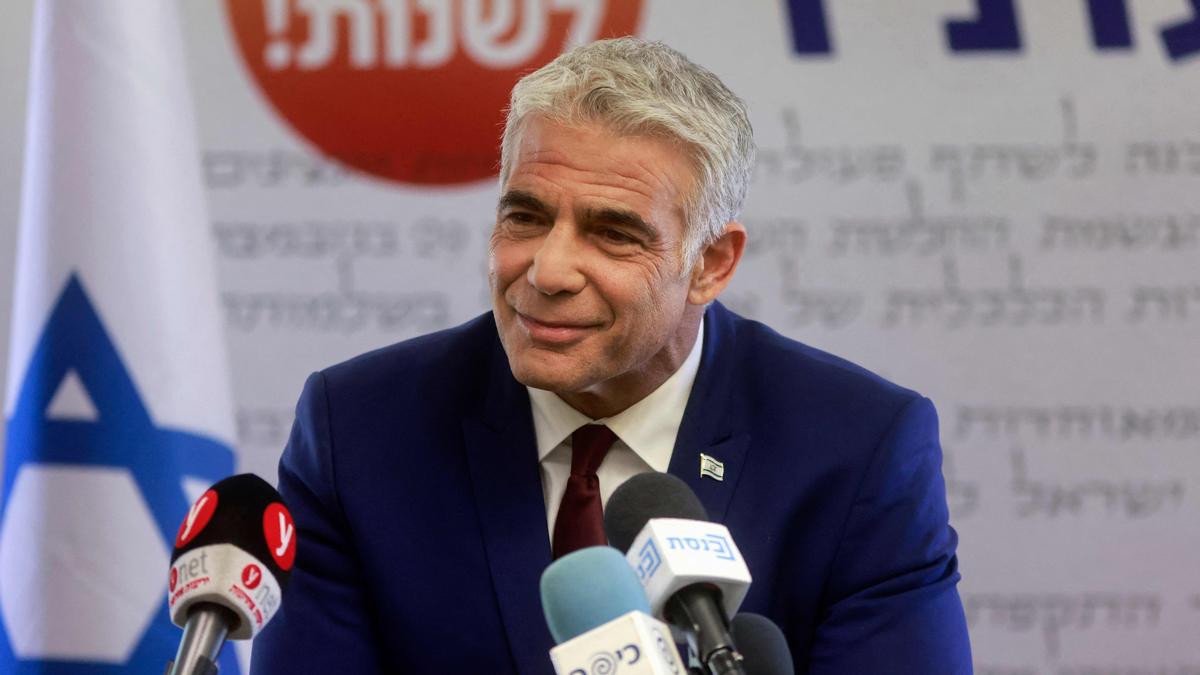
This creates a systemic bottleneck for Israeli defense planning. If the direct Iranian threat is "paused," but the proxy threat continues to iterate, Israel finds itself in a strategic pincer. The opposition leaders, specifically those with military backgrounds like Yair Lapid and Benny Gantz, utilize a framework of Multi-Front Synchronization. They argue that a ceasefire that does not include the total cessation of proxy funding is a tactical error because it allows Iran to decouple its own national safety from the aggressive actions of its subordinates.
Political Capital and the Credibility Gap
The internal Israeli critique also examines the "Domestic Credibility Constant." For a government to maintain a wartime or emergency footing, the public must believe that the sacrifices—economic, social, and military—lead to a definitive change in the security status quo.
The opposition characterizes the ceasefire as a "return to October 6th thinking"—a reference to the perceived complacency that preceded the 2023 escalations. The structural argument here is that "management of the conflict" is a failed paradigm compared to "resolution of the threat." When the government shifts from a stance of total victory to one of negotiated quiet, it creates a psychological decoupling among the citizenry and the reservist class.
The opposition identifies three specific failures in this shift:
- Economic Misallocation: Maintaining a high state of readiness without the permission to act creates a massive "idle capacity" cost for the Israeli economy.
- Diplomatic Atrophy: Accepting a ceasefire signals to the United States and regional partners (Abraham Accords signatories) that Israel is willing to tolerate a nuclear-threshold Iran, thereby weakening the coalition for stricter sanctions.
- Strategic Ambiguity Loss: By formalizing a pause, Israel loses the element of surprise, as any future strike will be viewed as a breach of international agreement rather than a preemptive security measure.
The Burden of Proof for the Netanyahu Doctrine
The administration’s counter-argument—that the ceasefire buys time for internal recovery and the replenishment of munitions—is viewed by the opposition as a "sunk cost fallacy." They argue that the munitions being stockpiled today will be less effective against the hardened targets Iran will build tomorrow.
The lack of a "sunset clause" or clear verification mechanisms in the reported understandings further fuels the opposition’s technical critique. In their view, a ceasefire without a Compulsory Inspection Regime is essentially a blindfold. They point to the historical precedent of the JCPOA and subsequent regional arrangements where Iran utilized the absence of kinetic pressure to advance centrifuge R&D and tunnel boring operations.
Calculated Escalation vs. Managed Decline
The opposition leaders are not necessarily advocating for immediate, all-out war, but rather for a Strategy of Constant Friction. This involves keeping the adversary in a state of perpetual "organizational stress." A ceasefire removes this stress, allowing the Iranian leadership to re-allocate cognitive and financial resources toward long-term strategic projects rather than immediate crisis management.
The disagreement, therefore, is over the nature of the Iranian threat itself. The Netanyahu administration appears to be treating the Iranian threat as a variable that can be dialed up or down based on immediate domestic and international pressures. The opposition treats the Iranian threat as a constant, accelerating force that can only be countered through continuous, unyielding counter-pressure.
This divergence in thought leads to the "Zero-Sum Security" conclusion: any gain in Iranian stability resulting from a ceasefire is an equivalent loss in Israeli long-term maneuverability. The opposition's "slamming" of the deal is a formal rejection of the idea that time is on Israel's side.
Tactical Realignment and the Shift to the Periphery
To mitigate the risks identified by the opposition, the Israeli defense establishment must now pivot toward a "Detection and Interdiction" model that operates independently of the formal ceasefire terms. If the direct confrontation with Iran is sidelined, the strategic focus must shift toward the accelerated neutralization of proxy logistics in the "Grey Zone."
- Hardening the Cyber-Kinetic Link: Since kinetic strikes on Iranian soil may be diplomatically restricted, Israel must increase the frequency and depth of cyber-operations targeting the Iranian IRGC command-and-control layers.
- Intelligence Depth in the "Third Circle": With a ceasefire in place, the reliance on human intelligence (HUMINT) and signals intelligence (SIGINT) inside Iran becomes paramount to ensure the "pause" is not being used for a nuclear breakout.
- Regional Integration of Air Defense: Israel must leverage the current diplomatic window to formalize a Middle East Air Defense (MEAD) alliance. If Israel cannot strike the source, it must perfect the shield in coordination with regional allies who share the Iranian threat profile.
The strategic play here is to use the ceasefire not as a period of rest, but as a period of hyper-focused preparation for an inevitable escalation. The opposition’s critique serves as a necessary, albeit politically charged, audit of the government's risk tolerance. It highlights that in the Middle East, a ceasefire is rarely a bridge to peace, but more often a tactical reset for the next phase of a multi-generational attrition war. The success of the Netanyahu administration will not be measured by the length of the quiet, but by the readiness of the IDF when that quiet inevitably breaks.