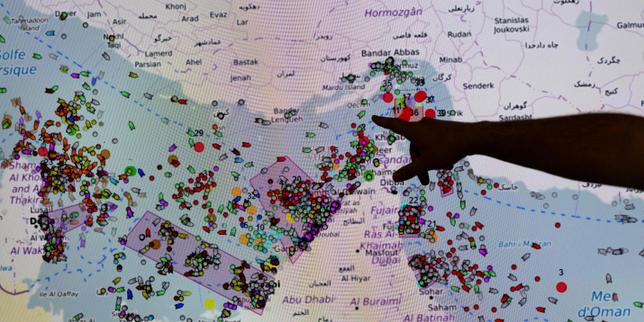
The maritime corridor of the Strait of Hormuz functions as a global economic juggernaut where the margin between a routine naval patrol and a systemic energy shock is measured in milliseconds. When reports emerge regarding the alleged targeting of a United States naval asset by Iranian forces, the immediate objective of a strategic analyst is not merely to confirm the physical status of the hull, but to map the intentionality behind the information flow. The denial issued by the United States Department of Defense regarding the strike serves as a primary data point in a broader framework of "Grey Zone" escalation—a state of conflict that exists below the threshold of open, conventional warfare but above the baseline of peaceful competition.
The Triad of Maritime Escalation Logic
To understand the friction between the U.S. Navy’s 5th Fleet and the Islamic Revolutionary Guard Corps Navy (IRGCN), one must apply a tripartite framework of escalation. Every incident in the Strait is filtered through these lenses:
- The Tactical Verification Gap: Modern naval warfare utilizes Integrated Air Defense Systems (IADS) and Aegis Combat Systems that provide high-fidelity tracking. If a kinetic impact occurs, the signature is unmistakable. Therefore, a denial by a superpower is rarely a cover-up of a physical reality—which would be visible via commercial satellite imagery or AIS (Automatic Identification System) anomalies—but rather a refusal to validate the adversary's narrative of dominance.
- The Asymmetric Signaling Protocol: Iran frequently employs fast-attack craft and loitering munitions. The goal is often not the destruction of a carrier strike group, which would trigger a disproportionate retaliatory response, but the demonstration of "anti-access/area denial" (A2/AD) capabilities.
- The Information Dominance Cycle: In the age of social media and state-aligned news agencies, the first "strike" is often digital. By claiming a hit, the IRGCN attempts to shift the risk premium in global oil markets and signal domestic strength, regardless of the physical outcome.
Quantitative Risks of Chokepoint Volatility
The Strait of Hormuz is the world's most sensitive energy transit point. Roughly 21 million barrels of oil flow through this 21-mile wide passage daily. This represents approximately 21% of global liquid petroleum consumption.
The economic cost of a single reported strike, even if debunked, is calculated through the Maritime Risk Premium (MRP). Insurance underwriters for shipping vessels respond to "denied" incidents by raising premiums for "War Risk" zones. This creates a hidden tax on the global supply chain. If the United States were to acknowledge a hit, the MRP would likely surge by 300% to 500% within hours, potentially decoupling oil prices from standard supply-demand fundamentals.
The structural prose of maritime security dictates that silence or immediate denial is a tool for price stability. By maintaining that no ship was touched, the U.S. removes the "certainty" required for market speculators to drive Brent Crude into a parabolic spike.
Anatomy of an Alleged Strike: The Kill Chain Analysis
For a naval vessel to be "touched" in the Strait of Hormuz, an adversary must successfully complete a sequence known as the F2T2EA (Find, Fix, Track, Target, Engage, Assess) kill chain.
- Find and Fix: Detecting a U.S. destroyer (DDG) requires sophisticated radar or visual spotting. The U.S. utilizes Electronic Countermeasures (ECM) to "mask" the vessel’s exact electronic signature.
- Track and Target: In the narrow confines of the Strait, the distance between the Iranian coast and the shipping lanes is so short that the "decision loop" for a ship's commanding officer is reduced to less than 60 seconds.
- Engagement: This usually involves C-802 silkworm derivatives or Noor anti-ship cruise missiles.
- Assessment: This is where the current information war resides. Iran claims a hit (Assessment: Success); the U.S. denies (Assessment: Failure).
The technical reality of U.S. naval defense involves the Phalanx CIWS (Close-In Weapon System) and the RIM-116 Rolling Airframe Missile. These systems are designed to intercept incoming threats at such distances that even a "successful" interception might be framed by the attacker as a "hit" if the debris falls near the hull.
The Doctrine of Proportionality and the Redline
The United States military operates under the Carter Doctrine, which states that any attempt by any outside force to gain control of the Persian Gulf region will be regarded as an assault on the vital interests of the United States.
A confirmed strike on a U.S. vessel is a "Redline" event. Under the law of armed conflict, this necessitates a "necessary and proportional" response. The strategic reason for the U.S. to deny a strike—even if a minor grazing occurred—is to avoid being boxed into a mandatory kinetic escalation. If the Pentagon admits to a hit, domestic political pressure and international credibility force a counter-strike on Iranian launch sites. If the goal is to avoid a regional conflagration while maintaining presence, the most "data-driven" move is to negate the adversary's claim entirely.
This creates a Strategic Ambiguity Buffer. By denying the incident, the U.S. retains the initiative to choose the time and place of any future retaliation, rather than letting the IRGCN's media wing dictate the operational tempo.
Cognitive Dissonance in State-Media Reporting
The reporting from Iranian outlets often targets a specific psychological demographic: the domestic audience and the "Global South." By asserting that they have touched the untouchable—a U.S. Navy ship—they erode the perception of American hegemony.
The U.S. response strategy relies on Radical Transparency for Verification. When the Department of Defense issues a denial, it is frequently backed by "Ship's Logs" or invite-only press tours of the vessel in question. The discrepancy between the two narratives isn't just a "he-said, she-said" scenario; it is a test of the Information Integrity Index. In the current digital landscape, the actor who provides the most verifiable "optical proof" (e.g., a photo of an unscarred hull with a timestamp) eventually wins the narrative cycle.
Proxies and the Plausible Deniability Framework
While the current report centers on the Strait of Hormuz and direct Iranian involvement, the broader strategy involves the use of "Proxy Force Multiplication." The Houthi rebels in the Red Sea provide a blueprint for how Iran tests U.S. naval defenses without taking direct state-level responsibility.
The movement of technology—specifically drone components and missile guidance systems—from the mainland to the Strait’s various islands allows for "deniable" launches. However, in the Strait of Hormuz, the geography is too tight for true deniability. A launch from Bandar Abbas is clearly a state-sponsored act. This increases the stakes of the "denial" game. If Iran launches and the U.S. denies, both sides are essentially engaging in a silent agreement to keep the oil flowing despite the tactical friction.
Structural Bottlenecks in Naval Intelligence
The primary challenge in analyzing these reports is the Latency of Information.
- Sensor Data: Classified. Only the Pentagon knows if a radar lock was detected.
- Visual Confirmation: Limited to crews on nearby commercial tankers who are often unwilling to testify for fear of being barred from regional ports.
- Cyber Attribution: Often, "strikes" reported in the media are actually cyber-attacks on ship tracking systems (spoofing) rather than physical missiles.
This creates a "Fog of News" that mirrors the "Fog of War." When a competitor's article focuses on the "En Direct" (Live) nature of the reporting, they are often just amplifying the noise. A strategic analysis ignores the "Live" feed in favor of the Structural Incentive. Iran’s incentive is to prove the U.S. is vulnerable; the U.S. incentive is to prove the Strait is safe for commerce.
The Strategic Recommendation for Regional Actors
The persistent tension in the Strait of Hormuz demands a shift from reactive monitoring to predictive modeling. Organizations operating in the region must de-risk based on the following logic:
- Diversification of Transit: Utilize the East-West Pipeline (Petroline) across Saudi Arabia to bypass the Strait of Hormuz where possible. This reduces the "Leverage Coefficient" held by the IRGCN.
- Hardening of Digital Assets: Vessels must employ advanced AIS-encryption to prevent the "digital strikes" that lead to false reporting and subsequent market panics.
- Validation of Kinetic Claims: Stakeholders should disregard state-media reports from either side unless corroborated by third-party satellite telemetry (e.g., SAR imagery which can see through cloud cover and smoke to identify hull integrity).
The current denial by the U.S. is not a conclusion but a maintenance of the status quo. The "Grey Zone" conflict will continue as long as the Strait remains the world's primary energy artery. The strategic play is to recognize that in this theater, the narrative of the strike is often more impactful than the missile itself. Control the data, control the premium, control the region.