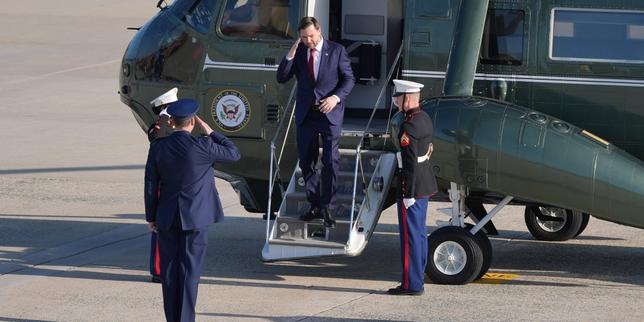
The emergence of Vice President J. D. Vance as the primary architect for direct engagement with Iran represents a fundamental shift in American diplomatic methodology, moving from traditional State Department multilateralism toward a high-risk, bilateral transactionalism. This strategy operates on the assumption that Iranian regional hegemony can be curtailed not through broad international consensus, but through targeted economic pressure coupled with personalist diplomacy. The success of this approach depends on three distinct variables: the internal stability of the Iranian clerical establishment, the credibility of the American military deterrent, and the alignment of regional partners—specifically Israel and the Gulf monarchies—with a deal that may prioritize nuclear containment over proxy disarmament.
The Triad of Iranian Negotiation Constraints
Negotiating with the Islamic Republic is not a singular act of diplomacy but a navigation of three competing power centers within Tehran. Any analyst viewing the Iranian government as a monolith misses the friction points Vance intends to exploit.
- The Supreme Leader’s Ideological Redlines: Ali Khamenei views any rapprochement with the United States as a potential "velvet revolution." For Vance, the challenge is offering enough economic relief to prevent internal collapse without signaling a weakness that the hardliners can frame as a victory for Western liberal values.
- The IRGC’s Economic Empire: The Islamic Revolutionary Guard Corps (IRGC) controls an estimated 30% to 40% of the Iranian economy. Sanctions relief that bypasses the IRGC is functionally impossible. Therefore, the negotiation must address how to de-escalate the IRGC’s regional militia activities (the "Axis of Resistance") while acknowledging their grip on domestic infrastructure.
- The Technocratic Pragmatists: Represented by the foreign ministry, this group seeks a return to the global financial system (SWIFT) and the modernization of Iran’s aging energy sector. Vance’s strategy targets this faction by presenting a stark choice: total economic isolation or a path to integration conditioned on specific, verifiable behavioral changes.
The Cost Function of Nuclear De-escalation
Vance’s approach necessitates a precise calculation of what constitutes a "fair" exchange. The previous Joint Comprehensive Plan of Action (JCPOA) failed because it decoupled nuclear concessions from regional ballistic missile development and proxy warfare. The Vance framework attempts to re-integrate these variables into a single cost-benefit equation.
The American side operates under a Credible Threat Mechanism. For diplomacy to work in this context, the cost of non-compliance for Iran must exceed the cost of surrendering portions of its sovereign defense programs. The current calculation for Tehran is shaped by:
- Breakout Time: The duration required to produce enough weapons-grade uranium for a single nuclear device. Current estimates place this at weeks, not months.
- Sanctions Elasticity: The degree to which the Iranian economy can continue to function via the "shadow fleet" of oil tankers and trade with China. If China remains a consistent buyer, Vance’s primary lever—economic strangulation—loses its potency.
- Domestic Unrest: The Iranian leadership’s fear of a "bread riot" remains the most significant internal pressure. Vance’s team is betting that the regime will trade regional influence for domestic survival.
Geopolitical Friction Points and Regional Alignments
The direct involvement of the Vice President signals to Riyadh and Jerusalem that the White House is bypassing the bureaucratic inertia of Foggy Bottom. However, this creates a secondary set of diplomatic challenges.
The Israeli Security Dilemma
Jerusalem remains skeptical of any deal that allows Iran to maintain a domestic enrichment capability. Vance must balance the need for a deal with the "Red Line" established by the Israeli security establishment. If a deal is perceived as too lenient, it risks a unilateral kinetic strike by Israel, which would instantly collapse the negotiations and force the United States into a broader regional conflict.
The Abraham Accords Expansion
Vance views the normalization of ties between Israel and Saudi Arabia as the ultimate counterweight to Iranian influence. By positioning the U.S.-Iran negotiations as a means to stabilize the region for trade and infrastructure (such as the IMEC corridor), the administration seeks to make Iran’s isolation so costly that the regime has no choice but to reform its external behavior.
Structural Risks in Personalist Diplomacy
The shift toward a Vice Presidential lead on such a volatile file carries inherent structural risks. Traditionally, the Secretary of State provides a layer of "deniability" and a buffer for the President. By placing Vance in the "perilous frontline," the administration has tied its entire foreign policy credibility to a single outcome.
- Information Asymmetry: The Iranian negotiating team consists of career diplomats who have been managing these specific files for three decades. Vance, while an astute political actor, lacks the decades of granular institutional memory regarding the nuances of Persian diplomatic protocol and the history of failed "Grand Bargains."
- The Lame Duck Constraint: If the Iranian leadership believes that the current administration might be replaced in a subsequent election cycle, they have every incentive to "slow-walk" negotiations. This creates a "Time Decay" factor where the value of American concessions diminishes as the election calendar advances.
- Verification Latency: Any deal involving nuclear centrifuges or ballistic missile sites requires a verification regime that is both intrusive and immediate. The "Anywhere, Anytime" inspection protocol is a non-starter for Tehran, yet anything less is a political non-starter for the U.S. Congress.
The Mechanism of Economic Sanctions Redesign
A critical component of the Vance strategy involves moving beyond broad-based sectoral sanctions to "Surgical Financial Disruption." This involves targeting the specific clearinghouses and front companies in Dubai, Turkey, and Southeast Asia that facilitate the IRGC's financial flows.
This strategy recognizes that the "Landscape" of global finance has evolved. The emergence of digital assets and non-Western payment systems means that the U.S. Treasury’s ability to "Leverage" the dollar's dominance is no longer absolute. To maintain pressure, the U.S. must provide a clear "Off-Ramp." This off-ramp is not a return to the status quo, but a structured, phase-based re-entry into global markets where each increment of Iranian oil exports is matched by a verifiable reduction in enrichment levels or a cessation of support for Houthi or Hezbollah activities.
Strategic Forecast and Mandatory Pivot
The success of the Vance-led negotiations will not be determined by a signed treaty—which would likely face insurmountable opposition in the U.S. Senate—but by a series of informal, reciprocal "understandings." The administration is likely pursuing a "Freeze-for-Freeze" model: Iran freezes its nuclear advancement at current levels, and the U.S. freezes the implementation of certain secondary sanctions.
For this to hold, the U.S. must execute a pivot toward Regional Deterrence Integration. This involves:
- Unified Air Defense: Linking the radar and missile defense systems of the Gulf states and Israel to neutralize the Iranian drone and missile threat.
- Maritime Security Task Forces: Increasing the frequency and lethality of interdictions in the Red Sea to signal that the cost of proxy naval warfare is unsustainable.
- Cyber-Kinetic Parity: Establishing a clear doctrine that cyber-attacks on American or allied infrastructure will be met with kinetic responses, removing the "gray zone" ambiguity that Tehran has exploited for a decade.
The current trajectory indicates that if Vance cannot secure a tangible reduction in Iranian regional aggression within the next six months, the administration will be forced to pivot from "Engagement" to "Active Containment." This would involve a significant escalation in the deployment of U.S. naval assets to the Persian Gulf and a potential green light for increased "gray zone" operations within Iranian borders. The window for a "Grand Bargain" is closing; the immediate goal is the management of a controlled rivalry to prevent a systemic regional collapse.
The strategic play is to force Tehran into a defensive posture where the preservation of the regime is contingent upon the abandonment of its revolutionary expansionism. This requires the U.S. to maintain a credible threat of force while simultaneously offering a viable economic future—a precarious balancing act that leaves no room for diplomatic error. The administration must now prioritize the hardening of regional alliances to ensure that even if negotiations fail, the containment architecture remains impenetrable.