The United States defense industrial base is currently operating under a deficit of capacity that makes a multi-theater conflict a mathematical impossibility without immediate structural degradation of European security. The prospect of a sustained kinetic engagement with Iran does not merely distract diplomatic attention; it creates a physical "inventory cannibalization" effect. If the Pentagon activates a contingency plan for a major Middle Eastern conflict, the fulfillment of European defense requirements moves from a delay to a definitive displacement. This is not a matter of political will, but a hard ceiling dictated by production lead times, logistics throughput, and the depletion of "swing" inventories.
The Tri-Theater Inventory Conflict
US military strategy has long transitioned away from the "two-war" capability toward a more precarious reality where resources are prioritized through a hierarchy of urgency rather than a baseline of sufficiency. The intersection of three specific geographical demands—Ukraine (attritional), Israel/Iran (high-intensity/high-tech), and Taiwan (deterrence)—creates a zero-sum environment for specific munitions and platforms.
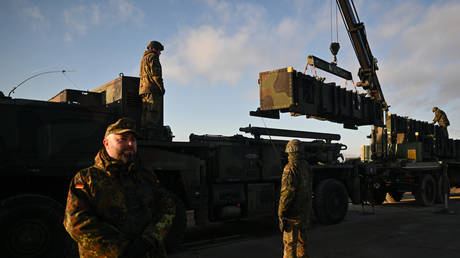
The primary constraint is found in the Interception Paradox. High-end air defense systems, specifically the MIM-104 Patriot and the Terminal High Altitude Area Defense (THAAD), are the primary assets required to protect both European NATO borders and Middle Eastern forward operating bases. When a battery is deployed to the Persian Gulf to counter Iranian ballistic missile threats, that unit is physically removed from the European rotational cycle. Because the current production rate of Patriot interceptors (PAC-3 MSE) is fixed at roughly 550 per year, a localized surge in the Middle East effectively freezes the modernization and replenishment of European stockpiles for a minimum of 18 to 24 months.
The Three Pillars of Logistics Displacement
To quantify the impact of an Iranian conflict on European arms deliveries, we must analyze the displacement across three distinct operational layers.
1. The Critical Munitions Bottleneck
The defense industry operates on a "just-in-time" procurement model that has been hollowed out by decades of peacetime efficiency drives. A war with Iran would necessitate a massive expenditure of Precision Guided Munitions (PGMs) and stand-off weapons like the AGM-158 JASSM. These are the same assets European allies are currently purchasing to deter Russian aggression.
The industrial friction here is characterized by the Lead-Time Lag. The average lead time for complex missile components—specifically microelectronics and solid rocket motors—exceeds 14 months. If the US military consumes its current "War Reserve Stocks" in a 30-day air campaign against Iranian infrastructure, those stocks will be replenished using the very production slots currently allocated to Poland, Germany, and the Baltic states. Under the "Defense Production Act" or "DX" rated orders, the US Department of Defense (DoD) has the legal authority to jump to the front of the line, effectively bumping sovereign allies to the back.
2. Sustainment and Maintenance Capacity
A conflict with Iran involves a high sortie rate for fourth and fifth-generation aircraft (F-15E, F-16, F-35). These airframes require specialized maintenance, repair, and overhaul (MRO) facilities. The US Air Force’s global MRO footprint is a finite resource. A surge in combat hours in the Middle East diverts the flow of spare parts—particularly engines (F135 and F110) and avionics—away from European hubs.
The result is a "Mission Capable" (MC) rate collapse in Europe. As parts are redirected to the combat theater, non-combatant units in Europe see their readiness plummet. This creates a "hollowed-out" deterrent: the planes are on the tarmac in Germany, but they lack the flight hours and components to be combat-ready.
3. Strategic Airlift and Sea-Lift Congestion
The logistical "tail" required to support a Middle Eastern campaign absorbs the vast majority of the US Transportation Command’s (TRANSCOM) heavy-lift assets.
- C-17 Globemaster III Availability: A surge requires constant "iron-bridge" flights for ammunition and personnel.
- Roll-on/Roll-off (Ro-Ro) Vessels: The movement of heavy armor or Patriot batteries requires specialized shipping that is in extremely short supply.
When these assets are locked into a Middle Eastern loop, the "Defender Europe" style exercises and the steady-state flow of equipment to Eastern Europe cease. This provides a strategic window for Russian opportunistic maneuvering, as the physical ability to reinforce the Suwalki Gap is compromised by the transit requirements of the Strait of Hormuz.
The Cost Function of Industrial Prioritization
The economic reality of arms delivery is governed by a non-linear cost function. As demand spikes during a conflict, the "Input Cost" for materials like titanium, high-grade carbon fiber, and specialized explosives rises due to emergency procurement. This leads to Budgetary Erosion for European buyers.
Most Foreign Military Sales (FMS) contracts include clauses for price adjustments based on economic conditions. If a war with Iran triggers a global energy price spike or a supply chain crunch, the cost of an F-18 or a HIMARS launcher for a European ally increases. Many European defense budgets, already strained by the 2% GDP NATO target, cannot absorb these 15-20% price escalations. This leads to "Order Attrition," where allies are forced to reduce the quantity of units purchased to stay within budget, further weakening the collective defense posture.
Tactical Displacement: The Artillery and Air Defense Crisis
While the war in Ukraine is largely a 155mm artillery struggle, a war with Iran would be an electromagnetic and missile struggle. However, the overlap occurs in the Production Surge Capacity.
Factories like the Scranton Army Ammunition Plant or Lockheed Martin’s Camden facility cannot simply "turn on" extra shifts without skilled labor—a resource that is currently at 100% utilization. Therefore, the strategic trade-off is binary. Every "Standard Missile" (SM-6) fired by a US Destroyer in the Red Sea or Persian Gulf is an SM-6 that was destined for a European Aegis Ashore site or a naval platform in the North Atlantic.
The "Known Fact" is that the US Navy is currently consuming missiles at a rate that exceeds production by a factor of 3 to 1. The "Educated Hypothesis" is that a full-scale Iranian engagement would increase this ratio to 10 to 1, effectively emptying global US magazines within 60 to 90 days.
The Institutional Failure of "Integrated Deterrence"
The US strategy of "Integrated Deterrence" relies on the assumption that allies will pick up the slack when US forces are diverted. However, this assumes the allies have the equipment to do so. By delaying deliveries to Europe to fuel a Middle Eastern conflict, the US actively undermines the very "integration" it promotes.
The bottleneck is not just the hardware, but the Technical Assistance Field Teams (TAFTs). These are the American experts who train foreign militaries on new systems. In a war scenario, these personnel are recalled to active duty or redeployed to the combat theater. A Polish tank battalion receiving M1A2 Abrams tanks cannot reach operational capability if the American trainers are redirected to a maintenance depot in Kuwait. The delivery of the hardware becomes a moot point if the "human interoperability" is severed.
Structural Dependencies and the European Pivot
This friction forces a realization within European defense ministries: the "American Umbrella" is subject to a hardware-level quota. The second-order effect of an Iran-driven delay is the acceleration of European "Strategic Autonomy." If US deliveries are unreliable due to Middle Eastern volatility, nations like Poland, Romania, and the Czech Republic will increasingly pivot to South Korean (K2 tanks, K9 howitzers) or domestic European (Leopard, Rafale) solutions.
This shift creates a long-term divergence in NATO standards. The more Europe pivots away from US hardware due to delivery delays, the more the "Interoperability Matrix" of the alliance degrades. A mixed fleet of US, South Korean, and various European systems increases the logistical complexity of a multi-national defense of the Baltic states.
The Strategic Play: Calculating the Point of Failure
The United States cannot maintain its current commitment to European rearmament while engaging in a high-intensity conflict with Iran. To attempt both is to ensure failure in both. The strategic imperative for European actors is to secure "Production Sovereignty" through localized licensing of US tech—moving the production of components like GMLRS rockets to European soil immediately.
For the US, the move is a brutal prioritization: the Middle East must be handled with existing regional assets and "Off-the-Shelf" lower-tier munitions, or the European theater must be accepted as a "Managed Risk" zone, meaning a temporary acceptance of Russian conventional superiority. There is no middle ground where the current industrial base satisfies both. The logistical data indicates that the point of failure occurs at the 90-day mark of a sustained air-and-sea campaign in the Gulf. Beyond that point, the "delay" in European arms deliveries becomes a permanent "denial" of necessary defensive capability.
Strategic planners must now treat "Time to Delivery" as a volatile commodity, susceptible to Middle Eastern geopolitical shocks. The assumption that an FMS contract signed today results in a delivery three years from now is no longer a valid baseline for national security planning.